
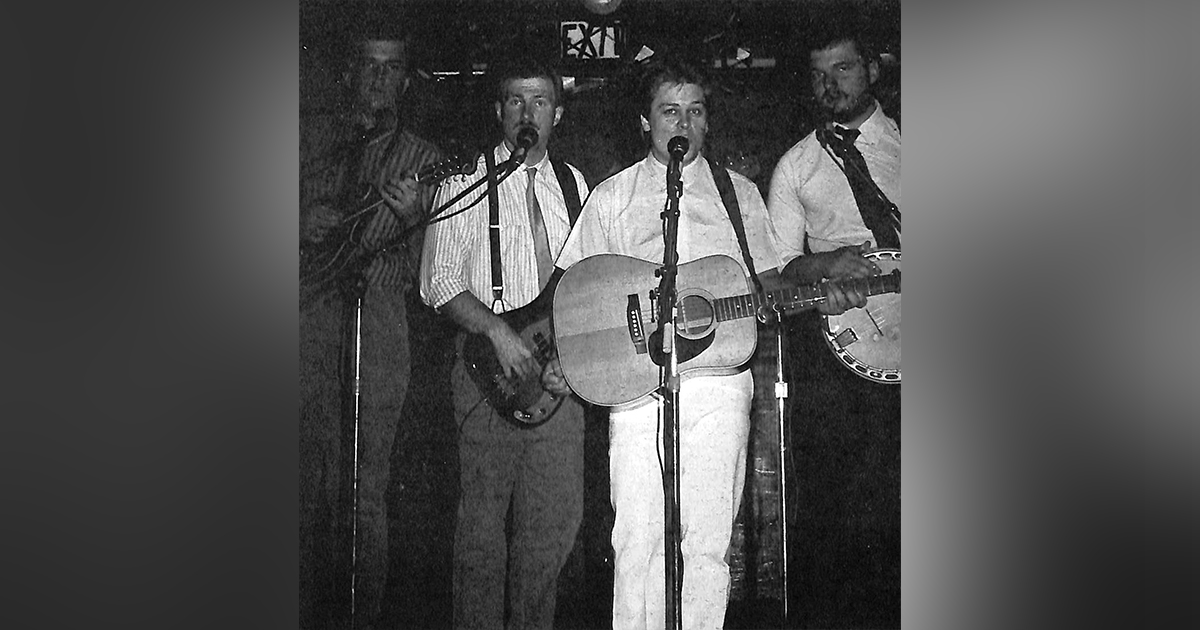
The Lonesome River Band—The Water Rolls High
Reprinted from Bluegrass Unlimited Magazine
January 1988, Volume 22, Number 7
The parking lot of a shopping center in Carney, Maryland, is neither the choice site to spend a damp Saturday afternoon nor the best place to interview an emerging force in bluegrass music. It doesn’t appear to be a great venue for the sparsely attended antique car show going on in front of the Lonesome River Band’s van either. The lonesome foursome from southwestern Virginia hadn’t included the Carney mall in their travel plans, but motels do have check-out times, and it’ll be another three hours before they can return for a second night at Baltimore, Maryland’s Cub Hill Inn — you have to be somewhere.
The Lonesome River Band had been stars the night before at the Cub Hill as the friendly audience grew larger and more enthusiastic song by song. The crowd’s pleasure fed back to the band. By the second set they were at their peak, driving home their mixture of old and new songs with a perfectly blended contemporary vocal trio, which rested when their instruments filled the available space with square dancers.
Two months later Monaco’s Prince Ranier put down his “American fried chicken” to join his royal family in applauding LRB as they headlined the Loew’s Grand Hotel and Casino on the Riviera. Literally, the hotel extends out over the Mediterranean Sea. The Prince had chosen the bluegrass band for his dining accompaniment over two other acts.
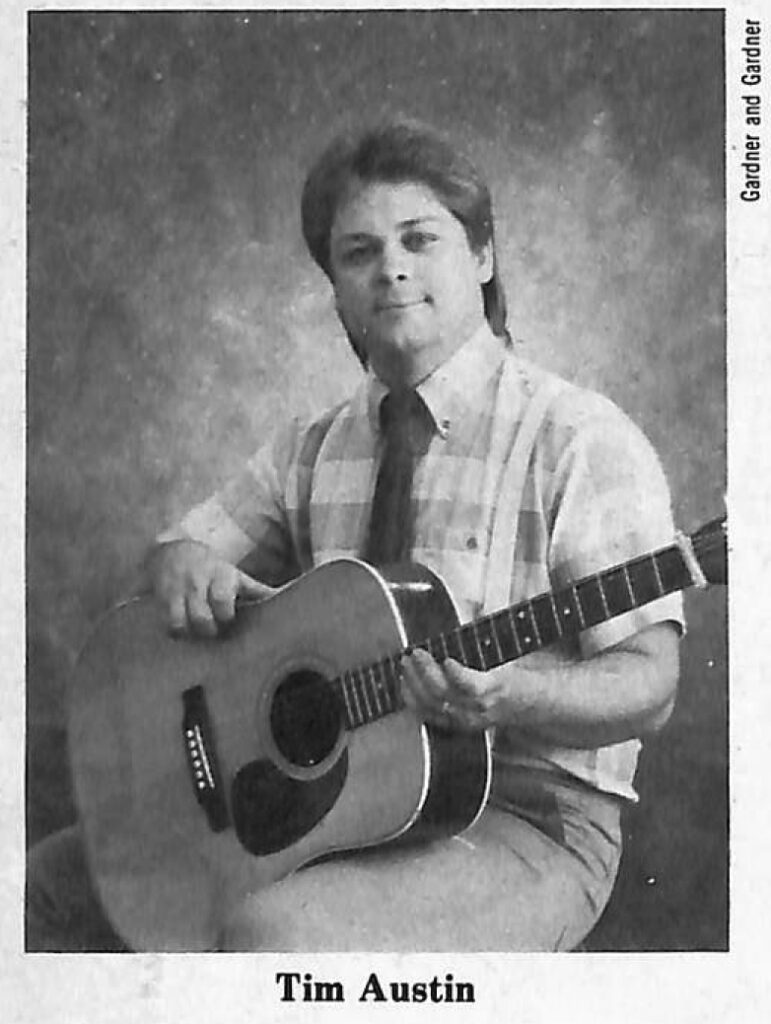
“A thousand people followed him in,” said guitarist Tim Austin, a Ruffin, North Carolina, native currently residing in Ferrum, Virginia, near the homes of Don and David Parmley, Allen Mills, Gene Parker, and Dempsey Young. “It was worse than Washington, D.C.”
“They had it roped off outside the ballroom. There were people waiting with cameras and all this stuff out there. It was a huge deal,” Jeff Midkiff, LRB mandolinist and fiddler until June, 1987, reported. “When the Prince was in there,” we played the entire time. It was about an hour and a half.”
“It was the hotel’s tenth anniversary,” explained bassman Jerry McMillan, like Midkiff from Salem, Virginia. They were putting on all this stuff for a big celebration of Loew’s Hotel and Casino’s ten years.”
“There were three bands from the United States,” Midkiff resumed. “It was a showcase of American music, and bluegrass; that’s definitely American.” “There were a lot of people that worked there, and they were dressed up as cowboys,” Austin said. “They had on jeans, bandanas, and tanned vests, even the women. That was the funniest sight, a French cowboy.”
“We walked in with our sports coats and ties on, and they had on their little cowboy suits,” McMillan recalled. “There were French people there who had never heard bluegrass before, but they had that foot patting; lot of them were,” Austin observed. “I thought, ‘That’s what it’s all about.’ They didn’t know why, but they were ‘patting’ it.”
The “why” was a Lonesome River Band sound that while unquestionably contemporary is clearly bluegrass. Unlike some modern groups that play rock or jazz on acoustic instruments or use bluegrass as a method for exploring many styles, LRB is aiming for an up to date bluegrass sound. All the members cut their teeth on traditional bluegrass, but rather than copy the masters to preserve the form of bluegrass, they want to apply what they’ve learned to keep the spirit of the music alive.
Austin caught the bluegrass bug as a teenager when Linton Moore, who was picking with Pat and Terry Smith, moved across the street around 1975. “I started traveling with them some… that got me interested in it, and I took up playing the banjo.”
In 1980 Austin joined Silver Train, a Danville, Virginia-based band formed by Roy Norton, currently of Brice Creek. Austin played banjo and sang the baritone parts on Silver Train’s only album, “Up Around The Bend” (Outlet STLP 1030). It contains two original tunes by Austin. Leaving them in 1981, he soon resurfaced with Lower 40 Grass, which specialized in picking at Air Force Officer’s and NCO clubs from one end of North America to the other.
“And, boy, we did some traveling. That was the first band I had played with professionally. They hired me at the beginning of the week. I left on a Thursday, and we were gone 28 days. That was the first time I had ever been away from home over two weeks.”
Quiting Lower 40 Grass along with two other members, Austin got married, settled near Ferrum, and obtained part-time disk jockey jobs with the help of Bill Vernon at both WYTI and WNLB in Rocky Mount, Virginia. He resigned, however, to spend the summer of 1983 running the Bluegrass Cardinals’ concessions.
Meanwhile, he was working on the transition from baritone singing banjo picker to lead singer and rhythm guitarist. “I just got so tired of playing the banjo… I didn’t want to learn anything new. I looked around and could see that you could count good rhythm guitar players on one hand. Pickers who really do have strong rhythm and use their rhythm foremost in the band … I feel rhythm is the major part in the make up of one’s total sound.
“I’m thinking more in terms of getting good dynamics on stage like Lester Flatt’s guitar playing. A lot of people really underrated him but his dynamics were just impeccable. He knew when to play hard and when to play soft. You can listen to the Carnegie Hall album [“Lester Flatt & Earl Scruggs At Carnegie Hall” (Columbia CS 8845)] and if you don’t know what dynamics are, you can hear them right there.
“Then, finally, the Lonesome River Band came to be,” Austin said. “The original band was myself on guitar, Steve Thomas, now with the Whites, playing mandolin and fiddle, Rick Williams on banjo, and Jerry McMillan on bass. Probably the middle of ‘83 was when we started working on it… we tried to work up enough material just to get through a doggone show.
“After we got our stuff together, what we had, we worked a lot of club dates around the Roanoke area, and we traveled down to North Carolina and West Virginia, playing places just around our immediate area.”
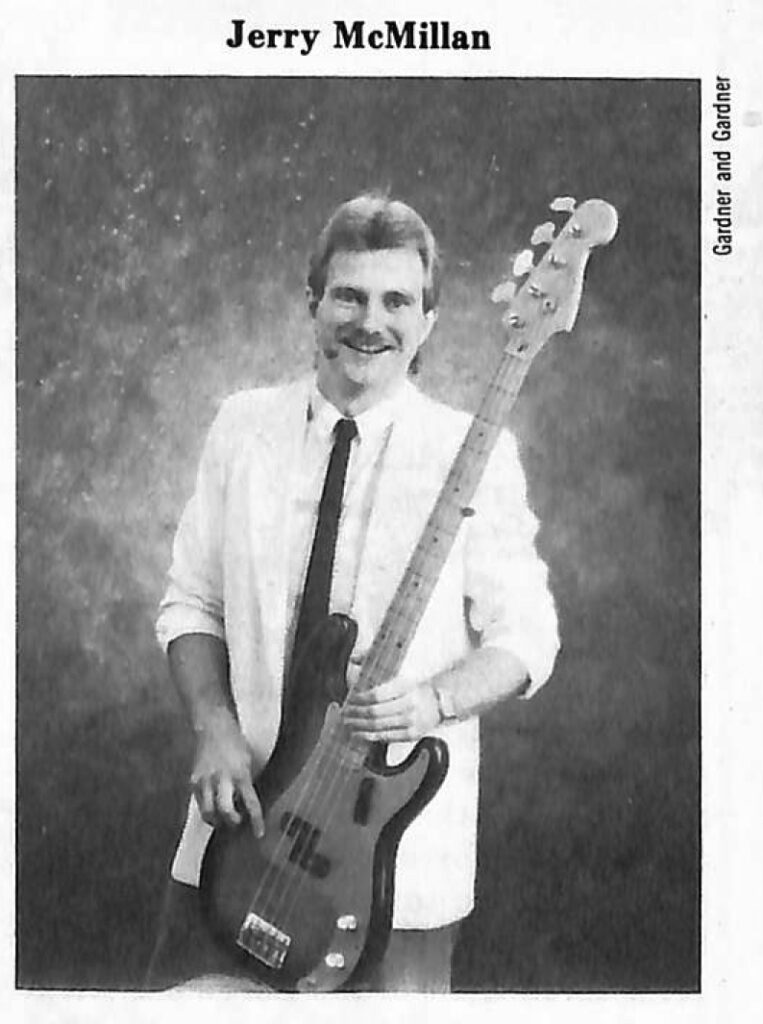
Jerry McMillan learned bluegrass the old fashioned way, playing with his family. “I have a brother who is about fifteen years older than I am, and he was already playing music with my dad. From when I was a little kid I just plunked around with different things. I finally took up the bass and stuck with it. From when I was eight [1971] up to my high school years me, my dad, and my brother played together… We were called the McMillans. We played quite a bit around the area, mostly just fiddlers’ conventions.”
Picking up fiddle, guitar, and mandolin, McMillan played in several juvenile bands with schoolmates Thomas and Midkiff, but LRB became his first serious commitment.
The early LRB managed to get a few festival dates in Virginia and North Carolina with Thomas and Williams playing when not on the road with Del McCoury [Williams’ primary employer at the time]. “Then Steve went with Jim & Jesse,” McMillan explained, “and he moved to Nashville. Rick just pretty much lost interest in it. Tim and I kept trying to keep the band going because we had already established our name around the Roanoke area … So about that time Jeff came along.”
“At the very start we worried what we were going to do about singing,” Midkiff, late of the “Mackin’ Tracks” era McPeak Brothers, said. “Until that point I had only sung baritone. I had only been singing that less than a year. I could sing the part, but the quality of my voice was really awful. After a while it almost got tolerable … so I started getting serious about my baritone singing.
“Another thing I liked was the idea of playing with a bunch of guys where everybody’s equal. If you make it, which we’re starting to get, you know everybody in the band has an equal amount of making it… I don’t want to be a sideman.
“Another thing I like about the band is just the music we play. It’s a happy medium for me … In this band I can do about anything because we play a whole bunch of traditional stuff, where I can play more traditional breaks and worry about the timing and drive, but we also play more contemporary stuff where I can use the scales and patterns that fit in just right with the more contemporary picking,” Midkiff concluded.
The drawback for the Lonesome River Band has been finding a steady banjo picker, one committed to the group for the long run and able to play both driving Scruggs and modern styles. Mike Jones replaced Williams. Then came Allen Watkins, formerly with Front Porch String Band and currently of Whetstone Run, for most of 1984. Billy Wheeler, the northern Virginia banjoman best known for his work with the Country Store, Charlie Moore, and Cliff Waldron, subsequently joined, staying with the band until the winter of 1985/86. With Wheeler, the band gave a strong performance on the Nashville Network’s Fire On The Mountain and made their whirlwind junket to the Riviera.
Through all the changes, the commitment of Austin and McMillan to the Lonesome River Band kept the group going. “I know Tim is the most determined musician I’ve ever been associated with,” McMillan stated. “Most of the musicians I had played with before could take it or leave it. From day one Tim impressed me as really wanting to make a go of it and wanting to succeed with his music and do it well. I’ve wanted to play music all my life. All of us have a real determination to succeed.
Wheeler’s Shar-Lyn records released LRB’s very well received 1985 debut platter, “I Guess Heartaches Are In Style This Year” (Shar-Lyn SL33-48507). Unlike many small label releases, the LRB album featured clear engineering by Billy & Joe Wheeler, Page Duppstadt, and the Cardinals’ David Parmley and sharp cover art. LRB exercised equal care in song selection, using originals by Austin, McMillan, and Wheeler, a couple of Larry McPeak compositions, and material drawn from Thomas, Gordon Lightfoot, the Louvin Brothers, and Flatt & Scruggs.
Following Wheeler’s departure just as LRB was ready to record a second album, the band first approached Summer Wages’ mandolinist, Rick Allred. After a few weeks, however, Allred decided he could not give his wholehearted commitment as a banjoman.
By this time LRB was facing the rapidly approaching 1986 festival season and had received an offer to record for Rebel Records, which at that point was considering spinning off a contemporary bluegrass subsidiary. The instability was even more frustrating; the solid vocal trio had developed that special blend that characterizes the best vocal groups.
“I feel that we sing together,” Austin explained. “We think the same when we sing. It’s like we were a family.”
“Tim and I have done the lead and the tenor for just about everything we’ve done so far,” added McMillan. “I’ve noticed that now we can start to try to work up a song, and we even think along the same lines. It’s a lot easier now that everything just seems to kind of flow together.”
“A lot of times we won’t sing a song with your standard lead, baritone, and tenor,” Austin said. “We do a high lead, high baritone type of thing along the lines of what the Osborne Brothers did. Some songs work better that way for us. Then again, a lot of the tunes we do are with your basic lead, baritone, and tenor.”
Instrumentally, LRB had grown tight, also. “The arrangements also are like a conglomeration of ideas,” according to McMillan. “We’ll sit down with a tune, and we’ll play it out and think about it for a little while, and come back and just put all of our ideas together.
“In a lot of the arrangements, we’ll bring the music up to a certain point, drop it down, and do different techniques, accents and various things like that to make the music peak at certain points, then drop off, to give it a little excitement instead of being a dry, straightforward song.”
Finally the search for a banjoman with 1940s drive and 1980s sensibilities located Randy Driskill, who had his first semi-professional job with Harvest, the James Bailey, Norman Wright, and Eddie King group. In 1979 he backed fiddling Senator Robert Byrd when he played for President Carter. Driskill had spent the 1985 season with the Spirits of Bluegrass, the well-thought-of Pennsylvania outfit.
Joining LRB at the end of March 1986, Driskill’s skill became rapidly apparent when he mastered their material in just a few weeks before the band entered Bias Studios to record their eponymous debut album for Rebel Records (Rebel REB 1645), which appeared in the fall of 1986. “Before the first cut was halfway through, I knew I was going to enjoy this album,” wrote reviewer Glenn Christensen in Bluegrass By the Bay. “These guys are hot stuff! … All the instrumentals, whether in breaks or in back-up, are as good as any I’ve heard, all the way up to Monroe and Scruggs themselves.”
“The Lonesome River Band” demonstrates the maturation of the band’s vocal power and their continuing search for songs that fit their treatment. Songs by Flatt & Scruggs, Ruby Moody, Bill Monroe, and Randall Hylton combine seamlessly with an Austin original, pop tunes from Jonathan Edwards and Carole King, a Jack Clement piece, and songs the band found from lesser-known composers. Bill McElroy’s engineering, guest work from the Seldom Scene’s Mike Auldridge, and the band’s intense preparation resulted in a sparkling and cost-effective recording.
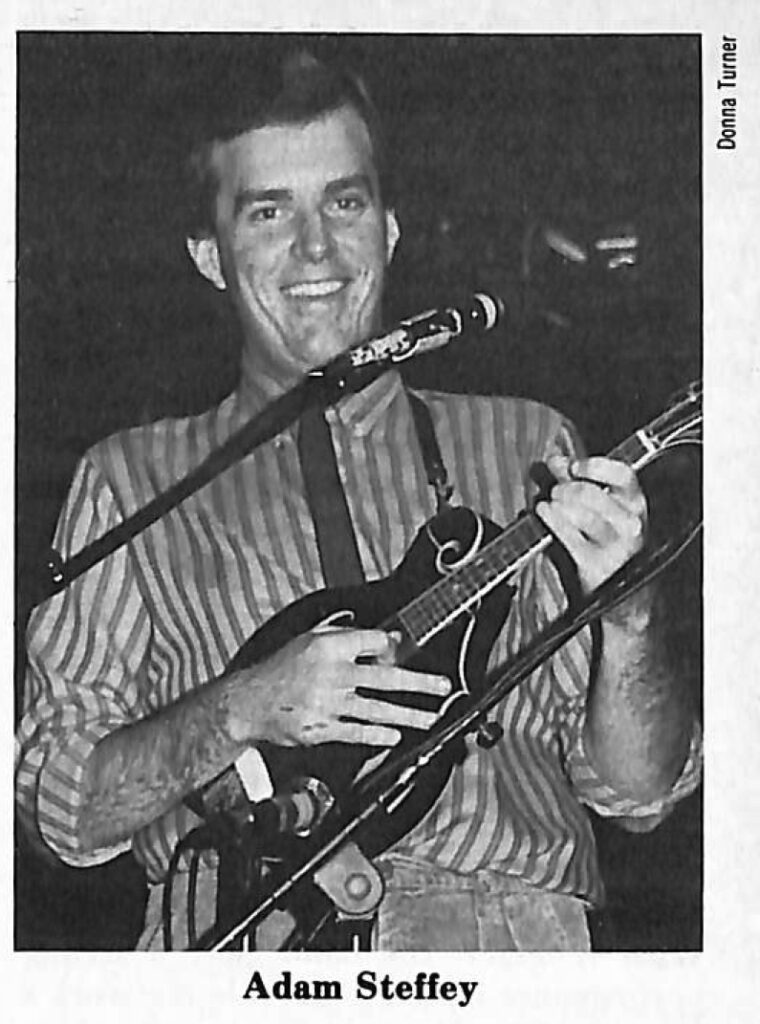
The summer of 1987, however, turned into a season of change. LRB purchased a RV, which replaced their trusty Econoline van. Midkiff left the band, replaced first by Canadian superpicker Ray Legere. LRB acquired the Bluegrass Cardinals’ bus when their neighbors moved up to a larger bus. Legere departed, and Adam Steffey took his seat.
Steffey, a 22-year-old Norfolk, Virginia, native, had been living in Kingsport, Tennessee, and playing with the revitalized Boys In The Band. BU reviewer Les McIntyre, in a glowing report in the Boys’ 1987 cassette, said, “The instrumental standout is Adam Steffey, whose blues-influenced mandolin is especially contagious on the instrumental ‘T.E.RT.’ ”
“We met him Missouri when he was playing with the Boys In The Band,” said Austin. “The reasons we chose him would be first, his musicianship and his singing. He is an excellent baritone, and you’ll really be surprised when you hear his bass singing. Second, he’s real witty— a good emcee and very intelligent.”
Steffey, who cites Sam Bush, Buck White, David Grisman, and Mike Marshall as his primary influences, was impressed by LRB at the same time. “I want to help create and maintain the driving rhythm that the band has, as well as growing as a mandolin instrumentalist.”
Steffey had barely settled in when Driskill decided reluctantly to leave the band due to personal concerns. The Lonesome River Band’s showcase at the IBMA World Of Bluegrass at the end of September 1987 brought an end to the Driskill period.
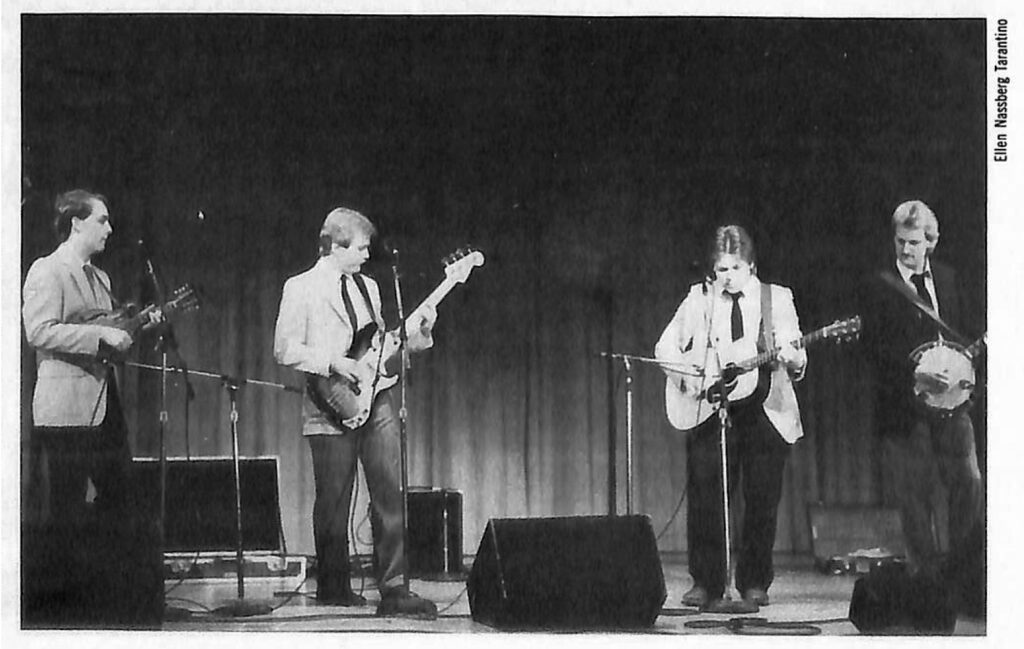
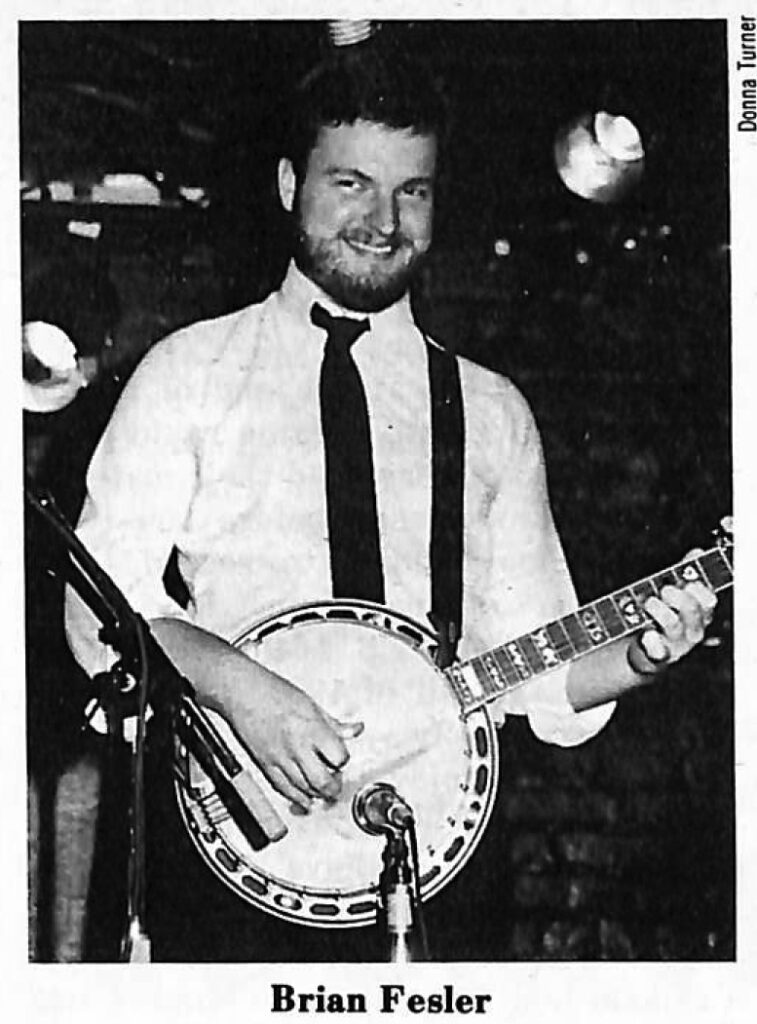
Brian Fesler received the invitation to fill Driskill’s shoes just prior to his 21st birthday on 12 November 1987. He had been working in Nashville for the Gibson Corporation and appeared at several major festivals in 1986 as the banjoist of the Gibson All-Stars. “I moved to Nashville in order to play bluegrass professionally,” Fesler explained, “but nothing much was going on for me. A band like LRB is what I’ve been looking for all along. Tim has the same attitude—really going all out to make it work—that I do.”
Fesler went to work immediately with the rest of LRB in order to be ready for the winter recording sessions for the band’s first all-gospel release (Rebel 1660).
A network television appearance, an overseas junket, recording for one of the premier bluegrass labels, a pair of hot new pickers and singers, and bookings that have doubled for four consecutive years, the Lonesome River Band stands on the verge of becoming a major force in bluegrass music for years to come. Their desire to work and succeed, however, still burns with an intensity that would make Bill Monroe proud.
“We’re trying to incorporate a lot of different musics to create something that would appeal to a wider range from your hardcore bluegrass fans on to the younger generation who like something a little more contemporary sounding,” said McMillan.
“Why do material of the Flatt & Scruggs era over and over and over when nobody can do it better than the original cut,” Austin said. “You never get anywhere copying anybody.
“I want the band to get a lot of original material, and I want the band to be associated with those songs. We do a lot of standard stuff on stage, but we also do a lot of different, versatile material. The songs can change if they’re done tastefully. Think about what you’re saying in the song, tell a good story, and make it meaningful to the people. We’ve gotten really good response from the radio stations on our first album about our original material.
“We’re trying to capture the young audience because that’s going to be the backbone in future days. We need to get back into the college market like they did in the folk music era, because it reaches a lot of people that way. That’s what we’re trying to do.”
With that modern world view and up-to-date sensibilities, genuine Appalachian roots, and a name drawn from Carter Stanley, the Lonesome River Band is ready for the third-generation bluegrass tide to rise.