
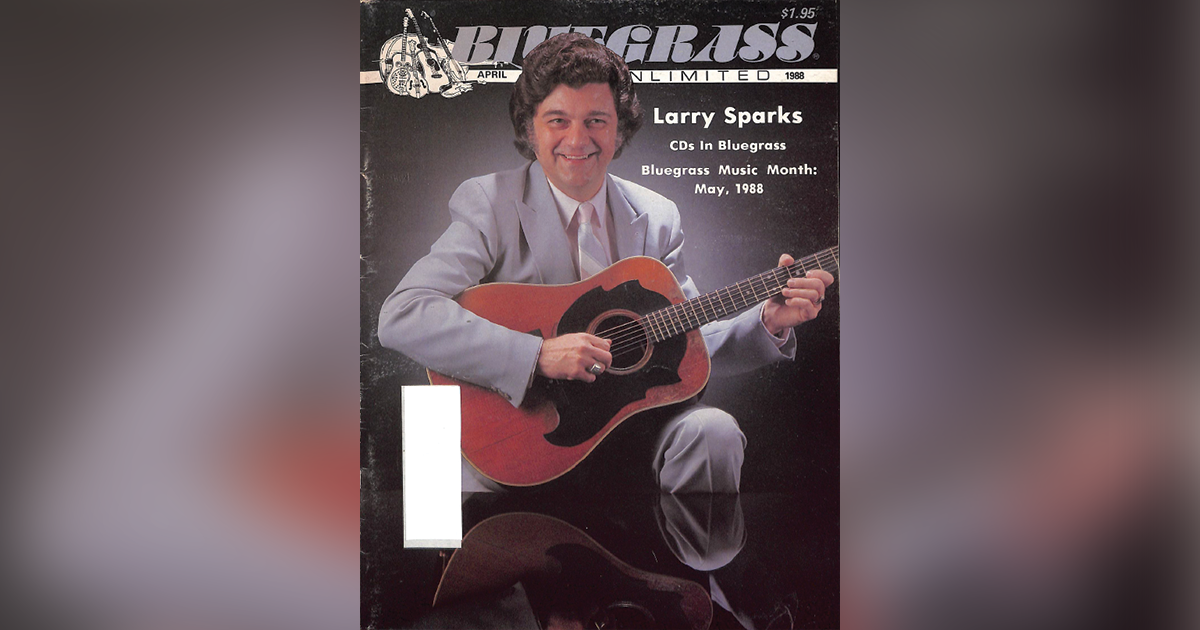
25 Years with Larry Sparks
Reprinted from Bluegrass Unlimited Magazine
April, 1988, Volume 22, Number 10
1988 marks an important milestone in the career of Larry Sparks. This year, Larry celebrates his 25th anniversary as a professional musician. For someone who is barely 40 years old (he just turned so on September 25), this seems to be an impressive accomplishment. But in looking back over Larry’s lengthy career, this is but one more entry in a passage dotted with numerous successes.
Although Larry is celebrating his 25 years in bluegrass, his involvement with and exposure to the music goes back much farther, to his early childhood days in southern Ohio. He was raised in a musical environment, in a family which definitely appreciated rural country music. “Everybody in my family knows how to play a few chords on the guitar and they can carry a tune pretty good. I think all my family has got music in ’em somewhere.” His mother and father were originally from Kentucky but moved to Ohio years ago for work. Of the 9 children in the Sparks household, 7 of them, like Larry, were born in Ohio.
Larry first began to develop his musical ability at the age of 5 when his older sister Bernice began to show him a few things on the guitar. Throughout the 1950s, he continued to improve his playing, partly by listening to the guitar in the early bluegrass bands. “In the mid ’50s when I was learning to play, the guitar players were Earl Scruggs, Don Reno, and Bill Napier, when he was with the Stanleys. Those 3 were really about the only 3 that I had heard in bluegrass, they standout to me as being players that I really noticed.” As far as groups were concerned, the bluegrass bands that he listened to were the Stanley Brothers, Flatt & Scruggs, Don Reno & Red Smiley, and Bill Monroe. Larry never did own records or a record player so the only way he heard their music was by radio. It was also by radio that he was influenced by other musical styles. “I don’t recall who they were but I remember listening to a lot of flattop guitar blues playing on the radio; blues music with guitar and harmonica. A lot of my licks are what I remember hearing, some of them are original things. I think some of it goes back to what I heard on the radio; the old blues.” No matter what his influences were, it was always acoustic music which appealed most. “I’ve always liked string music. I never cared a whole lot for electric instruments. They’re good for country and I’ve got nothing against them for that. But for my listening I always preferred the string instruments; acoustic music.”
Other events from Larry’s childhood helped to shape his later musical style. He was raised up singing in church and had been to revivals and other similar events. Some of the churches would have radio broadcasts and he would sing on them when he was small. “Those things really play a big part in later years. You don’t realize it then but they do when you get on down a few years, you can look back and all that stuff has meant something. I wouldn’t want to sing gospel music if I didn’t feel it. It’s got to mean something or I couldn’t do it.”
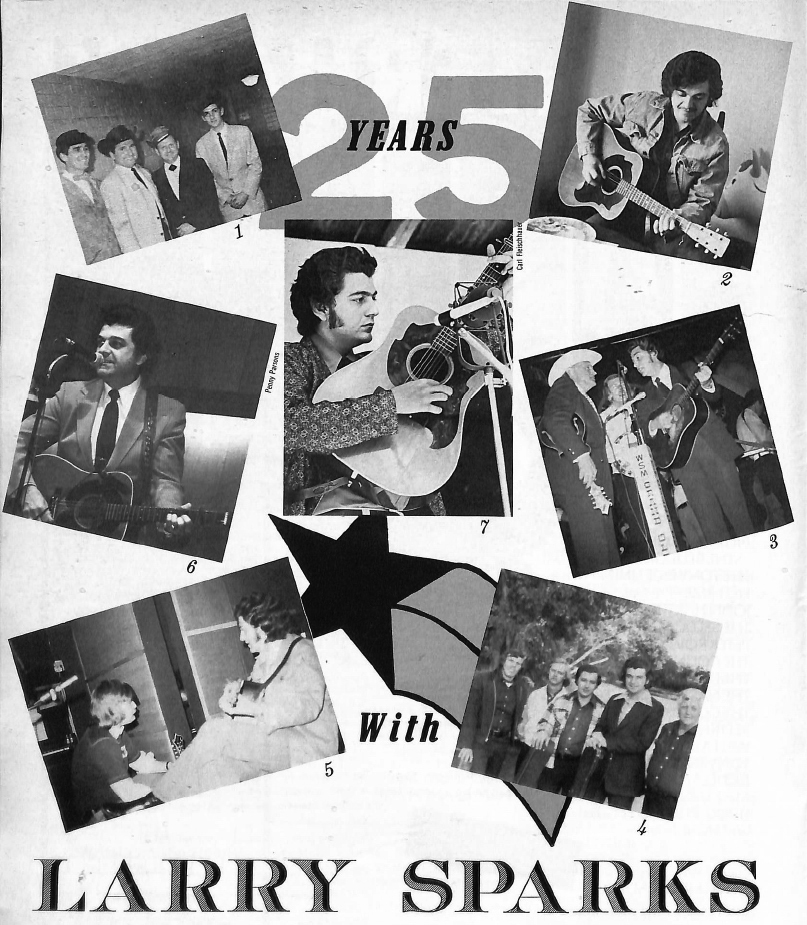
In 1960 —Larry was 13 —he began playing guitar in several local bands and he also started booking shows in his area. By his own admission, he started “learning the ropes pretty young.” To some of lesser determination or with less vision, starting a career in music so young would be unthinkable. Larry seems to take it in stride. For him, like a song title from his latest album, it was the “natural thing to do. In certain situations I really think it’s meant for you to do a certain trade, a certain job. I sort of feel it was just natural for me and meant for me to do what I’m doing. Everything has come natural to me, my playing and singing. I’m not saying it can’t be improved on but that it just comes natural. I’ve never had to take a lot of time practicing, I just took it and went with it. I feel it’s a God-given talent.” With a belief in such backing and support, Larry’s decision to start on his own so early in life does, in retrospect, seem only natural.
Sparks’ determination and hard work paid off for him handsomely in the fall/winter of 1964. It was at this time that he joined the Stanley Brothers’ show, taking the place of legendary guitarist George Shuffler. He worked with the show off and on for the next 2 years, playing lead guitar and singing an occasional baritone part in some of the trios. Following the death of Carter Stanley in December of 1966, Larry assumed the role of lead singer and guitarist in the Clinch Mountain Boys. He stayed with Ralph through 1969, helping him to record his first 5 solo albums (3 for King and 2 for Jalyn Records). Of the time spent with Ralph, Larry notes that Ralph never “did try to get me to play like anyone who’s ever been with him. What I did with him, it worked and people liked it. It was pretty much his style; the guitar players that had been with him before. The same with the singing, he never really told me to sing like Carter, he just let me go ahead with it. It was Carter’s style of singing and it matched Ralph. It was just a natural way of singing and it still is today to sing the same songs I did with him. It’s natural for me to sing that way and it’s natural to sing my own style.”
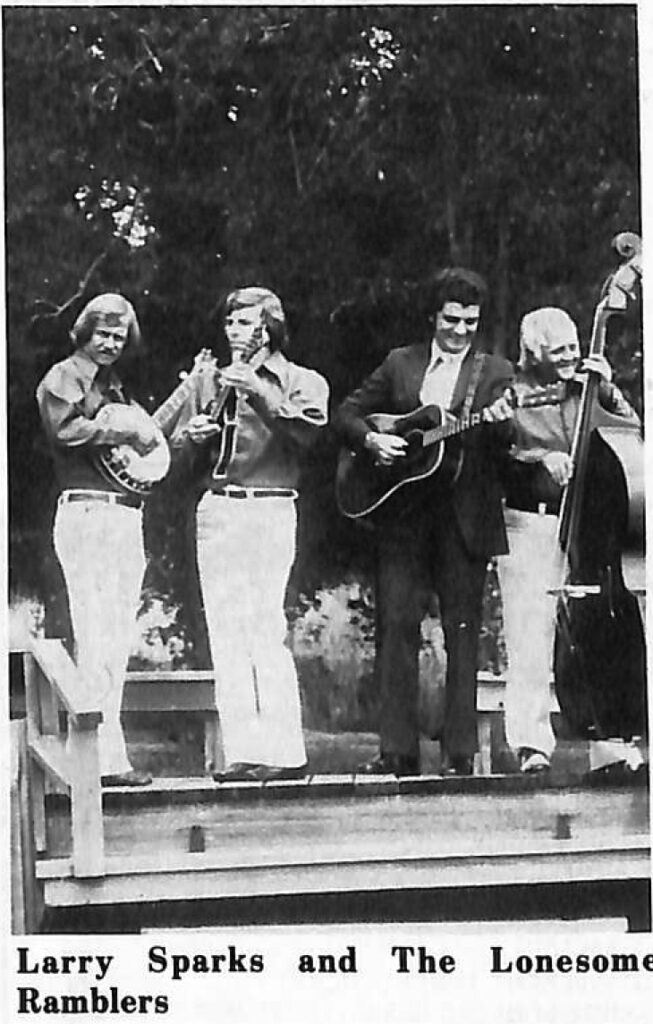
In the fall of 1969, Larry felt that he was ready to lead his own group. Thus began the Lonesome Ramblers. “I felt I had a style that if I worked with it would be accepted. I had to come up with a sound that was different and when you heard it on the radio, you knew who it was. And that’s not easy! It was not easy then and it’s harder now. My guitar playing was already different at that time. I needed to go more in my direction than the Stanley sound. I knew I had to have new and good material. My sister, Bernice, wrote a lot of good songs and we wrote some together. Songs we started out with 15 or 16 years ago are ‘young’ standards today. Songs like “Goodbye Little Darling,” “Lonesome Old Feeling,” “A Face In The Crowd,” “These Old Blues,” and tunes like that.
The early years of Larry’s solo career were rather hard, as they are for most musicians trying to establish themselves. It took up until the late ’70s before everything really started smoothing out for Sparks. After he left Ralph Stanley, it was 7 or 8 tough, hard years. “I love the music, you’d have to stay in it.” Through all of these struggling years, Larry was developing his own sound and style. His early efforts were, naturally, steeped in the Stanley tradition, an obvious fact given that he had just spent 5 years in their/his employ. However, by the middle 1970s, a recognizable Larry Sparks sound had emerged. The accent was on his soulful lead singing and bluesy guitar work—an infectious combination which quickly caught on with bluegrass fans. In addition, a band sound was developing. Mike Lilly’s banjo playing did a lot to set the banjo style in his music. “He played a big part in my sound back then. We did a lot of trio singing, too, Mike, Wendy Miller, and myself. I started using a fiddle quite a lot in the early ’70s. Joe Meadows was probably one of the first. I wanted a fuller sound.” Clearly Larry was achieving his goal of developing his own style within the framework of traditional bluegrass.
As he grew more comfortable with his role as a bluegrass bandleader, Larry began to experiment somewhat. The hard, traditional sound was softened slightly when Tom Boyd was added to the band in the middle 1970s. Tom was a talented multi-instrumentalist who was featured on banjo and Dobro; the latter a new instrument for the Lonesome Ramblers. He was also an excellent harmony singer with a somewhat softer edge than many of his predecessors had. Thus, the band had attained a somewhat smoother sound.
The smoother sound of the Lonesome Ramblers was successfully captured on record when Larry recorded his “You Could Have Called” album for King Bluegrass. “I had good material on that album. There was Mike Lilly, myself, Ricky Skaggs, and Tom Boyd on that. We pretty much did the album ourselves. I had ideas for the “You Could Have Called” album; the way the songs are laid out is the way that I wanted them. Ricky Skaggs overdubbed the fiddle and mandolin and sang with me on it. I don’t think I could have had any better mandolin playing or fiddle playing or tenor singing on those particular songs, cause it suited him. Everything matched, everything fit. It was more polished. I guess that some of the earlier ones before were more hard-core.”
In a very real sense, the “You Could Have Called” album set a standard for excellence which continues to this day. The albums which have followed remain consistently high in terms of recorded quality, material, and musicianship. The next album to be recorded was “John Deere Tractor,” his first for Rebel. “It’s really been a solid album. It’s still as popular now as it was the first year or two after I recorded it. It still sells.” This was indeed another album which showcased the fine musicianship of the Lonesome Ramblers (especially noteworthy is the fine fiddle work of Kirk Brandenberger) as well as Larry’s skill at selecting material. About half of the tunes from this album have become standards with Larry. They include the title cut, “John Deere Tractor” (which later became an early hit for the popular country music duo, The Judds), “Girl At The Crossroads Bar,” “Great High Mountain”, (a haunting gospel selection which was written by Keith Whitley), “Love Of The Mountains” (an excellent tune by Allen Mills which in a short time has become a bluegrass classic), “When I Lay My Burdens Down,” and “Carter’s Blues.”
Larry’s first concept album came in the late 1970s with his tribute to country music legend Hank Williams. For the album, Larry chose a lot of the songs by Hank which originally featured him and his guitar, many of which were issued as Luke The Drifter. Larry cites Hank as one of his early musical idols, along with Monroe, the Stanleys, and Flatt & Scruggs. Comparisons have been made between Larry’s versions and the original Williams’ recordings and although the comparisons have been favorable, Larry is quick to point out that he did not set out to copy Hank’s sound and style. “I didn’t try to sound like Hank Williams. It just came out the way it came out, and that’s just natural.” Much of the success of the album lies in Larry’s soulful interpretation of Hank’s material. The emotional intensity which was so vital in Hank’s original recordings found new life once again in Larry’s new versions.
Throughout the rest of the 1970s and early 1980s, Larry recorded 3 or 4 solid albums for about as many labels: “It’s Never Too Late” (June Appal) “Kinda Lonesome” (Lesco), “Ramblin’ Letters” (Acoustic Revival), etc. In 1980, after the Rebel label was purchased by Dave Freeman, a rather intensive program was begun to repackage and distribute Larry’s fine King Bluegrass material of the middle 1970s. (The King Bluegrass label was purchased by Rebel in the late 1970s.) Featured are many of the best cuts from his numerous King Bluegrass albums. The first package to appear was “Dark Hollow” (Reb-1597) which features “Six More Miles,” “Cannonball Blues,” “If That’s The Way You Feel,” and “Too Late To Walk The Floor.” Next to appear was Reb-1609, “The Best of Larry Sparks,” a super set which features many of Larry’s best and most popular recordings including “Smokey (sic) Mountain Memories,” “Kentucky Chimes,” “Just Loving You,” “A Face In The Crowd,” “Goodbye Little Darling,” and “You Could Have Called.” The final volume to complete this repackaging is Reb-1611, a gospel album called “The Testing Times.” This set uses 6 songs from the King Bluegrass catalog and also presents 6 newly recorded songs which were cut to complete the album. Featured are 2 haunting numbers, the title cut “The Testing Times” and “Great High Mountain.”
Following this energetic reissue program, Larry began recording new material for Rebel, starting with his highly acclaimed “Blue Sparks” album (Reb-1618). Larry ranks this, along with “You Could Have Called” and “John Deere Tractor,” as one of his favorite recorded efforts. Following this came “Lonesome Guitar” (Reb-1633), an instrumental collection which spotlights Larry’s bluesy lead guitar work. Lending excellent support on the album are Josh Graves and Stuart Duncan. This was Josh’s first occasion to record with Larry. Larry’s most recent gospel album is “Gonna Be Movin’ ” (Reb-1644), a solid set which presents, with 1 or 2 exceptions, all new material. Especially noteworthy are 3 fine tunes co-written by bluegrass balladeer Jim Eanes: “Let Him Lead You,” “Call Out To Jesus,” and “Ole Satan.” Larry’s latest album, a collection of straight bluegrass, is due for release as this article goes to press. Included is another batch of fine songs done in Larry’s own distinctive style. As with most of his albums, several of these will certainly become classics.
Larry is most pleased with his association with Rebel. “The quality that Rebel puts into the covers, it means a lot. I think it helps the album. It’s helped me a lot. People like to see a good quality cover now on an album and Rebel’s given me that.” Equally important is the good sound which Larry has achieved on his more recent releases. He gives much of the credit for this to Denny Chandler of Chandler Audio, the studio in Ashland, Kentucky, where most of Larry’s Rebel LPs have been recorded. Denny has a keen ear for acoustic music, especially bluegrass, and he knows how the end product is supposed to sound.
In recent years, the music of the Lonesome Ramblers has a more relaxed feel. “I do feel a lot more comfortable with everything at this time. It takes years before you can feel comfortable with your shows. Looking back, I think you can try too hard to do a good job. I think if an entertainer’s got the talent and you just let the singing and playing flow, it’ll work out. But then again, it takes experience to feel that. I don’t think you can put on your best shows until you have that feeling with the audience. You need to make them feel comfortable with you and then you get that communication between you and the audience.”
With 25 years in the business, Larry still feels his popularity, and that of bluegrass music as well, growing. “I think it’s more popular. It’s definitely grown in popularity from 10 years ago, even in the last 5 years you can tell a difference. You just watch the things around you, the crowd and the business end of it. It’s hard to say 10 years from now but let’s hope that it will be even more popular than it is now. If we just keep our fingers crossed on both hands that we can get more time on national television, that’s gonna help the music. If we can just get that in the next 10 years and really promote it right, I think bluegrass could really be big. That’s what I’d like to see. There’s a lot of good musicians that need to be in the business and they need to be out there making a living at it. I’d like to see the music just keep growing and getting bigger so they can do that.”
Larry also thinks a further boost for the music would be more quality air time on the radio. While the music is probably now achieving the most exposure it’s ever had, there’s still some room for improvement. As in other music, a more unified approach, or standardization, would help to strengthen the music as a whole. This would benefit all areas of the industry, including the artists, record companies, and radio stations. It would also give maximum exposure to the groups who need it most, namely the professional touring bands. Finally, it would ensure that the best music which bluegrass has to offer receives the exposure, thus helping to give bluegrass the good name that it deserves.
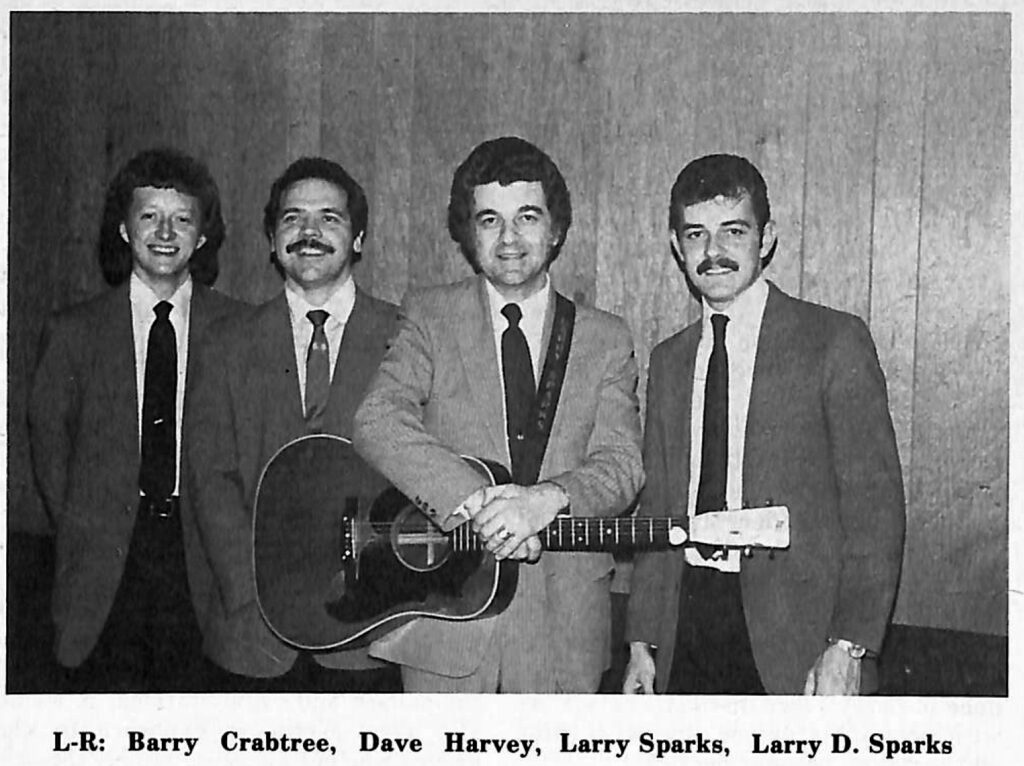
Even with the music at its peak of popularity, “It’s a tough road! It’s tougher now than ever and it’s gonna get tougher. We have more good musicians right now than we’ve ever had. It’s hard for a group to come up with a sound now adays. There’s so many into it now, it’s just hard to come up with a recognizable sound. And material is not there like it used to be 30 or 40 years ago. You’ve got to come up with good songs nowadays; you’re either gonna have to write it or find good songwriters to do it for you. There’s a couple who’ve been writing some for me. Randall Hylton is a very good songwriter, he’s got some good material. And Pete Goble and Leroy Drumm, they’re great songwriters. I’ve been recording some of their stuff and hope to be recording some more of it. We need good writers like these fellows because without them we’re just not going to be able to put out good material.” Over the years, Larry has had many top musicians in the Lonesome Ramblers and there have been groupings which have resulted in classic editions of the band. To his credit, through all of these changes, Sparks has been able to maintain his distinctive sound and style. His dedication to his sound is such that other musicians coming into the band conform to fit his style, thus keeping the sound intact. Of all of the bands which he has had in the past, he feels that his current band of 1988, the same band he’s had for the last few years, is as good or better than any he’s had in the past. Holding down the acoustic bass and tenor vocals is Larry’s son Dee Sparks, now a 5 year veteran of the Lonesome Ramblers. Playing banjo, for the past 3 years, is native Kentuckian Barry Crabtree. Rounding out the group, on mandolin and fiddle, is the talented David Harvey, son of noted mandolin player Dorsey Harvey.
In the world of bluegrass, there are precious few organizations which recognize and honor the achievements and accomplishments of bluegrass entertainers. Of the few organizations and magazines which have given awards in the past, Larry has been fortunate to receive his share. Most recently, he was asked to donate items for display in the Bluegrass Hall Of Fame in Nashville and also to the prestigious Country Music Hall of Fame. And too, his latest gospel album, “Gonna Be Movin’,” received an honorable mention at the latest National Association of Independent Record Distributors (NAIRD) awards show. An impressive accomplishment for a bluegrass entertainer.
In looking back on his past 25 years in the entertainment field, Larry feels a certain sense of accomplishment for his achievements. For now, it would be “nice to have people know what I’ve tried to do for the music. I feel I’ve brought a sound into bluegrass that people like, and so far they’ve accepted it. The 25 years is not all for me… I haven’t stayed in the business 25 years for myself. The people accepted me years ago and they’ve kept right on accepting me over the years.” His fans obviously mean a great deal to Sparks. He feels that it is a two-way street with them. He has given them lots of enjoyment and good music over the years and they in return have given him encouragement and support to continue. “I feel I’ve helped a lot of people with my songs, especially the gospel songs. I get letters in the mail and people tell me how they enjoy this certain song and the gospel music, how much it means to them. That means a lot to me. I guess that’s what keeps you going. You get that energy from the people and you keep going. I guess through all of it, I wanted to make some kind of a mark in bluegrass, bring something in it that people can remember. I think I’ve done that even if I never make another 25.
