
Bluegrass Music
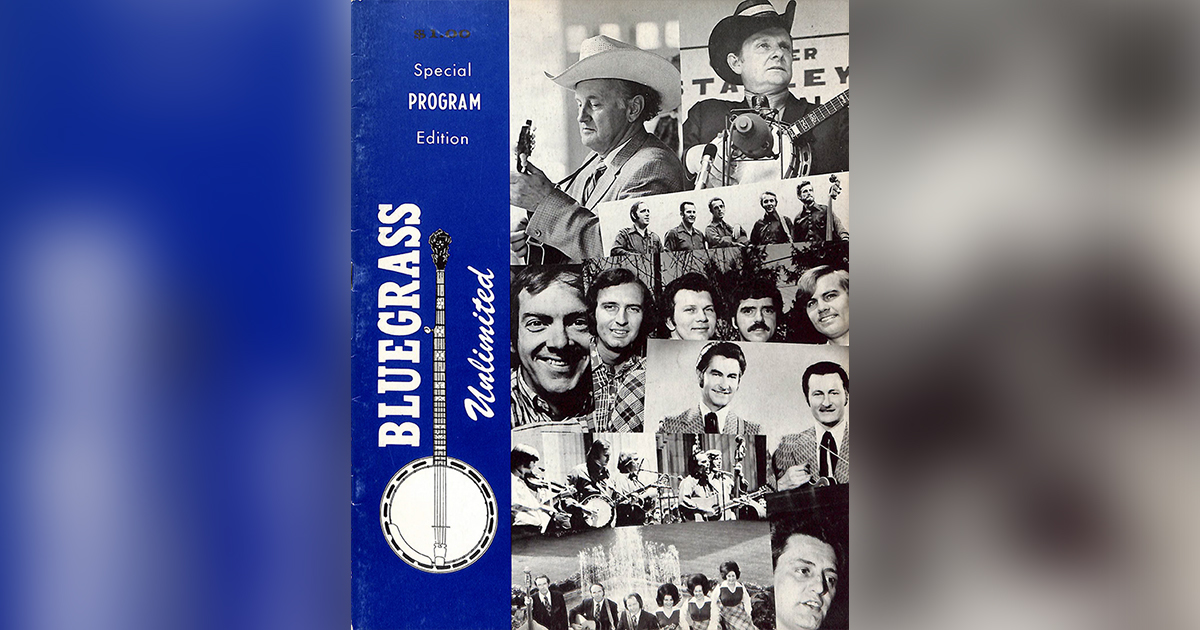
Reprinted from the Special Program Festival Schedule Edition, 1975 of Bluegrass Unlimited Magazine
Which was reprinted from Western Pennsylvania Bluegrass Committee Newsletters. Used by permission
Part I — Roots.
Bluegrass and modern country-western music are different styles of music with the same basic roots: the traditional music of the Southern Mountains. This music came originally from the British Isles with the first white settlers and included hymns, ballads and dance music, the latter often in the form of fiddle music.
The fiddle and its related bow instruments are found in all parts of the world and probably the most commonly known folk instruments in Europe, which abounds with national and regional styles – from the Balkans to Britain, Ireland, and Italy, where the instrument was perfected. The English and Scots-Irish brought their fiddle styles to North America in the seventeenth and eighteenth centuries, along with their ballads, jigs, and reels; and the fiddle was the principle instrument of the remote mountains for nearly two centuries, until the introduction of the 5-string banjo in the mid 1800’s.
Variants of the banjo are known to have existed in parts of Africa and Asia thousands of years ago, and it was the popular instrument of the black slaves in this country in its “homemade” form. A white minstrel musician from Virginia, named Sweeney, takes credit for inventing a standard, manufacturable banjo around 1840; and he presumably added the short fifth string which runs only halfway up the neck and acts as a drone. We would like to point out the fact that, contrary to what many seem to think, the banjo is not the “native instrument of America.” It was being played thousands of years before America was known to exist.
The 5-string banjo was a very popular instrument in this country from the Civil War until after the turn of the century, due probably to the popularity of the traveling minstrel show, etc. This popularity spread to the remote highlands of the South where it became accepted as the perfect twangy, ringing compliment to the droning, lonesome fiddle. The 5-string was still popular after 1900, due in no small part to the playing of Fred Van Eps and his school of classical 5-string banjoists – a three-finger style, with no picks, played on gut strings – a “legitimate” (as opposed to “folk”) music style. With the coming of the jazz age, the light tinkle of the 5-string began to lose out to the louder, more aggressive sounds of the four-string plectrum and tenor banjos. The old “five” was still heard in the hills after the straight music world had all but forgotten it, but by 1940 it had just about died entirely.
The guitar, mandolin and autoharp were all popular “parlor” instruments around 1900; and after about 1910, mountaineers began to discover that the bass notes and chords of the guitar added just the right rhythm and depth to the banjo and fiddle sound, and the classic mountain string band was complete. With a few variations, it was these two-and-three-piece string bands playing old-time mountain music, recorded commercially for local distribution in the South, that laid the stylistic groundwork for today’s bluegrass and gave birth to the modern country music industry.
Part II—Commercial growth of hillbilly records and the “birth” of bluegrass.
Commercial recording companies began to take mountain music seriously as early as the early twenties. By the middle and late twenties, the more popular old-time string bands (Gid Tanner from GA., Charlie Poole from NC., etc.) were selling hundreds of thousands of copies of their new-archaic sounding releases. These bands usually consisted of fiddle(s) and/or harmonica playing lead, accompanied by flat-top guitar and 5-string banjo played with thumb and finger, thumb and two fingers (primitive, non-bluegrass) or frailing (a down strum similar to, but usually less slam-bang than the style used today by Grandpa Jones).
1927 saw the first recordings by the original Carter Family and the legendary Jimmy Rodgers, a turning point in the industry. The Carters, from Virginia, smoothed out a lot of the old mountain music with good harmony singing and used mostly lead guitar and autoharp. Rodgers sang as a soloist and included a lot of the black sounds of his native Deep-South and was even backed up occasionally by a jazz band. He was the first ‘singing star’ of the music and was instrumental in shifting interest away from the string bands and adding ‘alien’ elements to the pure sounds.
The depression made and destroyed a lot of careers. Record companies folded, but radio seemed to survive and even thrive. Country music was broadcast nationally over such stations as WSM, Nashville, with its famed Grand Ole Opry, and the National Barn Dance, WLS, Chicago; and not only were city people hearing country music, but country people were hearing other types of music, which began to change their tastes in music. The remaining string bands became more and more confined to the mountains of East Tennessee, Kentucky .the Carolinas, etc.
One phenomenon of the thirties was the emergence of the guitar-mandolin duet acts, usually featuring close two-part harmony singing with the mandolin playing the ‘breaks’ and the guitar providing chords. These included such radio and recording duos as the Blue Sky Boys, The Callahan Brothers, Mac and Bob, and, most important to bluegrass, the Monroe Brothers. Some individuals, like J.E. Mainer, had the foresight to add one of these duets to their existing old-time string bands (which now usually included a bass) to form the basis for modern bluegrass: old-time fiddle and banjo music combined with smooth harmony singing and mandolin playing. In 1938, the Monroe Brothers split up and mandolin- ist Bill Monroe brought his newly- formed four-piece string band, The Blue Grass Boys (after his native Kentucky) to the Grand Ole Opry in Nashville.
The complexion of country music was changing. Loud electric and electric steel guitars were fast moving in, Hollywood Cowboys were crooning their latest hits; and out in Texas and Oklahoma, Bob Wills and his big swing-band were creating a new trend with Western Swing, basically a ‘big band’ with fiddles and cowboy hats and brass sections. Small radio stations still featured the original stuff and even the ‘Opry’ kept some of it, but it was becoming the exception. But Bill Monroe decided that he was going to keep the old music alive by doing something new and exciting within its own framework. His music was different; It had drive and power, and by the mid-forties it was clear that is was a style unto itself and needed a name to distinguish it from “old-time” and modern “country”. The name was to be “bluegrass”, after his Blue Grass Boys.
Part III—Bill Monroe, the “Father” of Bluegrass.
Bill and Charlie Monroe were born and raised near Rosine, Ohio County, Kentucky. Typically, they moved to the Industrial North in early manhood to make a living, but were soon playing music full-time. They played many radio stations throughout the Midwest and South, and their records on Victors’ Bluebird sub-label in the mid-thirties made them one of the most popular acts in country music. Hot-headed and independent, they split up in 1938 with Charlie forging a successful career as a soloist and Bill forming his famous Blue Grass Boys and taking them to the Grand Ole Opry in 1939. When Bill reached the Opry, his music wasn’t all that different from other popular acts like Roy Acuff, etc.; but by the time the Blue Grass Boys released their first Bluebird singles in the early forties, it was clear that Monroe was up to something. He used fiddle, mandolin, guitar and bass; but he added one elemental ingredient: drive. Or call it power, or excitement. His fast instrumentals were played with unbelievable speed and skill; he added heavy blues elements, and his singing was sky-high and crystal-clear.
Monroe had added a banjo player (Stringbean) in 1942, but it wasn’t until 1945 that bluegrass was officially born. The 5-string was seldom heard anymore in country music-it was almost a dead instrument-when Earl Scruggs joined Monroe at the Opry. Bill had already hired guitarist/singer, Lester Flatt, (who had previously played mandolin with Charlie Monroe) and a super-smooth fiddler named Chubby Wise, with a fine musician and singer named Cedric Rainwater on bass. The group was good before with a string of hits like “Kentucky Waltz” and “Footprints in the Snow”, but Scruggs’ dazzling three-finger banjo style, based on the older styles, really took the roof off the Grand Ole Opry. Old tapes made of their appearances back in ’45-48 show that this group had the house in near hysterics every time they opened up on a tune. It was all there, “hatched full grown”; virtuoso mandolin, banjo and fiddle, smooth solos, duets and trios with hair-raising gospel quartets.
This group recorded and released its first classic sides for Columbia in 1946-47, but their radio broadcasts and highly-profitable tent show caused a number of imitators. Some were quite good and themselves recorded for major labels. The earliest and best known of these were the Stanley Brothers, Carter and Ralph, followed by Flatt & Scruggs (who left Monroe in 1948), Reno and Smiley, Mac Wiseman, Lonesome Pine Fiddlers, etc. It was clear that Monroe had forged a concisely different style that, in an era when country music was going more electric, eclectic, and up-town, was satisfying the public need for a sound commercially dynamic and yet traditional. It was not “country”, a la Kitty Wells, or Western like Bob Wills. It needed a name, and in the early fifties the name became bluegrass.
Most of the early stars of the new idiom had served a period of apprenticeship with Monroe, enhancing his “father” role: Flatt and Scruggs, Don Reno, Mac Wiseman, Jimmy Martin, Carter Stanley (and brother Ralph), Sonny Osborne, and many others.
Part IV—Bluegrass today: 25 lean, hungry years later
Since Bill Monroe made the first big hit with bluegrass in 1945, it had had many, many artistic and commercial ups and downs. But let’s make one thing clear—bluegrass has never been as popular as it is today. It is not enjoying a comeback or revival because it was never really big to begin with. It has been way underground for many years.
In the early years, through the early mid-fifties, bluegrass did moderately well because it wasn’t really too different from ‘Hillbilly’ Music like that played by Hank Williams, Johnny & Jack, Carl Smith, etc. These country acts usually used acoustic bass, guitar and fiddle, usually adding only one electric instrument-non-pedal steel or guitar. Many, like Don Gibson, Hank Williams, and Carl Butler even played and recorded with mandolin and/or banjo. Some of the Louvin Brothers’ early records are fairly indistinguishable from bluegrass records of the same era.
The big crisis in country music came in 1956, with the advent of Elvis Presley and the new ‘Rock-a-Billy’. It took the country immediately and really hurt the more authentic acts & bluegrass alike. The industry was shaken and very few survived without heavy compromise. No one suffered more than bluegrass. It was ‘Change drastically or find something else.’
Probably the first major group to modernize was the Osborne Brothers, who in 1956-57, along with their guitarist, Red Allen, hit upon a new modern trio sound. They recorded ‘Once More’ for MGM in 1957, and it was a hit. Since then, Bob and Sonny have been the leaders in what might be termed the “up-town country” approach to bluegrass. In recent years, they have hit it big with a string of solid hits: “Rocky Top”, “Georgia Piney Woods”, “Listening to the Rain”, and “My Old Kentucky Home”, all done with banjo and mandolin as well as piano, pedal steel, etc. They were the first to use drums and electric instruments in what might questionably be called “bluegrass.”
The mid-fifties brought Rock & Roll, but the late fifties brought another phenomenon – the folk music boom, followed closely by the Hootenanny Craze. And floundering bluegrass latched onto it like a magnet to iron. It was generally accepted by the folk music intelligentsia as “authentic”, because much of the repertoire was from folk sources, and the sound was acoustic and non-commercial. Monroe, Flatt & Scruggs, and the Stanley’s began looking into the Folk Festival Circuit. Some of the northern collegiates were embarrassed by the pure corn of the music, but most were in total awe of the brilliant instrumental work and others even found themselves being moved by the disarming sincerity of the sentimental “heart” numbers and the total candidness of the entire idiom. The result was a tremendous boost for bluegrass. Even crafty Mac Wiseman, who had gone electric in 1959, began recording bluegrass again. Never one to miss an opportunity, Mac jumped on the bandwagon as “Master Folk Singer-Mac Wiseman”!
The exposure to northern-urban college audiences brought about a rash of city bluegrass bands. Flatt & Scruggs, Earl Taylor, The Country Gentlemen, and the Lilly Brothers all appeared at Carnegie Hall and most groups were recording LP’s directed at the folk music crowd. The whole thing seemed to culminate in 1963 with the ‘Hootenanny’ TV Show and the ‘Beverly Hillbillies’ TV Show. Flatt & Scruggs’ recording of the theme song was a huge hit, and then things dropped off. The folk music craze was replaced by the Byrds and folk-rock, and bluegrass was again stranded.
The Dillards and the Greenbriar Boys had a large impact on the urban audience, but one group geared its music and total approach at the new “City Billy-Folknik”. That group was the Country Gentlemen, founded in 1957.
They have been trend setters all along, starting the progressive, folk-oriented trend in bluegrass. Their influence on the music has been profound.
When the folk music craze folded, it left the bluegrass world with no other camp to invade. It must be realized here that, unlike ‘old-time’ musicians, most bluegrass musicians from the south are today under 50; and those in it full time are professional, working musicians. That these great men of bluegrass had had to live hand-to-mouth for so many years is a great tragedy-driving many of them to alcohol, religious fanaticism, or abandoning music totally. Tired of the meager living it provided, many banded together to push the music as a thing unto itself, independent of the whims and trends of popular music. The breakthrough came in 1965 with the first bluegrass festival at Fincastle, Virginia, sponsored by Carlton Haney and featuring most big-names in bluegrass.
The festivals opened the floodgate. Nashville sound pop-country radio stations who had scoffed at bluegrass as ‘unpopular’ took a second look as tens upon tens of thousands flocked to the scores of bluegrass festivals that began springing up.
In 1967, the original 1949 Flatt & Scruggs recording of “Foggy Mountain Breakdown” was reissued for the film ‘Bonnie & Clyde’ and won Grammy Awards. In 1971, Bill Monroe, long-neglected by Nashville, was elected to its Hall of Fame. In 1973, the tune ‘Duelin’ Banjos’, originally released in 1954 by Don Reno and Arthur Smith, became a national hit as recorded by Eric Weissberg for the movie, “Deliverance”. The LP, recorded by Weissberg in 1963, became the #1 LP in the country.
Not commercial? In the past five years, we’ve heard bluegrass on TV selling millions of dollars worth of everything from Corn Flakes to soda pop to airplane tickets. We would call that commercial.
Bluegrass has never been more popular than today. Due to the festivals, artists can take steady bookings all summer and get some long-awaited recognition. Some acts, like Jim & Jesse and Mac Wiseman, have found that they can now play the music they love; where once they were forced to play electric C & W. But it is still underground. The vast majority of the ‘Country’ Stations still refuse to play it, and only about 2 1/2 out of ten even recognize the name “bluegrass” as having anything to do with music. Hopefully, the dedicated listeners, musicians, promoters, and regional “committees” can put bluegrass where it belongs-at the top.

Very good ,thanks