

Becky Buller Releases Songs That Sing Me
Songs That Sing Me, Becky Buller’s first covers album, puts a spin on the concept. Rather than simply her take on familiar favorites audiences already know by heart, she has compiled a collection of songs that have meant the most to her, songs that she says “sing me into being.” Some, in fact, have been with her for a lifetime. Her parents tell her she was exposed to “The Camel Train” while still in utero. She says they have been singing that song since the early seventies. “I always loved it because it had my name in it—Rebecca.”
The album bears a strong imprint of the influence of growing up playing in what she calls a “quasi-family band,” Prairie Grass, composed of her parents and Gordy and Roxy Schultz, until Becky joined on fiddle when she was eleven or twelve. One of the band’s highest profile gigs, she says, was opening for the Dry Branch Fire Squad, from whom they learned one of her favorites, “Auction at the Home Place,” which appears on the album.
When researching the credits for the songs she chose for the record, Buller found the album with “Auction at the Home Place” and realized that Prairie Grass had played every one of the tracks. “Prairie Grass was pretty much a Dry Branch Fire Squad cover band,” she jokes.

“I’ve always loved that song. Every time I hear it, I want to cry,” says Buller. “Even when I’m singing it, I want to cry—especially when the church ladies lead in verse three. That’s so lonesome to me.” She added too that [Michael Henderson’s] writing is incredible. When she called Ron Thomason about getting in touch with the songwriter, he brought Buller and her band to the High Mountain Hay Fever Festival in Westcliffe, Colorado, where she got to play the song for him.
With this album project in mind, Buller started with a big batch of songs she loved. Her producer, Stephen “Mojo” Mougin, helped her winnow them down to eleven. She admits she has enough songs for another covers album. She had included individual covers on previous albums, but she says she and Mougin agree that if they decide to record a cover tune, they have to have a good reason to do it and, she added, “we need to do it in a way that’s not been done before.”
“Millworker,” one of two James Taylor songs on the album, was the first released from the project, with harmony vocals by Andrea Zonn, who has sung backup with Taylor for over twenty years, and Dan Tyminski. Buller had worked with Zonn on her Little Bird album, released in 2003, and Tyminski sang and played on her 2022 Christmas album The Perfect Gift.
For the second James Taylor song on the album “Jellyman Kelly,” a playful tune listeners may recognize from Taylor’s appearance on Sesame Street, she is joined by Bela Fleck, Abigail Washburn, and their two sons Juno and Theo, as well as Buller’s daughter Romy Haley, on vocals and flute—“her first flute gig,” says Buller.
Buller took time away from this project when FreshGrass commissioned her to compose a song cycle for their festival, which became her Jubilee album, released in 2024. In advance of Songs That Sing Me, she also released “Reach,” on which she was joined by her fellow members of the First Ladies of Bluegrass—Alison Brown, Sierra Hull, Missy Raines, and Molly Tuttle. “It’s similar to the way New Grass Revival did it, and their version is similar to the way Orleans originally recorded it, but we had never heard it done by an all-girl band before,” said Buller, “and it was fun getting to work with the First Ladies in the studio.”

Working on “Reach,” Buller admitted that she wanted to sing it like John Cowan did on NGR’s version. “I got in the studio and tried to do that, which is ridiculous because, first off, there’s only one John Cowan, and I needed to sing like me. She ended up getting vocal lessons from her cousin Samantha, an opera singer who teaches in Macon, Georgia, who helped her discover her own voice on the song. They worked together on other songs, which Buller says allowed her to try some new vocal approaches.
Buller added, “You never stop learning; I’m a big fan of continuing education.” She also credits Aynsley Porchak, Jason Carter, and Michael Cleveland for fiddle coaching as she worked on this new record. “I tried things on the fiddle that I’ve never attempted in the studio before, and I’m really proud of the work on these tracks. I can hear how I’ve grown on this album, and I hope other people can too.”
When Buller performs the songs from the new album live, she shares the story of her own discoveries of the music. She first heard “Wall Around Your Heart” from Tony Rice and J.D. Crowe as the Bluegrass Album Band, then found the original version by Don Reno and Red Smiley. “I love Reno and Smiley’s songwriting,” said Buller. “I’m surprised they weren’t bigger names in country songwriting during their time; they wrote some incredible songs.”
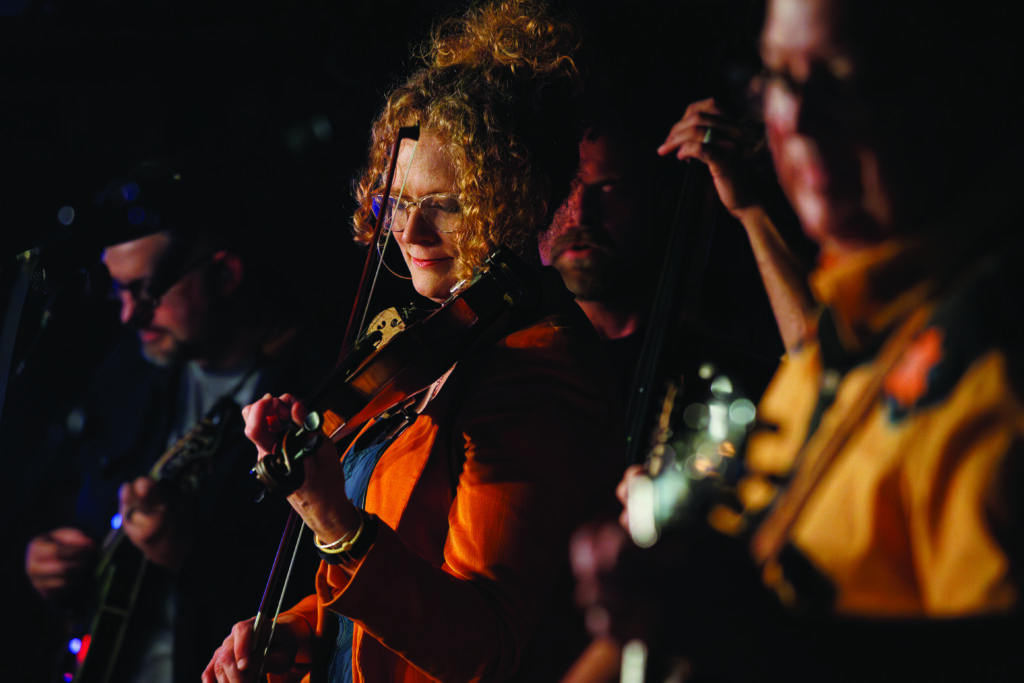
While Buller’s regular band—Ned Luberecki, Daniel Hardin, Wes Lee, and Jacob Groopman—played on four of the tracks, she brought in other special guests to play on certain songs. She invited Jim Lauderdale, who had recorded the song in 1979 with the late Roland White, to sing on “Wall around Your Heart.”
Buller added, “We had to get Jeremy Stephens on there because he is the best Reno-style banjo player that I know, and then Lauren Price Napier on that classic Monroe-style mandolin she does so well. I had Missy Raines again on bass. Mojo was playing guitar on that with us, and Jim was singing his little old heart out.”
For “Muddy Waters,” released by Seldom Scene in 1975, she says, “ We wanted to pull in some ‘Sons of the Seldom Scene,’ so we got Critter Eldridge on guitar, who quoted his dad’s iconic banjo break, and Jay Starling on the Dobro and the vocals, singing the main part of the duet with me.” Stephen and Jana Mougin added some color harmonies on the last chorus.
Buller said the song, written by Phil Rosenthal after Hurricane Agnes, was her most recent acquaintance on the album. “I had narrowed it down to a couple songs that I wanted to present in that sort of swampy, bluesy feel,” Buller said. “Then when Helene hit, I knew we needed to do this one.”
“A Hazy Shade of Winter” was one of the last tracks recorded for the project. While it had also been a hit for the Bangles, Buller learned it from the source, Simon and Garfunkel, having fallen in love with their music—the writing and the harmonies—in high school. She also noted, “There’s precedent for their songs being covered in bluegrass music, with The Country Gentlemen’s version of ‘Leaves Turn to Brown,’ so I feel like I’m just continuing it along. Bill Monroe himself was covering Hank Williams back in the day, pop stuff from his time. Jim and Jesse recorded ‘Johnny B. Goode.’ I love that a good song is a good song, no matter how it’s presented and no matter through what genre.”
The members of Becky Buller Band played on “A Hazy Shade of Winter,” with Alan Bartram of the Del McCoury Band and the Traveling McCourys on harmony vocals and Mougin singing on the bridge. Buller noted that the three of them had sung together twenty years ago on “Topaz Moon,” a song on her Little Bird album. “I love that we’re still making music together 20 years later,” Buller said.
All the songs on this album, says Buller, taught her a great deal about music. When performing, she gives credit to the songwriters, as well as the performers who first introduced her to the recordings. “These are people that taught me how to write,” she said, “And I am so grateful to them. That young songwriter that’s still inside me thinks, ‘Wow, I’m getting to take a turn singing these beautiful songs and sharing them with my voice and through the lens of my experience.’ I wouldn’t be the writer that I am without these songs.”

Buller says the title of the record Songs That Sing Me actually comes from C.S. Lewis’s Chronicles of Narnia series. “There’s a scene in The Magician’s Nephew where Aslan is creating Narnia. As he’s singing into the darkness, the light comes on, and everything comes into being. The Judeo-Christian creation story in Genesis talks about God speaking. He said, ‘Let there be light,’ and apparently, according to some scholars, that can be interpreted as He is speaking. It’s an ongoing thing, a continuing thing. The connection here to the record is that these are songs that sing me. They are still singing me, they are still informing my creativity, they’re still walking with me and inspiring me in my writing.”
As she shares these songs, from their variety of sources, they continue to resonate, this time with new listeners as well.
