
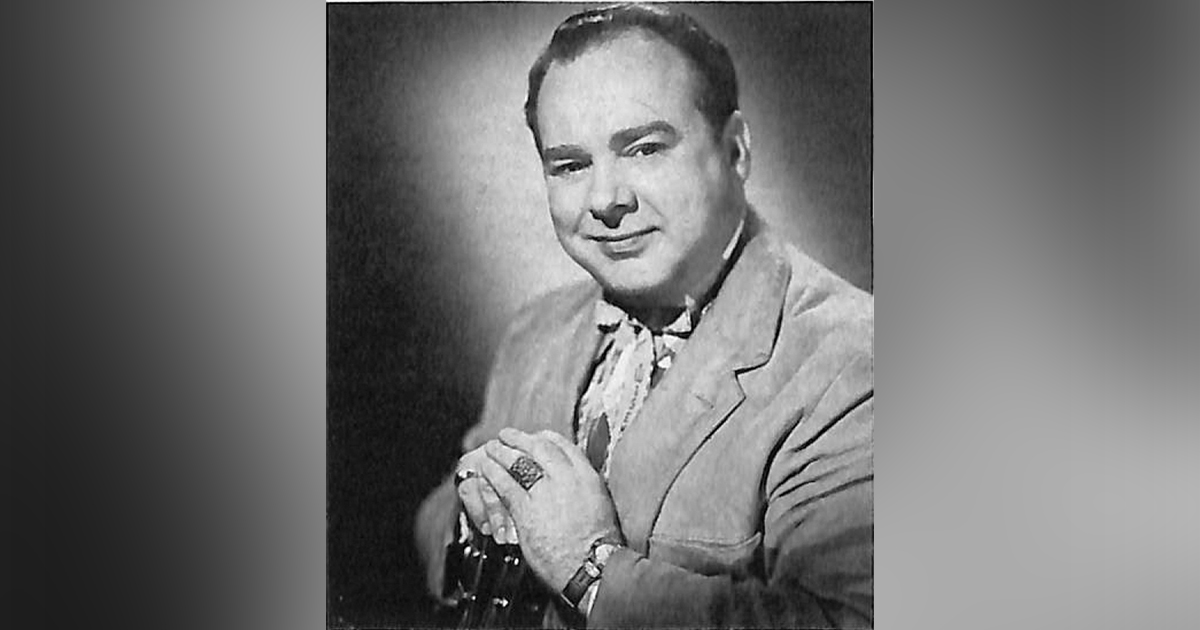
Mac Wiseman — The Bristol Years
Reprinted from Bluegrass Unlimited Magazine
October 1987, Volume 22, Number 4
Over the years hundreds—maybe thousands—of people have told me they went to work in the fields early and then worked late, just so they could come in at noon and hear the program,” recalls Mac Wiseman. He is referring to the widespread and intense loyalty of the rural audience for WCYB Bristol’s noon hour Farm and Fun Time during the late 1940s and early ’50s.
Mac had considerable radio experience prior to his arrival in Bristol in the spring of 1947. In fact he had just come from the much larger city of Knoxville where he had been working on WNOX radio with successful country singer Molly O’Day. (Mac can be heard playing bass on Molly’s records of that period.) Nevertheless, he was unprepared for the outpouring of enthusiasm that greeted his debut over the WCYB airwaves.
Mac was actually on twice a day. He had a 6 o’clock morning show of his own, just accompanying himself on guitar. He got a percentage of whatever he could sell for the sponsors, be it strawberry plants, baby chicks, Christmas ornaments or insurance leads. Then during the midday Farm and Fun Time show Mac would do a segment with his band, the Country Boys, initially consisting of Curly Seckler (mandolin), Tex Isley (electric guitar), and Paul Prince (fiddle).
“We caught on right away,” Mac remembers, his voice still tinged with the wonder he felt some forty years ago. “It was an unbelievable response.”
Soon Mac was busier than he could have imagined, playing schoolhouse shows nearly every evening, and sometimes afternoons as well. His music was part what now would be called bluegrass repertoire, part songs of the day —like Bob Wills or Wesley Tuttle tunes—a few old ballads and some gospel. “Our success was based solely on the radio shows,” he marvels. “I didn’t even have any records out.”
In the fall of 1947 Mac heard from Earl Scruggs who was still playing on the Grand Ole Opry with Bill Monroe and the Blue Grass Boys. Earl wanted to investigate the possibility of forming a band including Mac and fiddler Chubby Wise. (As far as Mac knew at the time, Lester Flatt had not indicated he might also leave Monroe.) Earl also mentioned that Bill Monroe was a fan of Mac’s and asked to be wakened in time to hear the early morning Mac Wiseman broadcast on WCYB when the Blue Grass Boys were travelling in the area.
Nothing concrete was worked out, however, for the time being. With the onset of winter, Mac found he was not fond of navigating unpaved mountain roads choked with ice, snow and/or mud in order to play remote mining camps. Accordingly, he travelled north up into Virginia, and the group disbanded.
A few months later, Mac was approached by both Lester Flatt and Earl Scruggs, who had left Bill Monroe and now had their own band, the Foggy Mountain Boys. Jim Eanes had signed on with them briefly, then left to work for their former employer on the Grand Ole Opry.
After a short stay in Hickory, North Carolina where fiddler Jim Shumate worked in a furniture store, the band moved to Bristol and, about April of 1948, became regulars on Farm and Fun Time. The group now consisted of Lester Flatt and Mac Wiseman, both on guitar and vocals, Earl Scruggs (banjo), Jim Shumate (fiddle), and Cedric Rainwater (bass). Flatt and Scruggs’ first four recordings were made the following fall, “My Cabin In Caroline,” “We’ll Meet Again Sweetheart,” “I’m Going To Make Heaven My Home” and “God Loves His Children,” with Mac’s voice and guitar making notable contributions.
Mac stayed with Flatt and Scruggs until Christmas of 1948. (It must have been that winter weather again!) This time he headed south to Atlanta where he performed on the WSB Barn Dance until it folded in the spring of 1949.
As it turned out, Mac’s next move was to the Grand Ole Opry where he took his turn as one of Bill Monroe’s Blue Grass Boys. (The two duets he recorded with Bill during this period, “Can’t You Hear Me Calling” and “Traveling This Lonesome Road” still rank well up among the “high lonesome” classics of bluegrass music.)
Another Christmas (1949) brought another change. Mac left the Blue Grass Boys and the Opry. By early 1950 he was back in Bristol, once again with his own band, as a regular on Farm and Fun Time. Personnel in the Country Boys varied, but by late in the year it included Ralph Mayo (fiddle), Ted Mullins (mandolin) and Mac’s first banjo player, Joe Medford. With the inclusion of banjo, Mac was able to work not just schools, but also dances where flat foot or clog dancing was popular. He would also frequently hire Don Campbell, formerly on Farm and Fun Time with Curly King’s group, to play amplified steel guitar on round dance (that is, anything not a square dance) tunes.
Early in 1951 Mac departed Bristol for the third and final time. Taking the Mayo, Mullins and Medford combination with him, he located in Shreveport, Louisiana where backed by his Farm and Fun Time band, Mac made his first recordings on the Dot label.
With the wealth of available talent on Farm and Fun Time, the ready availability of sponsors and WCYB’s large and supportive radio audience, why did Bristol not build a country/bluegrass industry of recording studios, music publishing and management along the lines that Nashville did? Mac Wiseman offers the interesting idea that it might be something as simple as the type of broadcast license involved.
WSM Nashville was permitted to transmit a powerful “clear channel” signal day and night which could be received as far away as New England. WCYB by contrast was limited under FCC regulations to daylight hours at lower power. It thus could never undertake an evening barn dance program like WSM’s Grand Ole Opry, which has served for decades as a focal point for Nashville’s preeminence in country music.
Nevertheless, Farm and Fun Time played a vital role by providing a home base for many of bluegrass music’s important figures during those crucial early years when the style was just starting to take hold. It is still remembered fondly by dozens of musicians who worked there and by the thousands who listened and enjoyed.
We never want to forget our bluegrass pioneers. Thanks for this article!!