
Home > Articles > The Artists > From ‘Wild And Crazy Guy’ to ‘Safe, Sensible And Sane’
From ‘Wild And Crazy Guy’ to ‘Safe, Sensible And Sane’
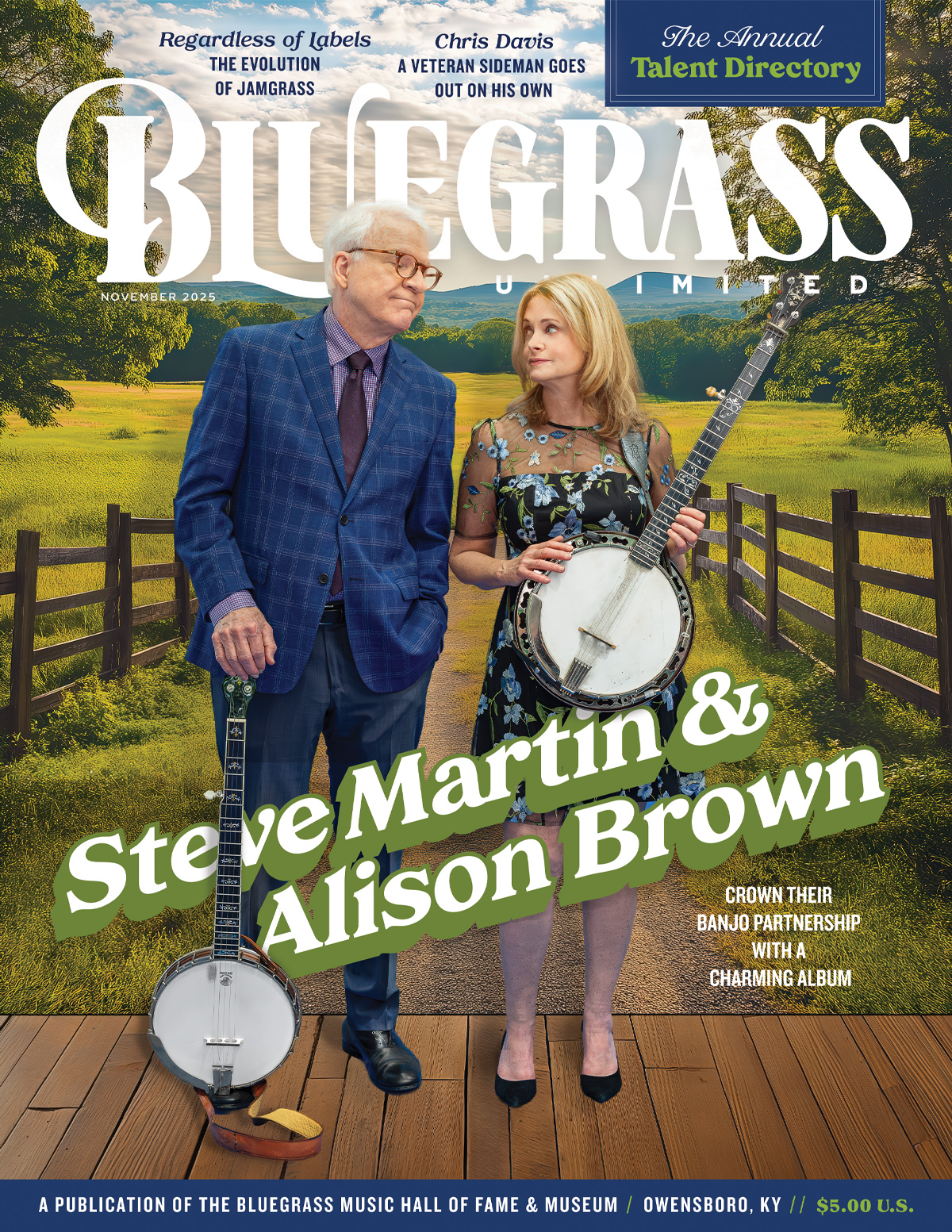
Steve Martin and Alison Brown Crown Their Banjo Partnership With A Charming Album
Steve Martin’s career transcends category and defies explanation. Over 50 years, he has: shared an Emmy Award writing for the Smothers Brothers TV show; filled arenas doing wacky, non sequitur comedy; hosted Saturday Night Live 16 times; starred in and/or written dozens of films from the surreal to the sentimental; written plays, musicals, essays and novels; and collected art with such expertise that he once sold an Edward Hopper painting for almost $27 million. Meanwhile, he’s earned top cultural accolades, including the Mark Twain Prize, the Kennedy Center Honors, and an honorary Oscar. Then, approaching his 80th birthday, Martin co-created one of the biggest hits of his life with the acclaimed cable series Only Murders In The Building.
To channel some of his old bits, he might say, with his smarmy 1970s grin, “I know what you’re thinking. You’re thinking, STEVE, with all that success, how could you POSSIBLY find time to get good on the BANJO? Weeellll, I FORGOT that being a world-class writer/actor/producer AND a Grammy-winning banjo player was IMPOSSIBLE!”
As eclectic as Martin has been in his creative life, he’s no dilettante. He pursues his passions with zeal, and the banjo has been in his life pretty steadily since the early 1960s. He’s very good, with a recognizable voice and style on the instrument, and he’s a prolific composer of tunes. It makes for a whole package that’s eccentric, funny, beautifully musical, and very American.
“I think about that a lot,” says banjo player Alison Brown, Martin’s friend and musical collaborator of the past decade-plus. “I’ve never met anybody who has such a multifaceted talent. His work ethic is incredible. Everything he does, he does to the top of his ability. He never phones anything in, and I really admire that.”
Of course, Brown is an accomplished Renaissance woman herself. The story’s well known that she is a Harvard grad with a UCLA MBA who went to work in investment banking before her bluegrass upbringing won out, and she left the finance world behind to become a working musician. She toured with an early version of Alison Krauss and Union Station and won the IBMA’s first Banjo Player of the Year Award that was ever granted to a woman. Since 1993, she’s led her own progressive string band, drawing on bluegrass, jazz, Celtic, and Latin influences. She’s taken the group to prestigious venues in the US and overseas and won a Grammy Award.

Business and banking are still in her life, in a much more creative form. In 1995, she and her husband/bassist, Garry West, opened Compass Records in Nashville. The company, based in a historic house and studio just off Music Row, has produced and released hundreds of excellent and progressive roots music records, while managing the folk, Celtic, and world music catalogs of Green Linnet and Red House Records, which they acquired over the years.
About 15 years ago, Martin invited Brown to be part of his board for the then-new Steve Martin Banjo Prize. The $50,000 annual award for innovative and important banjo players has become one of the most valuable philanthropic gestures on behalf of bluegrass and acoustic roots music in the 21st century.
During those same years, Martin got more serious than he ever had about his banjo playing, writing, and performing, joining forces with North Carolina’s Steep Canyon Rangers on record and on the road. Their first release together, 2011’s Rare Bird Alert on Rounder Records, featuring almost entirely Martin-written songs and instrumentals, was nominated in the Grammy’s Best Bluegrass Album category. They became a staple of the bluegrass and Americana festival circuit, while playing in important theaters where bluegrass is less common. Sometimes, when the Rangers couldn’t make a show date work, Martin would call on Brown and her band to join him on stage.
Their creative and collaborative relationship truly began, Martin says, when he and Brown met up on family vacations on the same (undisclosed) tropical island. Thus did two of the few people in the world who’d take banjos to the beach connect for their first one-on-one jam sessions.
“We played for an afternoon,” Martin says. “And I think I was doing more three-finger at the time, I don’t know. But I frailed a little bit. Anyway, so (later) this call came in, and (Alison) said, ‘Do you want to write a song together?’ And she sent me the first part of ‘Foggy Morning Breaking.’ Alison said, ‘Can you write a B part for this?’ And I did. And we had this little hit! And nothing is inspiring like a hit. And so I thought, well, let’s do it again.”
Deep down in their banjo chemical connection is a shared love for the Earl Scruggs and John McEuen duet take on “Soldier’s Joy” from the Will The Circle Be Unbroken album. The C tuning has an airy feel, and McEuen leans on an old-time frailing or clawhammer style, while Scruggs plays his signature three-finger roll. The blend has become something of a template for the Martin/Brown partnership.
“Alison felt that clawhammer and three-finger worked really well together,” Martin said on a three-way Zoom interview in September. “And my instinct is to go, you know, the banjo is hard to parse (for some listeners) anyway, and what if you have two? But she was right, and we managed to not intrude on each other.”
“To me, that’s the most beautiful sound,” Brown says. “So when Steve and I started playing, you know, clawhammer and three-finger, it had that sound. The two instruments blended so well together.”

As for that hit, Brown put “Foggy Morning Breaking,” a lyrical and impressionistic instrumental, on her 2023 album On Banjo and released it as a single. It became a major record of that year, topping the playlist at Bluegrass Junction and the radio chart at Bluegrass Today for multiple weeks, while earning two IBMA Award nominations.
Martin took the lead next, matching his love of having a bluegrass hit (“equal to having a number one movie,” he told broadcaster Terry Herd with apparent sincerity) with his cocksure wit to write the song “Bluegrass Radio.”
“You knew I was a writer, but you couldn’t name a title/That I wrote before I broke on bluegrass radio,” Martin sings with glee. And this became the first single released in advance of the new Brown/Martin album, their first full-length project together, Safe, Sensible And Sane.
The 13-song selection isn’t all archly funny or self-referential by any means. They co-wrote “Wall Guitar,” on which guest vocalist Vince Gill sings melancholy verses about returning to a neglected instrument after being left lonely by a lover. “5 Days Out, 2 Days Back” captures the rhythm and grind of the touring life, sung with experience by Tim O’Brien. That one, as a single and music video, took three nominations for the 2025 IBMA Awards.
Brown told BU that she’s been “staggered” by Martin’s contributions, lyrically and instrumentally, to the collaborative process. “I know he’s a great writer of words. We’ve all read his books and seen his screenplays,” she says. “But to see that he had such an intuitive sense for musical composition was just amazing. Like, what can’t this guy do? When you collaborate with somebody and send them an idea, you don’t know what’s going to come back. You have to be willing to accept whatever it is, right? On “Foggy Morning Breaking,” he just really got the musical thread and picked it up and carried it forward, rather than writing a non-sequitur. He has that kind of musical intuition.”
So did the parade of extraordinary guest singers who came through the Compass Records Nashville studio to elevate Martin’s unique way with lyrics. Aoife O’Donovan takes the lead on the gentle song “Michael,” a character-driven short story kind of song about an out-of-sorts narrator having her spirit restored through a walk and talk with an old friend.
“Alison sent me that track,” Martin recalls (she thought it was going to be an instrumental). “And I really liked, you know, shoehorning the lyrics into what she had written rather than saying, ‘can you shorten this and do this and maybe not go there?’ I liked that she was building in these pauses, and you have to find the words that sound right.” He, in turn, gives O’Donovan credit with understanding the unique vocal phrasing that made the Brazilian-inflected song land just right.
A similar dynamic played out when Celia Woodsmith and Della Mae lent old-time fire to a brash and clever “New Cluck Old Hen,” in which a self-centered guy (sung by Martin) is taken down a peg by the woman he left for greener pastures, all to the tune of the old American standard. “I actually had the lyrics written for like ten years, and nobody wanted to do it!” Martin says. “And then Alison suggested – we knew it was a misogynist song – we can have an answer. So I immediately wrote an answer, which Della Mae did. Fantastic.”
Arguably, the album’s tour de force is “Dear Time,” in which a 76-year-old Jackson Browne sings lyrics by Martin (now 80 years old) that confront old age with reflection and appreciation, not the cliches that are so easy to lean on with such a well-trod topic. “I thought, this is a subject I should be able to address. It’s like, write what you know,” Martin says. “But I wasn’t angry at the time. A lot of those songs about time are sad. But I wanted to go, no, it’s been pretty good, even with all the bad things. So that was the premise of the song – to present time very fairly.”
The album has three instrumentals, including track one, a prelude duo called “Friend Of Mine,” where the complementary three-finger and clawhammer blend really stands out. Martin’s timing and bright percussive tone are truly outstanding. “Evening Star” brings in Brown’s Celtic powerhouse friends Michael McGoldrick, John McCusker, and John Doyle for a lilting air with a 6/8 sway. By the time they reach the album’s streamlined closer “Let’s Get Out Of Here,” the ensemble of Sam Bush, Stuart Duncan, Trey Hensley, and Todd Phillips is working in true newgrass form, sounding like Béla Fleck’s 1990s Acoustic Planet band.
To find out more about his banjo voice and growth, I called on Graham Sharp, who has played banjo with Martin for more than 15 years with the Steep Canyon Rangers. “He has got a left-hand thing that’s really special,” Sharp said, harkening back to one of Martin’s early jobs as a sleight-of-hand magician. “I’ve often thought of it, when I watch his left hand, I think about the card tricks that he does. His freaking fingers are so damn deft. And you watch his left hand when he plays clawhammer. I think that’s where a lot of that lightness comes from. He’s just got the nicest touch.”
As it happens, Martin raised this himself in a 2009 Bluegrass Unlimited profile. “I found a similarity in the tactile skills necessary for magic and for the banjo,” he told Pete Wernick. “There’s a physical pleasure of moving your fingers precisely and exactly. That’s what I did when I was learning magic. It’s all about your fingers and your fingertips.”
“I find the clawhammer produces the sound of the banjo that I find emotional,” Martin said in our conversation. “Three-finger players like Alison, they’re magical. I just couldn’t compete with that kind of three-finger playing. But clawhammer, I feel I have an emotional connection to.”
Alison’s take is that “it’s so cool that Steve has such a deep love for the banjo and that he really loves the lyrical side of the instrument more than the shredding side of the instrument. And that’s always been my passion too – just trying to ferret out beautiful melodies. Steve’s touch on clawhammer banjo is just so beautiful. I mean, I’ve never dabbled into clawhammer at all, until I started getting to do this stuff with Steve. I’m currently trying to get better at it.”
The album wasn’t Brown and Martin’s only contribution to bluegrass music this year. They hosted the 36th annual IBMA Awards in Chattanooga, TN, performing a couple of songs and anchoring the show, giving Martin a chance to zing out some quality one-liners, including: “Actually, when I was asked if I would host the show, I said, ‘Are you kidding? I would do it for free!’ And they said, ‘Good, because you’re doing it for free.’”
As a globally famous comic actor who takes the banjo seriously, Martin brings a welcome and savvy revision to the thread of bluegrass history where the instrument itself was treated as comic relief back in the early days. His fame and his funny ways draw crowds who, in some cases, have gotten their first taste of live bluegrass at his shows. His energy and persona are so specific – a gentleman with an undercurrent of ever-present whimsy. The Wild and Crazy Guy of the ’70s does indeed come off as Safe, Sensible, and Sane today, but with a hint that he could get weird at any time. While Brown has long been known for her calm demeanor, her discipline as a picker, and her civilized banjo jazz. Her delight over this collaboration is understated but unmistakable. They make a peculiarly perfect pair.