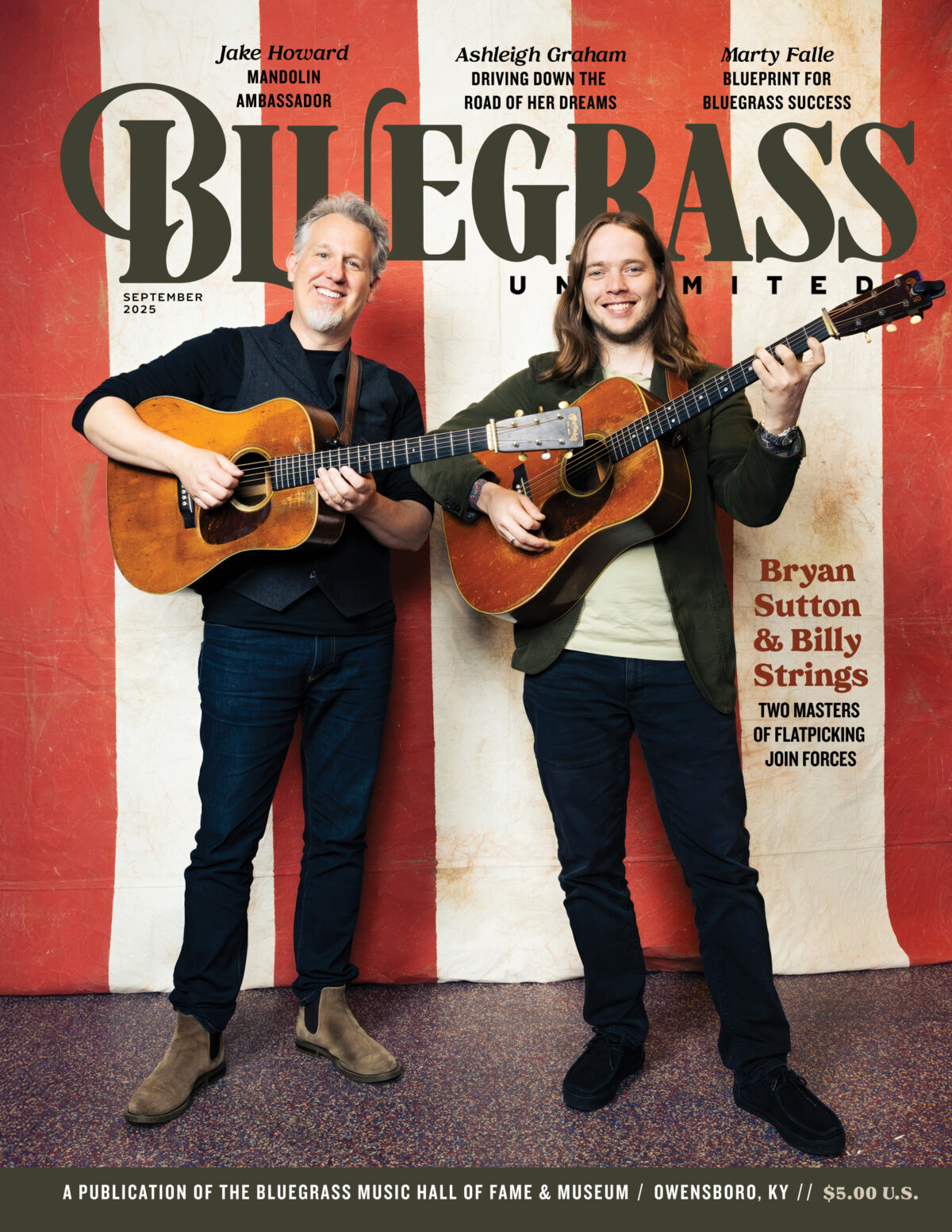
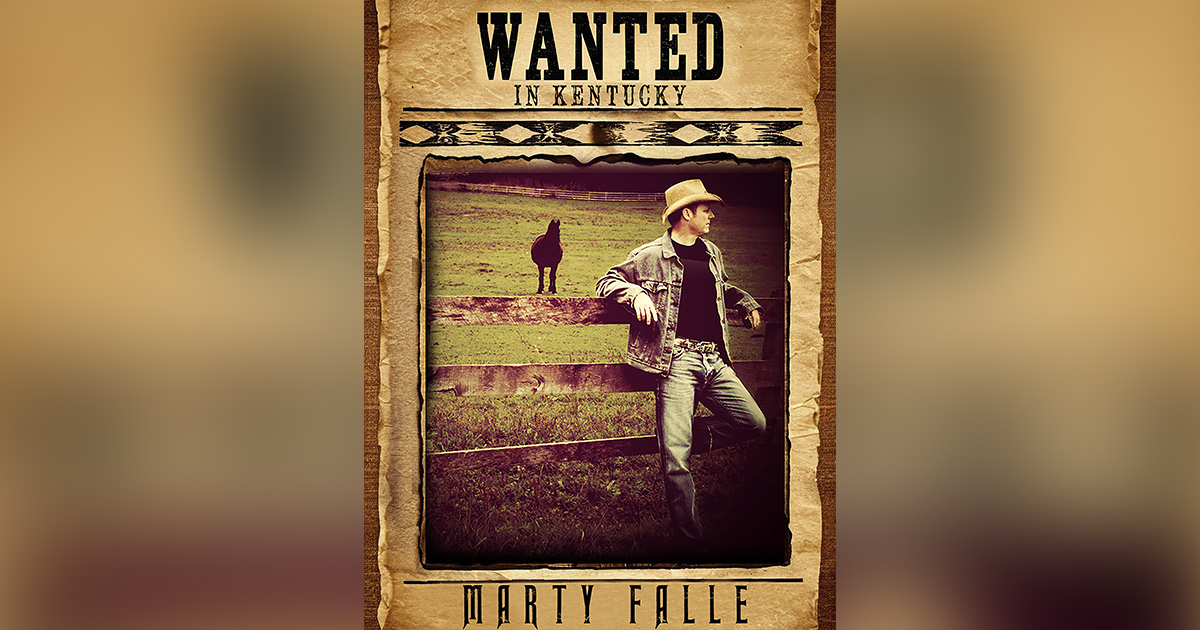
Marty Falle’s Blueprint for Bluegrass Success
When Marty Falle writes, he thinks in records, not singles. “That’s what I believe the original singer-songwriter artist is all about,” he says. His formula, which works for him, is “to write the record: write what’s in your heart, in your experience.”
To judge by the radio play and the number of tracks charting off the latest album, Wanted in Kentucky, this formula is working for him. The project, Falle’s seventh album, represents the culmination of what he has learned about himself and his music so far as he has built his career.
Falle is quick to credit Jonathan Yudkin, his producer. They first met when Falle reached out to him to add some fiddle on one of his projects after seeing his credits on other music. Yudkin was accustomed to doing remote recording, but he felt Falle could take his music to the next level and convinced him to come to Nashville to work with people who “do this three times a day.” The relationship grew into one of mutual respect.
Falle has achieved success both artistically and commercially by following his own path. He focuses on writing an album of songs and releasing it, then letting listeners and deejays decide which tracks they like.
For Wanted in Kentucky, all the songs on the album have been getting global airplay on radio on various terrestrial, satellite, or internet radio. Sirius XM, for example, has been playing three of the songs, including “Bury Me,” a Dwight Yoakum song that is one of the few covers Falle has recorded. Bluegrass Jamboree plays “Up Against the Big Hill Line,” and the Big Al and Sandy Show on Radio Bristol has been playing “Wanted in Kentucky.”
Falle notes that his favorites on the album change, but he has a special preference for narratives, especially those based on history. The title song “Wanted in Kentucky,” based on an incident in the history of his wife’s ancestors, is a personal favorite.
“I love the stories of ‘Breaker Boys’ and ‘Ghost Bride of Cumberland Falls,’” he says, referring to another cut getting lots of airplay nationwide. The song is a ghost story set just two or three exits down from Falle’s farm. “I’d been there so many times at night,” he says, “It’s a spooky place, and I had read about the story, but there weren’t any songs written about it, so I decided to write one.”
Falle’s music has also reached huge audiences outside of the United States. “It’s really taking off worldwide,” he says, noting interviews with stations in Norway, Denmark, the Netherlands, Spain, Italy, as well as New Caledonia, Australia, and New Zealand, where his songs enjoy airplay.
“I always ask, ‘What’s the allure?’ and they tell me there is a thirst, an appetite for American roots music, bluegrass, particularly Appalachian roots music.” He adds, “Our roots are over there, and human nature doesn’t change, does it?” Citing visits with his family to Ireland, he observed how community life revolved around pubs, a gathering place for all people from nine to ninety years old.
“What was stunning to me,” he noted, “was that the floor I was standing on was dirt. The bartender said this bar was 500 years old. People grab their banjo, their fiddle, or pennywhistle, and just go in there and play together. If you think about it, that’s roots music. It’s Scots Irish—the real origin of bluegrass music. Of course, Kentucky and Bill Monroe are important, but you have to go back further for the origin.”
Those roots are reflected in “Dance on the Emerald Green,” the album’s opening instrumental tune, with the addition of the pennywhistle, evoking dancing on those hard dirt tavern floors or Appalachian barn dances. Falle approaches the instrumentals on the album with the same care that he does his lyrics, and he is just as intentional about placement on the album. “Riling up the Rooster” changes the tone leading into “Freddie’s Runaway Balloon,” and “Black Hell Breakdown” leads naturally into “Breaker Boys.”
His producer Yudkin cites Falle’s willingness not to settle for a good song when he can write a great song. From the beginning of their collaboration, Yudkin questioned particular words and phrases, asking, “Is this the best way you can sing it for this song?”
“To Marty’s credit,” Yudkin says, “he has always taken suggestions and criticism seriously. He began re-examining his songwriting, and he’s now at the point where he knows exactly who he is and what he writes and can look at himself as a character. That’s where you get your best success as an artist, knowing who you are. Most artists never come to that point, but he took it all to heart.” He says he has seen Falle work with a specific goal in mind of his artistic image and artistic pursuit, noting, “that’s the gold mine for an artist.”
Part of the appeal of Falle’s approach, Yudkin says, is that he writes songs like “Freddie’s Runaway Balloon,” co-written with Jonathan Holmberg, who also collaborated on “Breaker Boys.” Both songs draw from stories set in the region, the kind of narrative nuggets Falle loves to mine. The ballad of young Freddie Meyer’s adventure has a light, breezy melody suited to the story’s happy ending, while “Breaker Boys,” a darker story, starts with a tone-setting intro of Yudkin on viola.
Falle is currently working with Yudkin to schedule touring. He admits that they talk about a tour, and then he gets busy writing, and they record another record. “Which is more important?” he asked, “touring or making a record? He is currently working on another 10 to 15 songs for a new record with plans to do a sound stage in Nashville, getting a live recording, and a video with a plan to play specific bluegrass festivals and music venues.

As Yudkin’s only bluegrass act, among a star-studded list of recording artists, Falle knows they have to work around his availability too, particularly as he is spending time in Mexico with Latin American acts he produces and accompanies.
Another challenge is the availability of the band members who have worked on his albums in the past. “We want the same people,” he says, “because the chemistry’s so good, and even though we could swap out a couple of people because we’ve got a good network of folks, we just don’t want to do it.” To date, those pickers and players have included Carl Miner on guitar, Mike Bub on acoustic bass, Josh Metheny on dobro, and Matt Menefee on banjo, with Falle on guitar and Yudkin on fiddle and mandolin.
Falle sets his high expectations for his music. Yudkin points out that part of the secret is writing about what he knows; the history and the places that intrigue him touch his listeners. “His love for storytelling makes him a kind of curator. It’s all there for people who want to hear it,” says Yudkin, “only Marty has extremely high standards for his music. One of the things I love about producing him is his excellence. He doesn’t just pursue excellence; he starts with it.”