
Notes & Queries – August 2025
Q: Could you provide me with some info on Fiddlin’ Mutt Poston? I will be playing one of his fiddle tunes on our radio program in the coming weeks and have been unable to locate any info about this gentleman. Thanks.
– Wilson Moore, Amherst, Nova Scotia
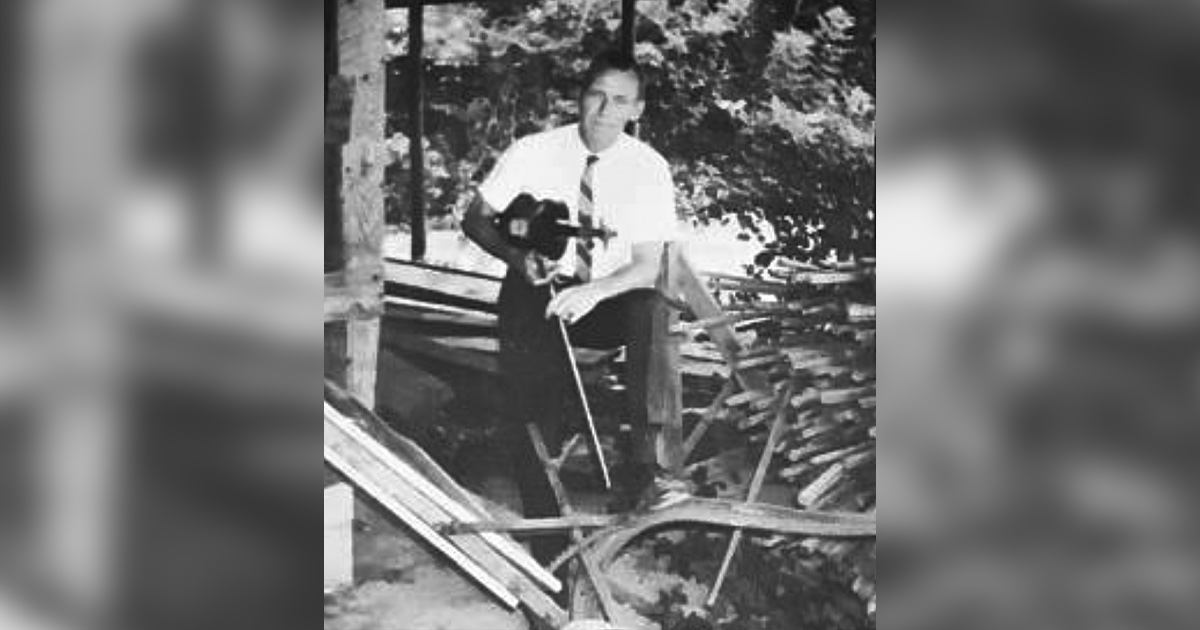
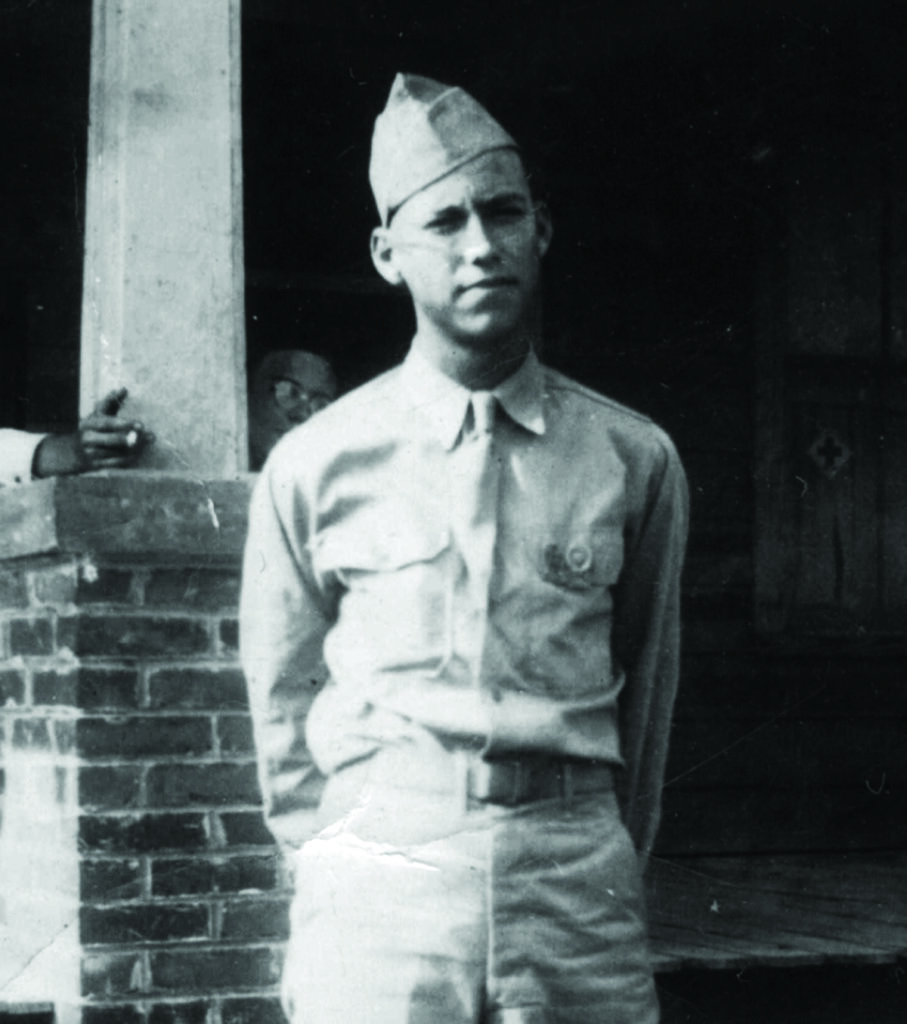
A: Mercer Adron “Mutt” Poston was a fiddler from South Carolina who appeared on a number of albums on the Rural Rhythm label in the late 1960s. He was born on January 27, 1924, in Hannah, South Carolina. Shortly after graduation from Hannah High School, Poston joined the U.S. Army. He served in the Tank Destroyers during World War II, where he was deployed to England, France, Belgium, Luxembourg, and Germany.
During the Battle of the Bulge, Poston was wounded in action and captured by German forces, becoming a prisoner of war at the Berga concentration camp. His time in captivity was harrowing, as food was scarce and survival depended on resourcefulness and camaraderie. It was during this time that Mutt formed a close bond with fellow POW Ed Roper, who credited Mutt with helping him survive the ordeal. Together, they supported each other, scavenging for food and staying at the back of prisoner marches to find scraps. Their friendship became a lifeline, and they were liberated by American forces in April 1945.
For his service, Mutt was awarded the Purple Heart, three Bronze Stars, the Good Conduct Medal, the Victory Medal, the American Campaign Medal, and the European-African-Middle Eastern Campaign Medal.
After the war, Mutt returned to South Carolina and resumed a quiet life as a farmer. He married Polly Poston, and together they raised four children: Furman Poston, Mike Poston, Debbie P. Strickland, and Dianne P. Parker. Mutt was deeply involved in his community, becoming a member of Bethlehem United Methodist Church, the Hannah Masonic Lodge, and organizations such as the POW, DAV, and American Legion.
Musical Career
In the late 1950s, Mutt began pursuing his passion for music. By 1958, he was performing professionally and in the 1960s fronted a band billed as the Farm Hands. The group performed at venues like Freddie’s Log Cabin, entertaining audiences with round and square dances.
Mutt collaborated with talented musicians, including Ira Ford (bass), Sleepy Powell (steel guitar), Red Farrell (guitar), and Marvin Shady (guitar). His fiddle playing became a staple of the band’s sound, and he gained recognition for his contributions to rural music.
Recording Career
Mutt’s musical career reached new heights in the middle and late 1960s and early ‘70s when he began recording with the Rural Rhythm label. He appeared on at least nine different albums:
RR-125 – Clarence Jackson with Fiddlin’ Mutt Poston and the Farm Hands
RR-129 – Clarence Jackson with Fiddlin’ Mutt Poston and the Farm Hands Heart Warming Recitation
RR-130 – Fiddling Mutt Poston and the Farm Hands Hoe Down! Volume 5
RR-131 – Clarence Jackson with Mutt Poston and the Farm Hands 25 Dobro and Steel Guitar Favorites
RR-154 – Fiddling Mutt Poston and the Farm Hands Hoe Down! Volume 2 – Fiddling on the Mountain
RR-156 – Fiddling Mutt Poston – Hoe Down! Volume 6 – Blues Instrumentals
RR-157 – Fiddling Mutt Poston – Hoe Down! Volume 7
RR-173 – Fiddling Mutt Poston with Clarence “Houndog” Jackson – Favorite Country Waltzes
RR-178 – Edith Roberts with Fiddling Mutt Poston – Sings Carter Family Favorites
RR 1168 – James Wall, Jim House, Doward Owen, Mutt Poston, Tommy Dodd – Old Time Songs
It was through Clarence Jackson that Poston realized all of his recorded work. Jackson, acting as a producer for Uncle Jim O’Neal’s Rural Rhythm label, recalled that “Uncle Jim usually sent me twenty songs and about $250. The songs or instrumentals were like all Carter Family, all fiddle tunes or some other specialty numbers. The band received $25.00, a hundred albums, and the option of purchasing others at the wholesale price to sell on personal appearances. I produced the James Wall album, all the Maggie Valley Country Singers, Fiddling Mutt Poston, Raymond Fairchild and so many others that I can’t recall them all. My association with Rural Rhythm was a good one and I especially enjoyed presenting so many talented artists to an international audience.” Jackson estimated that he produced about 40 albums for the label. Among those releases were several solo outings by Poston, a few collaborations with Jackson, and still more where he and his band served as a backing unit for solo artists.
Mutt’s style was not considered traditional bluegrass, which led Bluegrass Unlimited reviewer Dick Spottswood to critique it in 1967 as “good hillbilly cocktail music.” Critics noted that his approach, while not exceptional, was enjoyable and contributed to the unique sound of Rural Rhythm’s recordings.
Later Years
Mutt continued performing and recording into the 1970s, leaving a lasting impact on the music of his area. He passed away on April 17, 1990, at the age of 66.
Q: Reno and Smiley recorded a song called “Speedin’” which is identical to “John Hardy.” This is acknowledged on some of their albums by being written as “Speedin’ (John Hardy)” on the track listing. However, I’ve been trying to find the reason why they call their version “Speedin’” and can’t seem to find the origin story. Do you know how this came to be? Thanks!
– Melissa Tanguay, Portland, Oregon
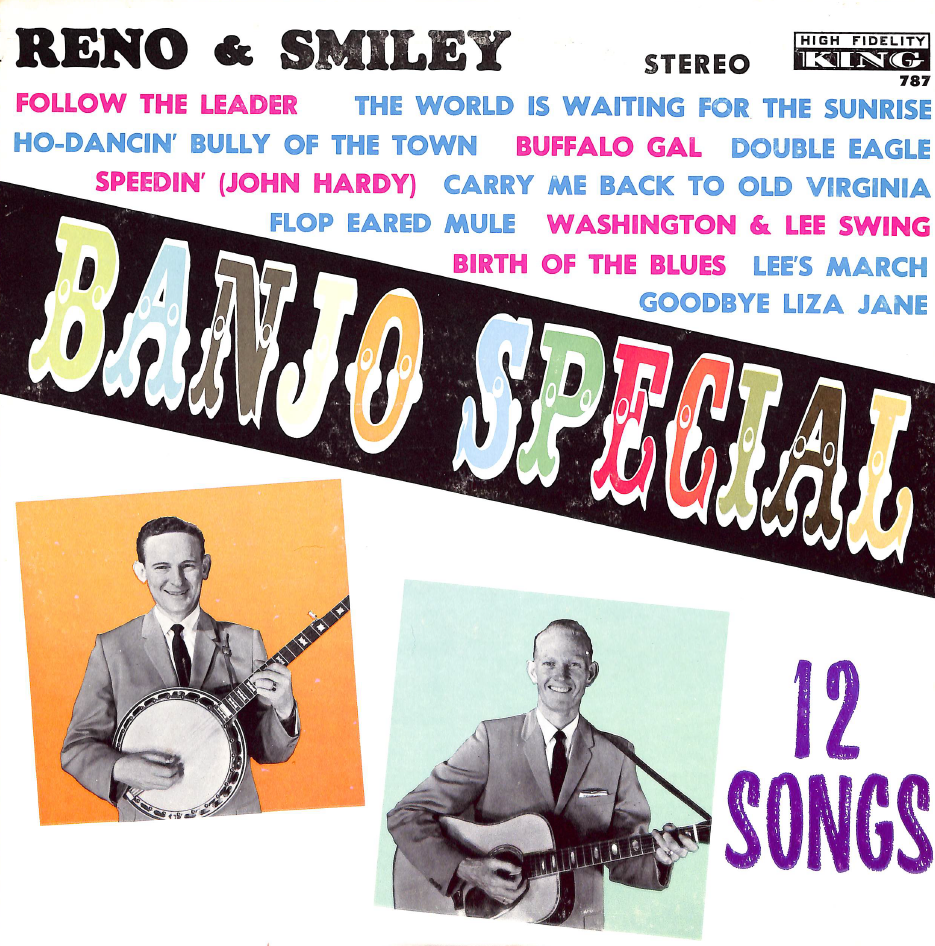
A: I reached out to several Reno & Smiley aficionados for help with this but came up empty. Ronnie Reno, who participated in the recording of the song (he was 13 at the time!) confessed “I don’t remember why they called it ‘Speedin’. My thoughts are that Sid Nathan [owner of King Records] wanted publishing on the song!!” Had this song been copyrighted by Lois Music (the publishing arm of King Records), that argument would make sense. However, King Records listed the song as being “Traditional.” Although indeed traditional, the song had been recorded (and copyrighted) earlier, most notably by the Original Carter Family. Perhaps, and this is only a guess, King Records listed the tune as traditional to avoid paying Peer Music and A. P. Carter for the use of the song. But, if King was going to do that, why not go all the way and claim the song as being written or arranged by Reno & Smiley? If any of our readers have any thoughts…
Newport Folk Festival – 1963: A Celebration of Bluegrass and Traditional Music
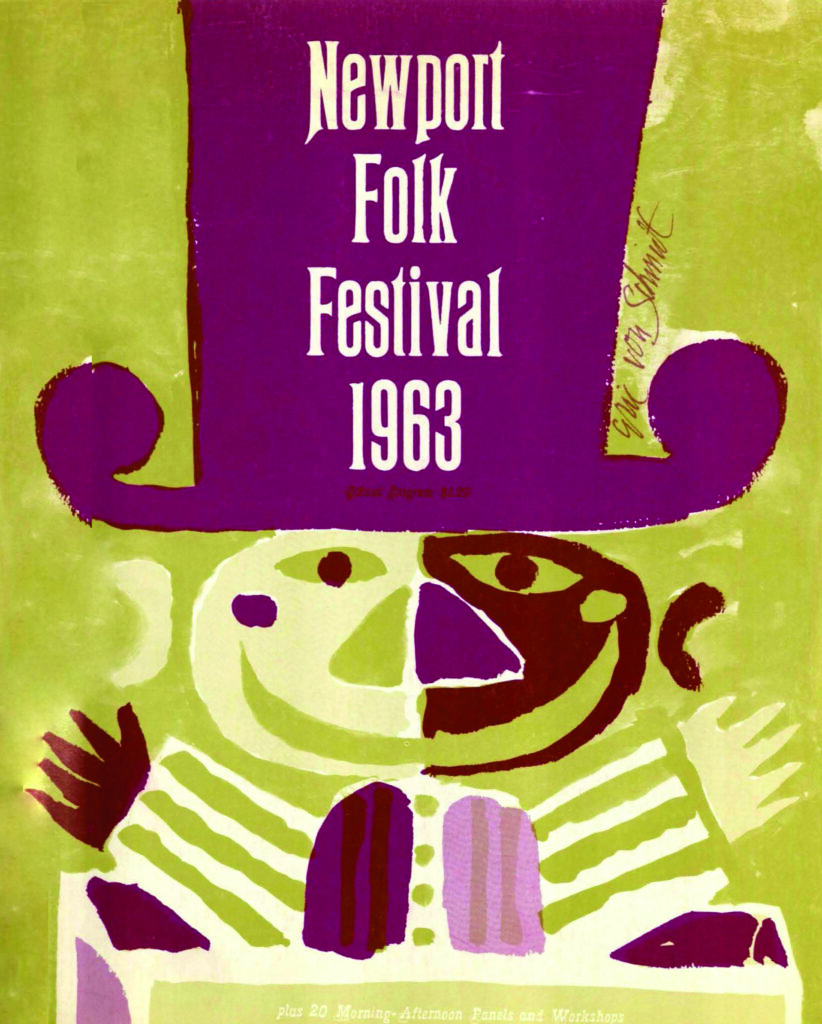
With bluegrass music currently in the middle of the 2025 festival season, it’s worth taking a look back at one of the forerunning events that helped to shape today’s music scene: the 1963 Newport Folk Festival. Bluegrass and old-time music figured prominently in a wellspring of folk and traditional artists. Performers included Bill Monroe and His Blue Grass Boys, Doc Watson, Bill Clifton, Jim & Jesse, Mac Wiseman, the Morris Brothers, Ralph Rinzler, the New Lost City Ramblers, Tex Logan, Fred Price, Clarence Ashley, Dock Boggs, Eric Weisberg, the Dillards, and Maybelle Carter. The event attracted nearly 50,000 admissions over a three-day period (July 26-28).
The festival, first held in 1959 and 1960, returned in 1963 with a renewed focus on diversity and authenticity. Organized by a committee of seven folk performers, including Pete Seeger, Theodore Bikel, and Bill Clifton, the event aimed to present a wide variety of folk music while supporting the field through scholarships, research grants, and other initiatives. As Bill Clifton noted, the festival provided “an opportunity for performers and spectators of like interests but divergent tastes to meet and enjoy the whole spectrum of their folk music.”
Bluegrass Takes Center Stage
Bluegrass music was a central feature of the festival, with workshops and performances that celebrated its roots and evolution. Bill Clifton – known for his string of successful recordings for Mercury, Starday, and Blue Ridge – led a bluegrass workshop that traced the genre’s development from old-time country music to the innovative sounds of artists like Bill Monroe and His Blue Grass Boys. Monroe, who had only recently been dubbed the “daddy of bluegrass,” captivated audiences with performances of classics like “Molly and Tenbrooks” and “Bluegrass Ramble.” His music, described by Clifton as creating “excitement reflected in hundreds of pairs of eyes,” showcased the genre’s dynamic energy and emotional depth.
Other bluegrass luminaries included Jim & Jesse McReynolds, who opened the workshop with their fast-paced instrumental “Border Ride” and melodic songs like “Grave in the Bend of the Valley.” The Morris Brothers, Wiley and Zeke, provided a historical perspective, bridging the gap between old-time mountain music and the bluegrass style popularized by Monroe. Their renditions of “Salty Dog Blues” and “Give Me Your Love and I’ll Give You Mine” resonated with audiences eager to learn about the genre’s origins.
Mac Wiseman shared his journey from working with Molly O’Day and Bill Monroe to forming his own band. His performance of “Traveling This Lonesome Road” alongside Monroe was a highlight of the workshop, illustrating the collaborative spirit that defined the festival.
Traditional Artists and Their Contributions
The festival also celebrated traditional artists who preserved the rich heritage of American folk music. Maybelle Carter, a member of the legendary Carter Family, showcased her autoharp and guitar techniques, inspiring both seasoned musicians and newcomers. Clarence Ashley and Fred Price brought old-time Appalachian music to life, while Dock Boggs shared his unique banjo style, blending blues and mountain traditions.
The New Lost City Ramblers, long recognized for their dedication to reviving traditional string band music, performed with authenticity and passion, bridging the gap between historical recordings and contemporary audiences. Renowned fiddler Tex Logan and banjo virtuoso Eric Weisberg added instrumental brilliance to the workshops.
Evening Performances: A Showcase of Talent
The festival’s evening concerts featured a mix of bluegrass, traditional, and folk artists, creating a tapestry of musical styles that delighted audiences. Bill Monroe and His Blue Grass Boys, Jim & Jesse, and the Morris Brothers represented the bluegrass tradition, while Doc Watson, Mississippi John Hurt, and Maybelle Carter brought their unique interpretations of traditional music to the stage.
The Dillards, then a young and inventive group that was headquartered in California, demonstrated the genre’s adaptability and appeal to younger audiences. Their innovative approach to bluegrass highlighted the genre’s potential for growth and evolution.
The festival’s closing performance, where all the directors and Sunday evening performers joined Pete Seeger, Joan Baez, and Bob Dylan to sing Woody Guthrie’s “This Land Is Your Land.” As Clifton remarked, the festival left attendees “broader and better informed, but humble in the awareness of the enormous breadth and scope of our musical heritage.”
Other 1963 Summer Folk Festivals and…
The Newport Folk Festival was part of a larger movement of folk festivals held throughout the summer of 1963, including the Monterey Folk Festival, the Ozark Folk Festival, and the Philadelphia Folk Festival. While these events showcased a variety of folk styles, Newport stood out for its emphasis on bluegrass and traditional music and generating significant profits to support the folk field.
The 1963 Newport Folk Festival was a landmark event that celebrated the richness of bluegrass and traditional music while fostering a sense of community among performers and audiences. Through workshops, performances, and the dedication of its organizers, the festival highlighted the enduring legacy of these genres and their vital role in American culture. As Theodore Bikel urged attendees, “Do not merely attend a series of concerts; wander about; participate in the workshops, the debates; agree, disagree, argue; and above all, sing.”
Over Jordan
Thomas Hubbard “Tom” Markham (February 12, 1937 – April 22, 2025) was an audio engineer, television cameraman, and innovator whose chief claim to bluegrass fame was that he recorded a now-legendary session by Stanley Brothers at his studio in 1960. In addition to songs such as “Little Maggie,” “If I Lose,” and “God Gave You to Me,” Markham also recorded one of the classics among classics, “Rank Stranger.” This specific recording was later enshrined in the Library of Congress’s National Recording Registry. From his early experiments with recording systems to his groundbreaking work with bluegrass legends and local rock bands, Markham’s career was marked by creativity, resourcefulness, and a passion for authentic artistry.
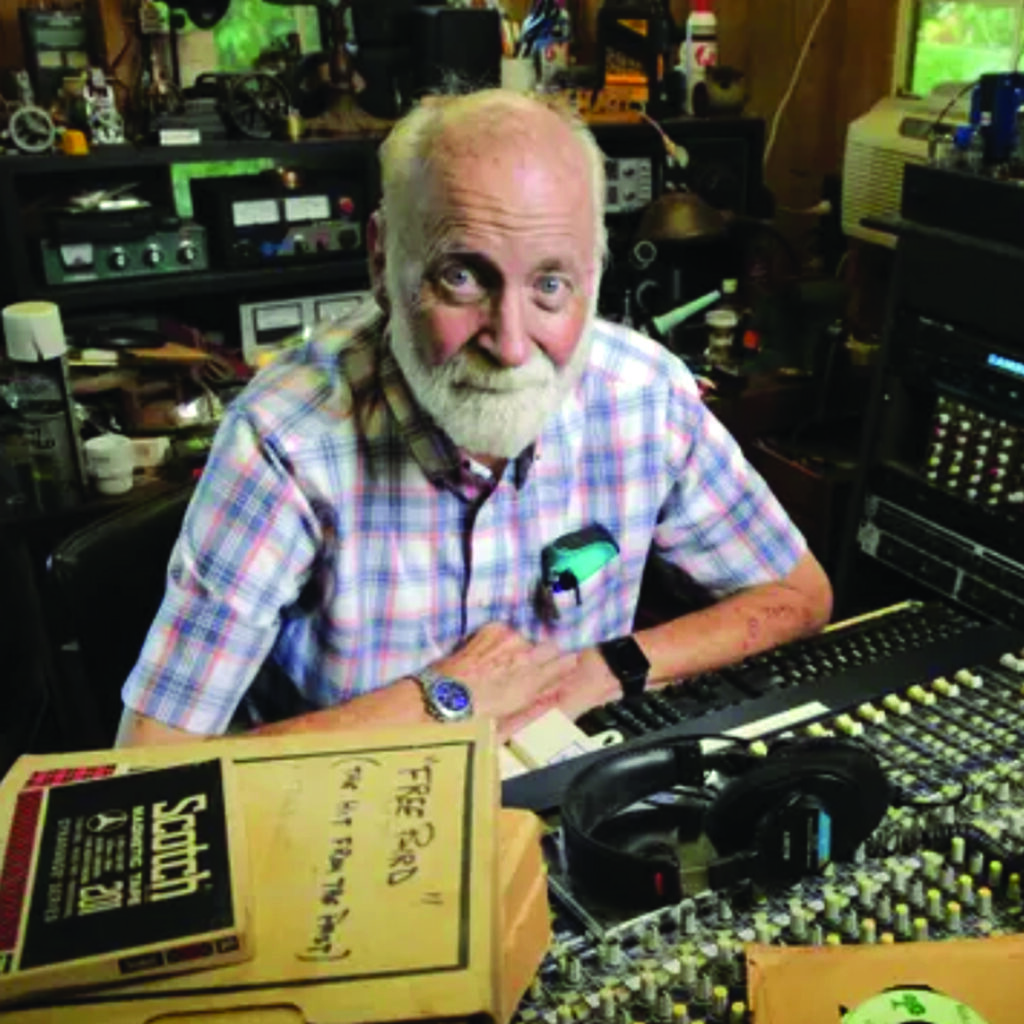
Born and raised in Jacksonville, Florida, Tom Markham discovered his passion for recording and engineering early in life. He honed his “electromechanical” aptitude by experimenting with recording systems, ham radios, and model airplane engines. While still a student at Landon High School, Markham set up a tape machine in his house and used a bathroom as an echo chamber to create recordings. His ingenuity extended to building a Tesla coil with a friend, which produced lightning bolts up to four feet long and was later displayed at the Jacksonville Children’s Museum.
Markham’s early experiments laid the foundation for his career in audio engineering. His ability to think outside the box and his passion for capturing sound in innovative ways would later define his work in music and broadcasting.
In 1959, Markham co-founded Magnum Recording Studios with his friend Tom Rose. Operating out of a garage-sized building on Love Grove Road (now University Boulevard), the studio was equipped with a mix of used and new equipment. Despite its modest setup, Magnum Studios became a hub for local musicians and produced recordings that gained regional and national attention.
Recording the Stanley Brothers
One of Magnum Studios’ most notable achievements was hosting the Stanley Brothers, an influential bluegrass band, for a recording session in May or June of 1960. The Stanley Brothers recorded tracks such as “Rank Stranger” and the gospel gem “I’m Ready to Go.” Markham and Rose charged $6 an hour for studio time, a modest fee that reflected the studio’s grassroots approach.
The recording session was notable for its simplicity and authenticity. Markham used just two microphones: one for the bass and an omnidirectional Altec condenser mic for the rest of the band. The Stanley Brothers, skilled in live performance techniques, adjusted their proximity to the microphone to achieve a natural mix. This method captured the raw, live energy of their music, which Markham believed was superior to the multi-track recording techniques that later became standard in the industry.
Markham’s partner, Tom Rose, noted that recording with the Stanley Brothers was somewhat of an education for the duo. He recalled that “at the session, we’d sit there and talk and they gave my partner, Markham, quite a few engineering tips. The first night they recorded there was a wire loose in one of our microphones and it was the mike that Carter was singing through. Carter kept saying to Markham, ‘There’s something wrong with this microphone, Tom.’ After they left that first night Markham said ‘I’m gonna take that microphone apart.’ He took it apart and a wire was loose. He said ‘Carter knew what he was talking about.’”
Markham’s minimalist approach to sound engineering showcased his ability to capture the essence of live performances. His recordings of the Stanley Brothers remain a testament to the power of simplicity and artistry in music production. When compared with other Stanley Brothers studio recordings from the same era, the work recorded by Tom Markham stands up today as one of the group’s best-recorded sessions.
Broadcasting Career: Live Television and Creativity
In addition to his work at Magnum Recording Studios, Markham worked at WJXT, a television station in Jacksonville, Florida, from 1957 to 1964. He was involved in live TV productions, including music shows and news programs. Markham recalled the excitement of working in an era before videotape, when all shows were broadcast live, adding an extra layer of creativity and energy to the productions.
Markham also ran camera for programs like “Face the Nation,” where he was proud to serve as the main cameraman during a live broadcast featuring Florida Governor LeRoy Collins. His work in television complemented his passion for audio engineering, allowing him to explore multiple facets of media production.
Markham’s broadcasting career highlighted his versatility and ability to adapt to different forms of media. His work in live television required quick thinking and resourcefulness, qualities that also defined his approach to sound engineering.
Shade Tree Records and Jacksonville’s Rock Scene
Markham’s career extended beyond bluegrass. In the late 1960s, he co-founded Shade Tree Records, a label that played a pivotal role in Jacksonville’s burgeoning rock scene. Shade Tree Records signed a young Westside band that would later become Lynyrd Skynyrd. Markham helped record their early tracks, including a raw version of “Free Bird,” and promoted them locally.
Markham also established Warehouse Studio, where he recorded early songs by Jacksonville’s Molly Hatchet. Known for his genius in engineering and recording, Markham left an indelible mark on Jacksonville’s music scene. His ability to capture the raw energy of rock bands and his dedication to promoting local talent helped shape the city’s musical identity.
Legacy and Impact
Tom Markham’s career was defined by creativity, resourcefulness, and a passion for authentic artistry. His work with the Stanley Brothers, Lynyrd Skynyrd, and Molly Hatchet showcased his versatility across genres, while his innovative sound engineering techniques, such as using a salvaged gasoline tank as an echo chamber, demonstrated his ingenuity. Despite the short-lived Magnum Recording Studios, its impact on bluegrass and Jacksonville’s music scene was significant. Markham’s dedication to capturing live performances extended to his contributions in broadcasting and grassroots recording studios, pushing the boundaries of what small studios and live television could achieve. His recordings remain a testament to the power of simplicity and live artistry, inspiring musicians, audio engineers, and broadcasters alike. Markham’s legacy is one of innovation and authenticity and serves as a reminder of the importance of creativity and resourcefulness in achieving greatness.
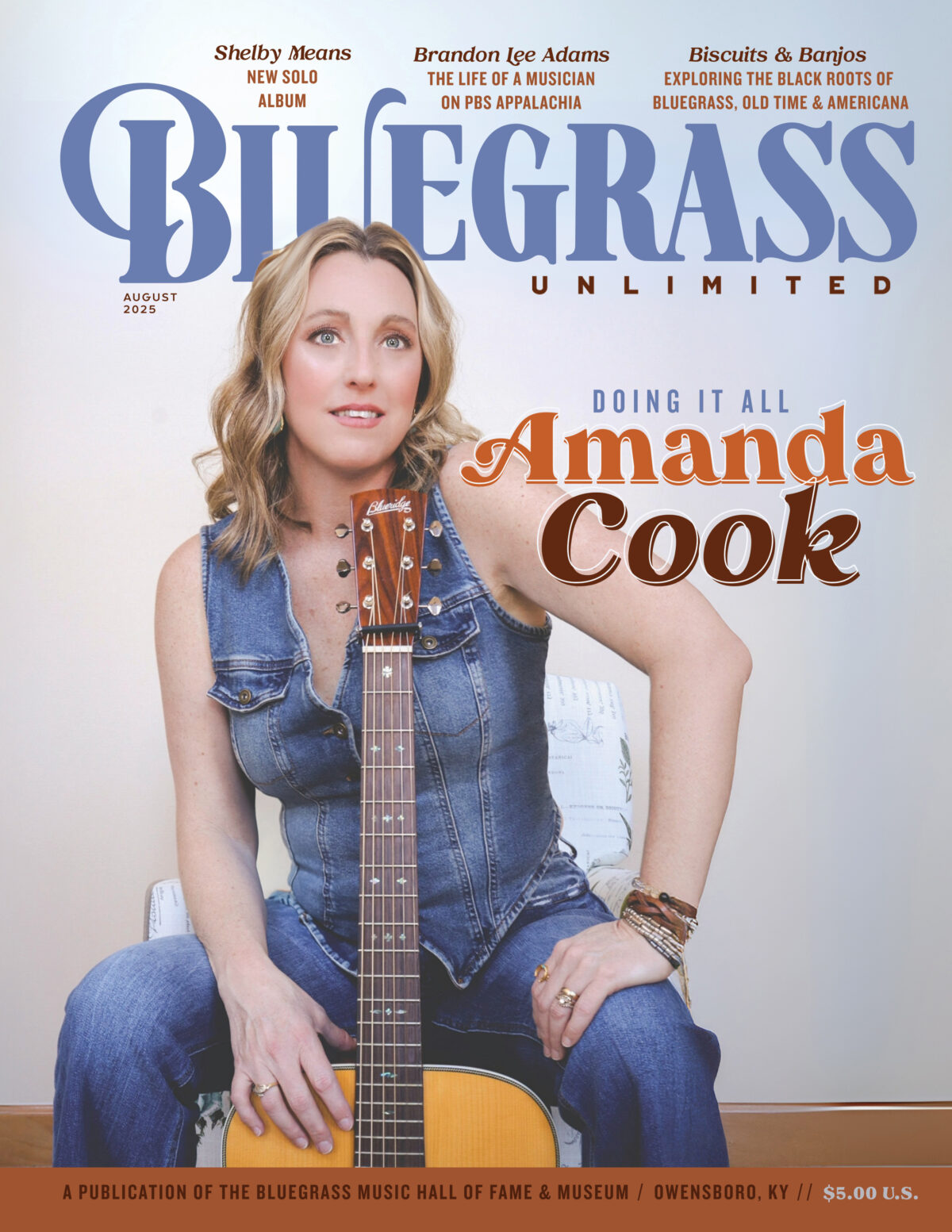
I can’t read this article, and I haven’t gotten the August magazine. I think I’m already paid up, but I can’t find anything about it. Please let me know my status. I’ve been a subscriber a long time, and want to stay that way, but I’m very disappointed at this point.