
Brittany Haas
The Newest Punch Brother
For many reasons, bluegrass music is a unique genre amongst the various forms of music performed and recorded in the United States. One reason is that a relatively high percentage of the fans of the music also play the music. At any given bluegrass festival, the main reason many of the attendees go to the event is so they will have the opportunity to jam in the campgrounds and parking lots. Another unique aspect of bluegrass, which goes hand-in-hand with the fact that many of the fans are players, is that bluegrass fans pay more attention to knowing the names of the members of the professional bands. In other words, I think that most pop, rock, and country fans are not really interested in who played a given guitar solo on an album. Whereas bluegrass fans like to know who played the banjo, fiddle, or mandolin solo when they hear it. Bluegrass fans tend to know the names of band members and when band members change, they tend to keep up with that information.
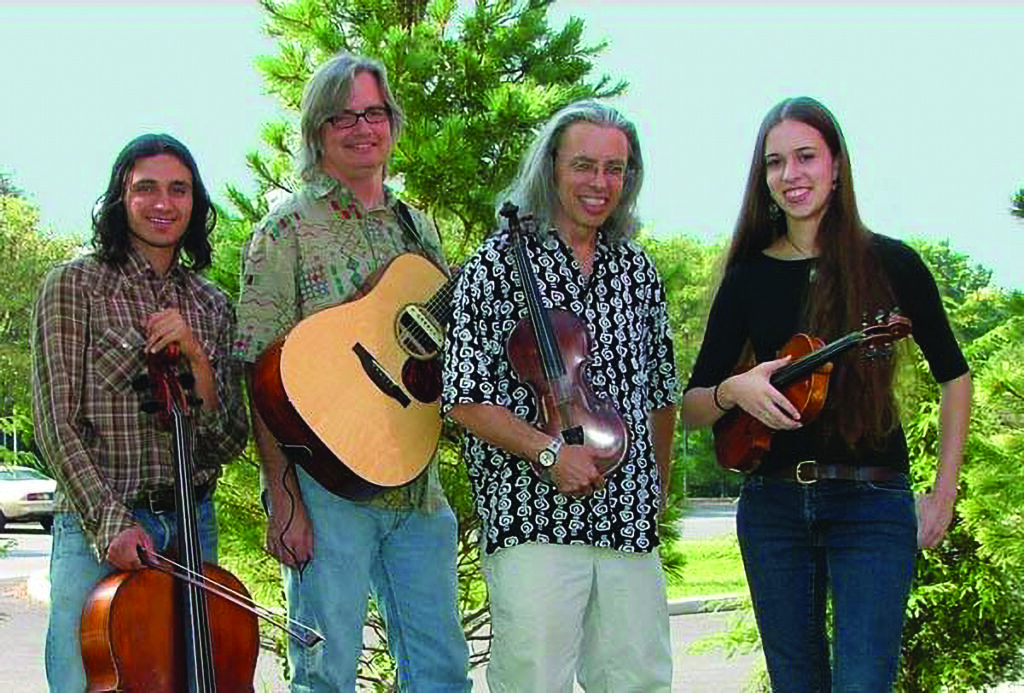
As Ron Thomason would say, “I told you that, to tell you this.” In all of my years of following bluegrass bands, I have always been interested in keeping up with the prominent bands and the members of those bands. So, when Darol Anger formed his Republic of Strings band around the turn of the last century, I naturally checked out who he brought into the band. The quartet included Darol on fiddle, Scott Nygaard on guitar, Rushad Eggleston on cello, and Brittany Haas on second fiddle. I knew of Scott’s work with Tim O’Brien, Laurie Lewis, and others and I also knew Scott personally because by that time he had worked as a columnist for Flatpicking Guitar Magazine, a magazine that I published and edited. I had known Rushad Eggleston since he was a teenager because we lived close together in the Monterey area of California and Rushad regularly attended a jam session that I hosted there. Brittany Haas was new to me, but her work with that band was impressive and I have followed her remarkable career ever since. What I did not realize until I interviewed Brittany for this article was that when she joined Darol Anger’s band she was only 13 years old!
Over the past twenty-five years, Brittany has performed with a wide variety of bands and duos—the most notable being Republic of Strings, Tony Trischka, Crooked Still, Hawktail, Dave Rawlings Machine, and a duo with her sister Natalie. Brittany’s newest job is with the Punch Brothers. In addition to performing and recording, Brittany has helped countless fiddlers learn their craft through lessons online at two of the top platforms for acoustic music—Peghead Nation and ArtistWorks. She has also spent time teaching at the college level by being selected as an artist-in-residence at East Tennessee State University (ETSU) and, in the coming year, through classes that she will teach at the Berklee College of Music in Boston. Additionally, she has taught at many workshops and music camps over the past twenty years.
Getting Started
Brittany grew up in Menlo Park, California. Her mother played a little bit of piano, but other than that her parents were music fans, but not involved in playing music. When asked about how she became interested in learning to play the violin, Brittany said, “When I was four years old, my best friend had seen a violin player play at a wedding and he wanted to learn violin. So our parents took us to lessons together.” She started out learning by the Suzuki method and said that she loved it. But when her violin teacher gave her a few fiddle tunes to work on for fun she became even more excited about playing the violin. Her mother, noticing Brittany’s interest in fiddle tunes, started to explore opportunities for Brittany to learn more fiddle-style music since her Suzuki teacher didn’t have much experience with it. Her search led her to Jack Tuttle who was teaching fiddle at Gryphon Stringed Instruments in Palo Alto, California. For those readers who don’t know, Jack Tuttle is a very well-known and highly respected teacher of all bluegrass instruments and is also Molly and Sullivan Tuttle’s father.
When Jack was asked about having Brittany as a student, he said, “I taught her from age 8 to 15. Kind of hard to put the experience down to a sentence or two, but needless to say she was a singular talent, and certainly by the age of 12 or 13 I knew she was on her way to being one of the all-time great fiddlers. Today I’d say she is the most expressive fiddler I’ve ever heard, and I don’t think I’m alone in that opinion.”
Regarding her lessons with Jack, Brittany said, “Finding Jack was a huge stroke of luck because he was an amazing teacher and he showed me the whole world of fiddle playing. The really amazing thing about his teaching is that he was also teaching me how to improvise. We would learn the melodies and he had them written out with chords and then he would back me up on guitar and he would make me improvise, which was really scary at first. But I am so grateful that that was a part of it from the beginning. He also showed me bluegrass songs and taught me the whole concept about how a fiddle player would take a break. He would show me which kind of licks were normal and then how to take the melody and riff on it a little more. There was also a boombox in the room where he taught and we listened to a lot of Stuart Duncan and Kenny Baker and Bruce Molsky and Tommy Jarrell and older folks like that.”
About the same time that Brittany started studying fiddle with Jack Tuttle, she also started attending Alasdair Fraser’s Scottish fiddle camp in Santa Cruz, California. Through attendance at that camp, she was able to meet and work with Bruce Molsky and Darol Anger. Remembering that camp, Brittany said, “It was so communal. There was this whole huge scene of people who wanted to play together and dance to the music and do all of the fun things that exist around the music making.” Brittany’s sister, Natalie, who is three years older and started playing the cello one year after Brittany began learning the violin, also attended the camp. In addition to working with Molsky at the fiddle camp, Brittany also attended workshops that Molsky gave at Gryphon when he traveled through town. She also continued with her classical violin lessons while studying fiddle with Jack Tuttle.
When Brittany was about 13 years old, she started studying with Darol Anger. Brittany said, “Darol was living in Oakland and I would go up to his house every other week or so. He taught me all sorts of stuff and then ended up hiring me for a band that he was putting together at the time called Republic of Strings. That was really cool because I was getting regular instruction from him and I was also in his band learning on the fly. As a second fiddler in the band, he could show me exactly what he wanted me to do. I learned so much. Darol is a great teacher and mentor.”
When asked about bringing Brittany into the band at such a young age, Darol said, “By the time Brittany showed up in my musical life, she was already playing at a level that would satisfy just about any professional fiddle player. So, after Bruce Molsky introduced us, I’d been working with her for maybe a year and had pretty much run out of technical-type things to show her. Even though she was so young, her levels of self-possession and focus were off the charts. Hmm, maybe the best way to add to Brittany’s music knowledge base was to put her in a professional gigging situation somewhat tailored to her skills, with sympathetic and creative mentors… Everyone wins.
“Guitarist Scott Nygaard and I already had an informal band that was playing around the San Francisco Bay area, and together we decided to reconfigure our group to include Brittany and cellist Rushad Eggleston, who had recently started at Berklee College. So, Brittany was really the catalyst for The Republic Of Strings, a group which I’m proud to say has inspired a couple of generations of string musicians. Brittany and her sister Natalie, and their family, have been and continue to be one of the major joys of my musical life.”
When asked about how working with Darol and his band changed her approach to fiddling, Brittany said, “Jack Tuttle’s approach to learning improvisation was melody-based. The melody was used as a jumping-off point. The approach was melody-centric and melody-driven. With Darol, I learned how to play more freely because at some point the melody goes away.” Brittany explained that the way she looks at it, each genre can provide a different access point for widening improvisation ideas. In Celtic and old-time music there is variation, but not a lot of improvisation. With bluegrass, the improvisations tend to be melody-based. Blues music is somewhat phrase-based (what Brittany called “licks or little nuggets”) and jazz allows more free expression without being as melody-based as other genres. She said that there are also situations when you “Start from nowhere…and free improv can be a good way to train yourself in that.”
Moving East
Brittany performed with the Republic of Strings for five years and left to move east and attend college at Princeton. When asked if she went to college to study music, Brittany said, “I thought that if I went to school to study music, I might not like music anymore. I thought that the joy of it would get squashed a little bit from studying it in an academic setting. Now I realize that that probably wouldn’t have happened. I think that it would have extended my horizons in other ways. But, it was not what I was ready for at that time. I wanted to keep studying academics and I stayed open to other career possibilities for a while. But, it became quickly clear that I was not going to be able to not play music.”
While at Princeton, Brittany studied evolutionary biology with a minor in music. Although her school studies were focused away from music, her time spent outside of the classroom brought more music education because she met and started to perform with Tony Trischka and Michael Daves. She also would commute to New York City on the train and attend jams there. She said, “It was a fun time and I really enjoyed playing with them, and I got deeper into bluegrass in that setting.”
During her junior year in college (around 2008) Brittany also joined the band Crooked Still. Crooked Still was formed in Boston when Aoife O’Donovan and Corey DiMario were studying at the New England Conservatory of Music, Rushad Eggleston was at the Berklee College of Music, and Greg Liszt was a graduate student at MIT. That configuration stayed together until late 2007 when Eggleston left the band to form Tornado Rider. In January 2008 Tristan Clarridge and Brittany joined the band. When Brittany graduated from Princeton in 2009, she moved to Boston. She stayed with Crooked Still for four years.
Boston was a music-rich environment for Brittany. Others who were living in Boston during the time she was there included Jordan Tice, Joe Walsh, Kimber Ludiker, Wes Corbett, Hanneke Cassel, Matt Arcara, and others. Brittany said, “I could not list everybody, but it was a very rich scene with a whole lot of jamming. There were a lot of great musicians there, often living in just a few concentrated houses. I was playing all of the time. There was such a camaraderie…it was fun. I felt very lucky to be around all of those people.”After spending three years in Boston, Brittany moved to Nashville for two years, then went on tour for about a year (calling no place her home), moved back to Boston for a year, and then back to Nashville in 2015. After her time with Crooked Still was coming to an end (roughly 2012) the band Hawktail began to come together, first as a trio with Brittany, Jordan Tice (guitar), and Paul Kowert (bass). When they first came together, they called themselves Haas Kowert Tice. Dominick Leslie joined the band later and they became Hawktail. Hawktail’s first album (You Got This) was released in 2014 and they have come out with a new album roughly every two years since. We featured Hawktail in the November 2022 issue of Bluegrass Unlimited. Last year the band collaborated with the Swedish band Väsen and toured with Aoife O’Donovan as her backup band. In 2023 they wrote music for a FreshGrass commission that they have yet to release. In 2023 Brittany also recorded with her sister Natalie (HAAS).
When asked about working with Brittany in Hawktail, Jordan Tice said, “Brittany can evoke more with her instrument than just about anyone and despite all the music we’ve made I’m still in awe of her abilities and continuously surprised about what she’s able to pull out of her hat. I think she’s truly one of the greats of any generation due to her combination of musicality, ace ability to fill the role of fiddler in any band, and her complete individuality. She’s also so experienced and musically pure of heart that her impulses as a writer, collaborator, and arranger are always spot on.”
“I think the fact that her voice on her instrument is so powerful, emotionally rich, and nuanced is why Hawktail can get away with being an instrumental band. She’s a rare instrumental stylist that can function as a lead singer of sorts.”
The Punch Brothers
Before becoming a member of The Punch Brothers, when Gabe Witcher left the band, Brittany had worked with Chris Thile on the Live From Here radio show. Brittany said, “He knew me and he knew my playing. So, I think they discussed it among themselves and they called me and said, ‘What do you think?’ It was an easy decision. I feel so lucky to get to make music with them. They are amazing people and I love them all.” Since she joined The Punch Brothers in the summer of 2023, the main thrust of the band’s efforts has been their podcast titled The Energy Curfew Music Hour, which is described as an audio-based variety show. To date, the band has performed on the podcast with musical guests such as Kacey Musgraves, Jason Isbell, Jon Batiste, Norah Jones, James Taylor, and others. Brittany has yet to record an album with the band, but she said that they are currently writing material for a new project with plans to begin recording soon.
When asked about having Brittany in the band, Punch Brothers guitarist Chris Eldridge said, “Brittany is a ‘force of nature’ musician. She has something that all of my very favorite musicians share, which is that her ‘voice’ is unmistakable. You can tell in literally a single note that it is her. That is so rare and speaks to a certain very ‘deep’ aspect of musicianship. But she’s also unbounded in the sense that she can also do nearly anything musically. It’s a remarkable combination. It’s absolutely such a joy and honor to get to make music with her. Having her in the band is opening up new possibilities, which is very exciting.”
Teaching the Fiddle
Since she was 13 years old, bands have sought to have Brittany Haas with them on stage and/or in the recording studio. She has also been in high demand as a fiddle teacher. Not only have many of the most popular music camps hired her to be a teacher, but two of the most prominent online learning sites for acoustic music—Peghead Nation and ArtistWorks—have brought her on board as an instructor, as have the two most prominent college-level programs—ETSU and the Berklee College of Music.
Brittany’s Peghead Nation course has been available for roughly ten years and focuses on fiddle styles. Brittany brings in a guest fiddler for each lesson to teach tunes in different fiddle styles, including blues, bluegrass, old-time, Irish, Scottish, and Swedish. In addition to teaching the tunes themselves, these lessons focus on techniques that might be either unique to that style or approached differently in that style, such as different bowing techniques, approaches to double stops, and various embellishments with the left hand.
ArtistWorks brought Brittany on board about three years ago. Darol Anger was the first fiddle teacher on the ArtistWorks platform. When they were ready to bring on a second fiddle teacher, ArtistWorks discussed it with Darol and they decided to bring Brittany on board. They have since brought on Alex Hargreaves as a third fiddle instructor. Over the course of the ArtistWorks lessons, Brittany starts with fundamentals and then uses a tune-based approach to teaching theory and technique. She said that she uses tunes as a vehicle to learn all aspects of fiddle playing and she gradually increases the difficulty. The ArtistWorks platform includes video exchange whereby any student enrolled in the course can send in a video and receive direct video feedback from Brittany.
When a student enrolled in the ArtistWorks course wants to learn about arrangement or improvisation, Brittany uses the video exchange feature to present those concepts. Her approach to teaching improvisation is also tune-based. She said, “I use the melody as a jumping-off point. We work on what might be added or taken away.” She says, “I teach students that they do not have to feel pressured to come up with a whole new thing.”
Brittany also encourages her students who want to learn about improvisation to listen to other people’s solos in order to get outside of their own head, and not just fiddle solos, but solos on any instrument, recommending that students “Listen to anything that widens your mind.” She also feels that aspects of good improvisation include learning how to relax and let your brain flow without rules and self-criticism. She said, “You learn how to get into the right mental space where you can relax and let things come through freely. You can learn how to be adventurous and not worry about playing the wrong thing. When you can learn to let loose and go for it with confidence, you find cool stuff.”
When asked how she helps her students get into that relaxed mental space, Brittany said, “I try to make them feel good and increase their confidence in themselves. I encourage them to keep exploring and tell them that there are no wrong notes, especially when they are practicing. You just got to go for it and let loose.”
College-Level Teaching
Brittany worked as an artist in residence at ETSU during the 2021-2022 timeframe. Although she was living in Nashville at the time, she rented a room near ETSU and stayed there three days out of every week. At ETSU she worked with students privately, she conducted band coaching sessions and she co-taught a lecture class with Roy Andrade on the Art of Interpretation. Regarding that class, Brittany said, “We listened to music a lot and talked about how to develop personal styles. We worked a lot with the Harry Smith anthology. There was a lot of hands-on work involving folks learning something traditional, imitating, and then following the spectrum into making it their own.”
Most recently, Brittany was awarded the 2025 Eisenson Family Prize for American Roots Music. The endowed fund allows roots music musicians to visit the Berklee College of Music to engage students in ensembles, private lessons, and master classes. Regarding Brittany being selected for this prize, Bruce Molsky, a visiting scholar in the Roots Music Program at Berklee said, “Brittany is the voice of what fiddling has become and where it’s going, an artist who floats seamlessly and naturally and humbly between styles, while embracing and amplifying everything that’s beautiful about the instrument.” Brittany will visit Berklee three times over the next year (spring 2025, fall 2025, and spring 2026) and conduct two days of teaching per visit.
Although she is not yet 40, Brittany Haas has been playing the fiddle continuously in top-tier bands for 25 years. There is no doubt that she will remain a highly sought-after performer, recording artist, and music instructor for many years to come. If you have a chance to see her perform with the Punch Brothers, Hawktail, or with her sister Natalie—take it. If you are a fiddle player and are looking to take your playing to the next level, check out Brittany’s course at ArtistWorks.