Tim Surrett
Balsam Range’s longtime bassist Tim Surrett has worn plenty of musical hats over the course of his career. Vocalist/sideman/singer/producer/sessions player/record label owner, but these days he’s soaking in the joy of fatherhood. At age 60, he spends as much time as possible with his only child, Braden, 15, a junior on the high school baseball team, the Pisgah Bears.
“I’ve got so much going on, and I know my time with him is limited,” Surrett said in an interview from his hometown of Canton, North Carolina. “He’s already had his first college visit.”
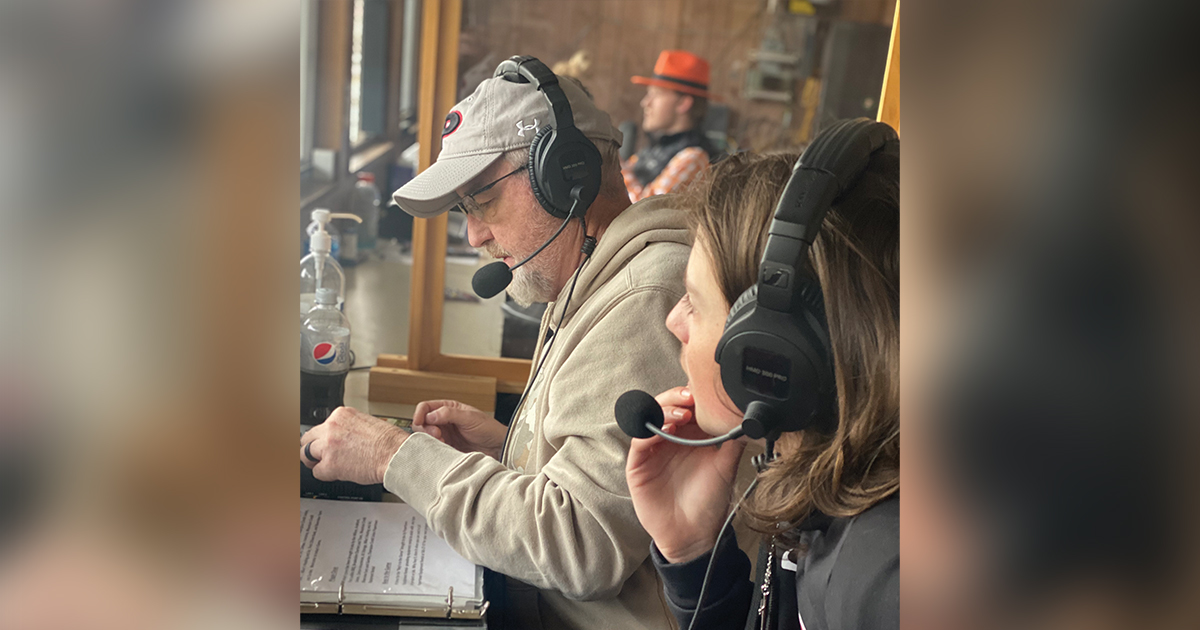
When Surrett watches his son pitch or play another spot in the infield, he does so from the vantage point of a broadcasting booth. He’s the high school baseball radio announcer for WPTL. He’s also the host of Paper Town Roots Radio with his nephew Carter, playing bluegrass, classic country, and gospel music. Fans can listen digitally on www.wplt.com or papertownrootsradio.com on Mondays and Wednesdays from 7:00 to 10:00 p.m. “It’s something I started during COVID because we couldn’t play music,” Surrett said. “I missed talking with people.”
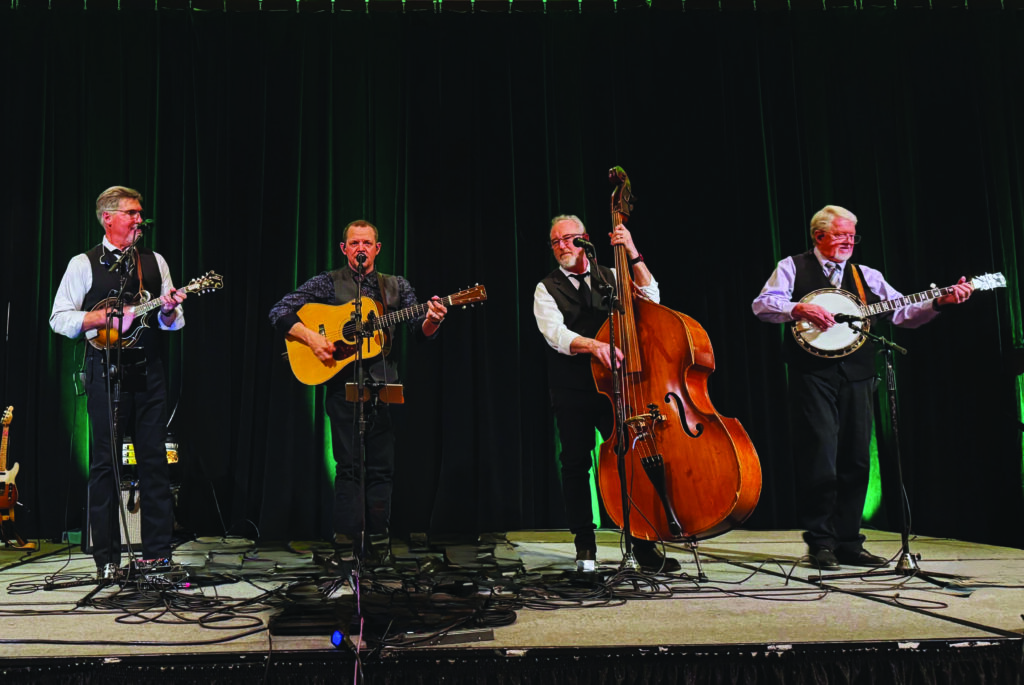
Of course, Surrett continues his main gig, playing in Balsam Range alongside Dr. Marc Pruett (banjo), Caleb Smith (guitar, lead, and baritone vocals), and Alan Bibey (mandolin and vocals). Surrett laid down the solid bass groove again for the band’s latest project, Kinetic Tone, which features the chart-topper, “That’s What the Years Do,” the #2 hit, “We’ll All Drink Money,” and “Snake Charmer” that won over radio and fans to give the guys a Top 3 hit. “That was a fun tune,” Surrett says. “If you listen to that intro, it’s like, okay, here’s Alan Bibey. Ka-blam! Here it went.”
Bibey of recent Grasstowne fame is a two-time IBMA Mandolin Player of the Year and 9-time SPBGMA Mandolin Player of the Year. He replaced Darren Nicholson who amicably left to pursue a solo career after 15 years with the group. “It’s been a really good fit musically and personality-wise,” Surrett says. “Alan blows our minds a lot of times with what he does on the mandolin.
The album also includes the cut, “Echo Canyon,” a song set in California after the Gold Rush, that the band recorded with the Atlanta Pops Orchestra. Previously, Balsam Range had collaborated on two albums with the APO ensemble. One of the albums, Mountain Overture, debuted on the Billboard Bluegrass Chart at #5 and the Classic Crossover Chart at #6. Surrett says the band has to be in a different frame of mind when recording with classically trained musicians.
“Orchestra people are such great musicians. They play what’s scored on the music in front of them. We’ve had a lot of our music scored, and we have to remember to play it like it’s scored instead of doing it like a bluegrass band does. ‘Hey, take it!’, it’s like Flatt & Scruggs meets Pink Floyd meets Beethoven. They are very tiring shows because, under their union rules, you have to rehearse the whole show before you play the show. So, you do the show twice in one day. At the end of it we’re just limping to the Hampton Inn,” he said, chuckling.
Balsam Range goes down another road with “Worry” that Surrett describes as an Earl Scruggs guitar gospel song. “We always like to find something that’s different,” Surrett explains. “We do an a cappella thing almost, but it’s more of a finger-picking thing with that quartet sound. We’ll probably do it around one microphone. Any visual change, I’ve always thought, is a good thing. When you go to a typical bluegrass festival and you see five guys or four guys and a girl or whatever and then the bands change, you look [and ask yourself] is that the same five people? I don’t know. So we try to think of different things to do. We laugh when we travel talking about that song. I do my Little Roy impersonation. “I said that’s gonna be a crowd-pleaser right there.”
A Little Bit of Everything
Growing up in the mountains of western North Carolina, Surrett was surrounded by great musicians. “When we won Entertainers of the Year, somebody asked me, ‘Are y’all the best band in the world?’ I said, ‘I’m not sure we’re the best band in Haywood County.”
With that influential backdrop, Surrett absorbed all he could of the local music scene. It was a main staple at home too. “We’d always get together on Christmas night with my dad’s side of the family. My Uncle Sherman was a great, great singer. We’d be singing Merle Haggard songs. “Sing Me Back Home” is a Christmas song to me.”
A railroad worker, Surrett’s dad introduced him to bluegrass but was more into the sounds of classic country like Marty Robbins and Ray Price. He played local functions. “I’ve always said he was an animal singer,” Surrett jokes. “He sang at the Moose Lodge, the Lion’s Club, the Caribou Lodge, and the Elks Lodge.”
Unfortunately, his dad stopped playing as much by the time his son was a teenager, but Surrett had already developed a passion for the music. “When I was 14, I played country music on Thursday night and Friday night. Saturday night, I’d play with a little high school rock and roll band somewhere, and Sunday I’d play with the gospel quartet in church somewhere. I loved rock and roll and I wanted to be Led Zeppelin because it had that drive and power to it. But bluegrass had that same drive acoustically so I loved playing it as well.”
In his early days, Tim was into playing guitar until he was overcome by a realization. “There’s so much music in our region, especially back then. I told my dad I think everybody I know has a guitar, and there’s two bass players that I know. I said I think I might be interested in the bass and he said, ‘I think that’s the smartest thing I’ve ever heard.’ I got a bass on Christmas Day, and by Christmas night, I was in a rock and roll band. It was the era of the 70s where you only needed one string. You’re playing ‘LaGrange’ and whatnot. I was an electric bass player for the next 15 plus years, and I ended up in the early 80s playing in the studio, and I played on hundreds of records as an electric bass player.”
Surrett got his professional start right out of high school, hitting the road with a gospel group. He worked his way through the industry playing with Hall of Famers like Squire Parsons who wrote the classic gospel song, “Beulah Land,” and eventually ended up for a decade with the Kingsmen Quartet with whom he sang lead and baritone. The quartet received the Singing News Fan Award for Favorite Band of the Year for seven straight years (1989-1995) while Surrett was voted Favorite Musician by the Singing News readers in 2004 and 2005.
“It was a great time. We worked four days a week every week and 10 days at a time sometimes, but it was my life. That’s what I wanted to do. They hired me as the bass player, and I was perfectly happy and ended up having to sort of learn how to sing while I was there. The Kingsmen sing high and hard, and my voice was just giving out. When I saw that was going to be a big part of it, I started taking opera lessons from a dear old German lady in Asheville. It was amazing the difference because at that time the opera tones would match what the gospel music sound was. I kind of got into that stuff for a while. That’s weird. I’d be listening to Tony Rice and Pavarotti. My wife will not let me just put shuffle on my phone because you’re gonna get Luciano Pavarotti, and then Reno and Smiley or something,” he said, laughing.
Surrett kept up his opera vocal lessons the whole time he was in the quartet. “It’s easy to fall out of that. Some people just have natural tones and bluegrass is full of it, but I never did. It’s like a golf swing or a baseball swing. That’s why they have coaches to watch them, keep them in the right groove.”
Divided Highway
Though Surrett loved his journey with the Kingsmen, he also began to fall seriously in love with bluegrass. “They (gospel and bluegrass music) were running parallel with me all this time because it brought me back to my dad’s music and all that. Plus, I was traveling 200 days a year. When you do your own music that much, you want to hear something else and I’d be up all night on the bus listening to bluegrass.”
Listening wasn’t enough to quench his thirst for bluegrass. He wanted a side outlet to play the music. “That’s where Mountain Home Records came in,” Surrett explains. “Mostly, it was bluegrass gospel back in those days, but it’s evolved into a really good record label that we’re super proud of. So, I was always doing bluegrass on the side.”
Health concerns and losing his voice caused Tim to leave the Kingsmen and full-time touring. In the meantime, he ran into his old friend Marc Pruett. “I am a man of faith. I’m not a big coincidence guy and I hadn’t seen Marc except in the studio for years, and we reconnected and ended up working together for our county government before Balsam Range ever started. It was always a divided highway. It’s two separate careers that were going on almost simultaneously. And with Balsam Range, when it sprang up, we didn’t ever think we’d be outside of our county and didn’t care.”
In the Studio
In the early 80s, Surrett took his electric bass playing skills into the studio to play on hundreds of records with artists including Ralph Stanley and Tony Rice. During his time behind the mic, the musician found there was a demand for upright bass players. “On a lot of sessions we’d get to the last song on the record and the producer or somebody would say, ‘Hey, you got an upright?’ Oh, man. I was afraid I was going to lose work, so I bought everything in the world that was supposed to sound like it … and finally just broke down and bought one and fell in love with it.
“Balsam Range is the first band I’ve ever played upright bass with as far as that’s my instrument on the road. The rest of the time it was electric bass or guitar or Dobro or something like that, but I absolutely fell in love with the upright and it’s my favorite thing to play.”
Surrett got his start in the studio about a year after graduating high school. While he was busy traveling, a studio in Asheville, North Carolina that was recording all gospel music asked him to be their house bass player. “I would travel on the weekends and get home on Sunday night, wake up in the bus in the parking lot on Monday morning, and run straight to the studio. That went on for a number of years, playing electric bass, singing backup vocals for people, and producing records.”
Two of the late greats that Surrett worked with in the studio were Ralph Stanley and Tony Rice. “Ralph Stanley came to the studio when we started Mountain Records. We were going to do vocals one night, and I was at the board with the engineer and it went so good. The first time Ralph told me, ‘Son, you just tell me where to come in. I’ve never recorded without my banjo before.’ He was just singing in the vocal booth. He did a couple of them and he said that went so good, let’s cut some more tracks. He was something else man.”
Over the years Surrett recorded a lot with Rice. The first was an all-gospel instrumental project called Crossings. “I was terrified because he was such a hero to us all,” Surrett remembers. “He’d turn around and say, ‘Does that sound good to you?’ ‘I guess. Why are you asking me? You’re Tony Rice!’” It was the first time I had ever met him, and I was producing the record.
I got back into bluegrass because of Tony. I heard “The House of the Rising Sun” on the radio one night by The Seldom Scene. Side three of that album was a live set by J.D. Crowe & The New South. That’s the first time I heard Tony, and it blew my mind, and I started listening to all his stuff. We ended up doing a lot of recording, and the last couple or three years that he traveled on tour he’d say, ‘When you get a weekend off, why don’t you ride with me.’ His band just met at the gig from wherever they were, and I would ride with him all night in that Lincoln. It was precious times for me to meet a hero and become great friends and end up recording together and spending a large amount of time together all over the country.”
Surrett continues to play on sessions with the same guys he started with three decades ago. “That was the best thing that ever happened to me as far as quality of music. I love playing on other people’s records, got into the producing side of it and did that more than playing for the last 10 or 12 years, but my favorite thing is still just to be the bass player on session.”
On the other side of the glass, as a producer, Tim found the job was much harder. “You’re responsible for every note on the record, not just your part, but I enjoyed the process of starting from nothing and getting to that point where I always turn around to the engineer and artist and say ‘Somehow we fooled around and made a record!’
One of his most recent producing projects was Jaelee Roberts’ album, Something You Didn’t Count On. “It’s just a fun process, especially when they pop and do well. The new artists like Jaelee, even though everybody knows who she is in the business, it’s fun to watch those songs chart and know you did your part.”
Tim doesn’t consider himself an organized person, but he has a way of “herding the ducks” to keep the musicians on track. “You’ve got to keep it focused and moving down the road and getting it all to come together,” he says. “The studio can be intimidating and tension can get in there. I’ve seen bands break up during a recording session. Your job, as producer, is to get the quality of the recording the best you can and also maintain an atmosphere of fun. It’s expensive, but when the red light comes on, it’s not like we’re going to nuclear war. Have some dang fun. If you keep it light and fun for the artist, I think it comes out in the music.”
More than 40 years after turning pro, Tim can say he’s been richly blessed in his musical journey. His wealth of experiences has provided him with a bank account of memories, and from now on, he can follow what his heart wants to do. “After you’ve been in the business for a long time, all the other stuff gets knocked off of you,” he says, laughing. “You’re left with this is why I like doing this and this is what I’m willing to do. All the other periphery stuff goes away.”