
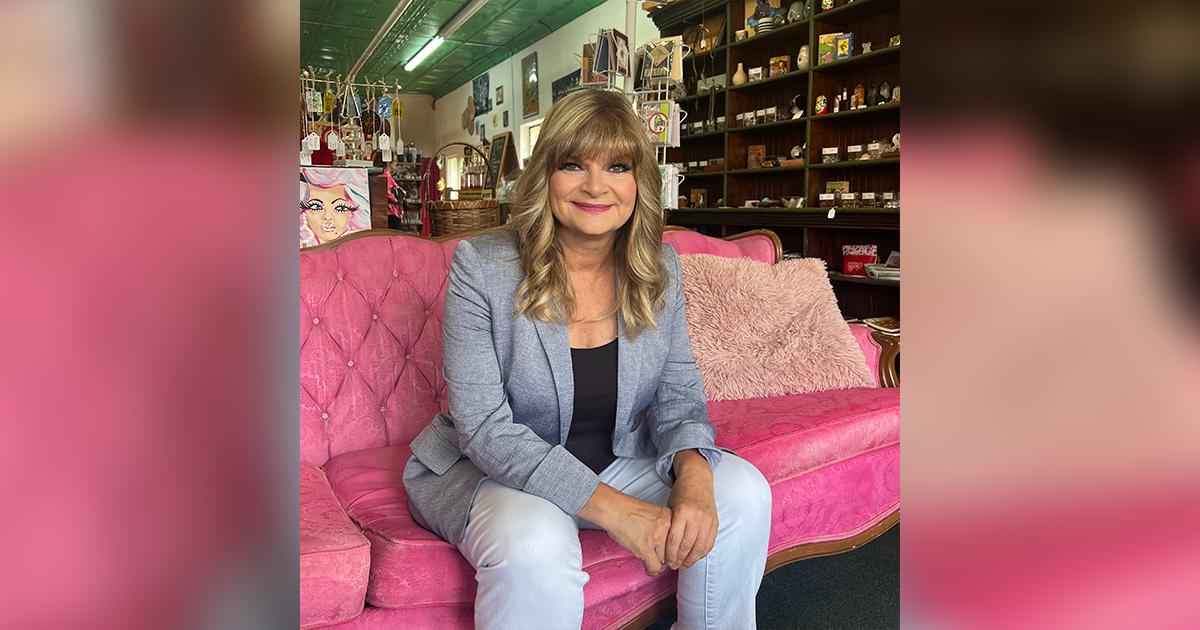
Cindy Baucom
Looking Forward
Cindy Baucom is a true visionary in the bluegrass world. She is the host/producer of the weekly syndicated radio show, “Knee-Deep in Bluegrass,” as well as “Stained Glass Bluegrass” for BluegrassCountry Radio, which also airs in syndication weekly. The western North Carolina native is also an emcee, musician, singer, songwriter, bluegrass music historian, and served two consecutive terms on IBMA’s Board of Directors. She was happily married to the late Duke of Drive, Terry Baucom. Now she is adding book author to her resume. A true entrepreneur, she is in the process of publishing a children’s book that she has penned with a specific purpose in mind.
Written from the Baucom family dog’s perspective, her book, Solomon Simon Dog Man Jack, describes in rhyming verse (much like a bluegrass song) living with a master who suffers from Lewy Body Dementia. The devastating disease attacked Bauc’s brain and eventually ended his life on December 7, 2023. Though it robbed her of the love of her life and best friend, instead of accepting the role of grieving widow, Cindy looked forward and decided to turn a negative into a positive. The result is a little book with simple text that addresses a complex subject that is destined to do big things. It begins:
This is a story about my friend and me
And a dreadful disease he didn’t foresee
He had retired as a traveling musician
When his doctor revealed he had a condition
He needed a pet as his memory was fading
At the animal shelter, I was there waiting
Cindy found it therapeutic. “(Writing the book) helped me focus my grief into something positive. “I want to raise money for Lewy Body Dementia research and animal shelter adoption.” Cindy outlined her reasoning for tackling this new venture and the history behind it. “Last summer I was in a really dark place, while walking the dog I would think, ‘What can I do to channel my grief?’” She had an epiphany.
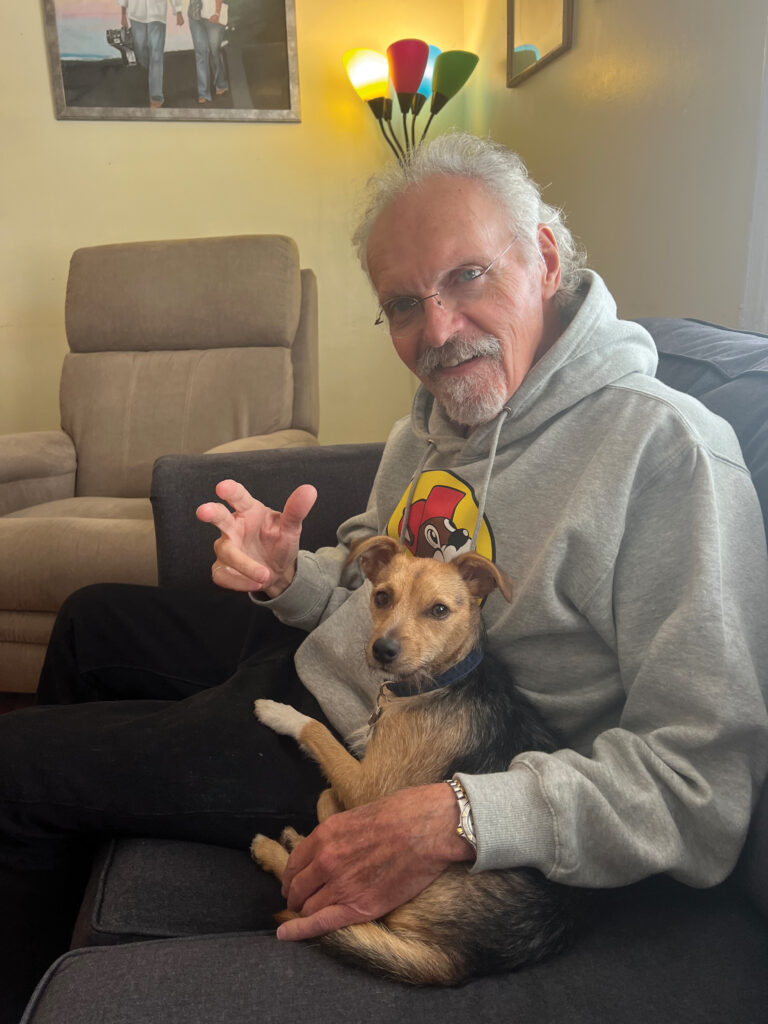
“Terry and I had always owned dogs. The last one passed away a couple of years before his diagnosis and we had just never gotten another dog. After his diagnosis, he started saying, ‘I would really like a dog. I think it’s time that we get a dog again.’ It proved to be a good idea. We visited shelters and found the most loving, nurturing little terrier. He was exactly what Terry needed.” Initially named Solomon, the terrier became Terry’s constant companion.
“As Terry’s disease progressed, he kept forgetting his name so he renamed him a bunch of times. That is what I decided to base the book on.” She shared a particular incident. “One time Lou Reid came to visit Terry. This little dog is a jumper. If he is flat-footed, he can jump up to my shoulder. Lou said, ‘Terry, that dog must have some Jack Russell in him the way that he can jump.’ Terry looked at him and said, ‘Jack would be a good name for him.’ He would come up with different names.“
Once the budding author had the idea, the story began to develop over the course of several weeks. She would get out her phone and document her thoughts. “I might go several days without thinking about it. None of it was in order. One night, I couldn’t sleep, so about 3 am, I got out my phone and thought, ‘I wonder if I could arrange this in an order that makes sense and turn it into a children’s book?’”
She is still in the process of acquiring an illustrator, establishing timelines, and publishing. While visiting with Ricky Skaggs at a festival a few months ago, she explained what she was working on and welcomed input from Terry’s former Boone Creek band mate. “When I shared it with Ricky, he said he wanted it for his grandkids. ‘I want them to know Terry was my friend and we played music together.’” Skaggs offered his assistance. So Cindy inquired, “Would you write a foreword about Terry and your relationship? It will help people understand him a little more if they’re not as familiar with him.
A smart business woman, Cindy formulated a plan. “I really want this to be on a big scale. If I can get this widely distributed in major book stores, school libraries, waiting rooms in doctors’ offices and hospitals, I think my long term vision of awareness to the disease and the importance of animals as support can be achieved. I learned that after Robin Williams committed suicide, his autopsy revealed that he had Lewy Body Dementia. His wife later released a documentary about his life and became chairman of the Lewy Body Foundation. I am setting my goals really high. I want to connect with her. If this book can help other families down the line that are dealing with similar situations, that’s what I want to do. I want it to make an impact.”
Cindy has truly taken lemons and made lemonade, putting a positive spin on something that was so devastating in her life. “Because of a deep faith that I’ve had all my life, I realize things happen for a reason. It’s all in God’s overall plan. I can’t understand why or the timing of it all. I can’t change it, but what I can do is try to do my best everyday to make that situation into something that Terry would be proud of.
“It was a challenging time, but it was an honor to get to take care of him. When I look at our life together, I try to just be very grateful for the 23 years we were together. Instead of focusing on the loss, I focus on the great years: the travel we got to do, the music we got to produce together, the interests that we shared. I loved his laid back, non-confrontational attitude. He was just the most super cool human being. Even though I have been heavily involved in the music since I was a teenager, when Terry and I became a couple he increased my ‘cool factor’,” she laughed. “He helped deepen connections in the bluegrass community. We enjoyed the same things and were raised so similarly. Even though he was 13 years older than me, we had so many things in common. He never wanted drama. It was really easy to be married to somebody like that.
“Thinking back on all his travel and dedication to his music, to think, even though I had three children under the age of 10, he wanted to marry. He took on the whole tribe and it worked out beautifully. His friends would say, ‘You are so lucky that Cindy supports you.’ Terry would agree, ‘You’re right! She’s pushing me out the door, saying this is what you’re meant to do.’”
Cindy was supportive because of her own upbringing and passion for music. “Growing up in Ashe County which is the very northwest corner of North Carolina, bordering both Tennessee and Virginia, that area was rich with music. I assumed everyone had a childhood like mine. Music was so much a part of everything. My dad (Jim Brooks) built instruments and played music. There were rehearsals and jam sessions at the house, music in church and nearly every aspect of social life in the mountains. Music was such a big part of everything.”
Her dad instilled in his daughter that music is less about notes and lyrics and more about the bond it creates with others. “At eight, I started piano lessons. When I learned to play basic hymns, our church needed a piano player so I started playing for the congregation and choir when I was around 12. In fifth grade, I started playing saxophone in the school band. By seventh grade, we could audition for the high school marching band. I was one of three students who were moved up to that level.
People in high school just didn’t understand my passion for bluegrass. To have the ability to read music and the music theory experience really helped me transition into learning to play guitar and move into a band situation with my dad. He was showing me chords on the guitar. I would do a few songs with his band, then they needed a bass player.”
Cindy’s dad borrowed a bass for her to try. “I loved it,” she fondly recalled. “It was a great old Kay, but it had cat gut strings that were unraveling. I played until my fingers literally bled.” That was proof enough to her father that she was devoted to the instrument. He bought her a 1947 Kay bass from Herb Key in North Wilkesboro. “Dad got me that when I was 15 years old and it’s still the bass I play today, even though opportunities as a bass player are not as frequent as they once were.”
Cindy also began working at the local radio station. She started at WKSK in West Jefferson as a teenager. “I did a live bluegrass show for three hours every Monday and Tuesday called ‘The Bluegrass Spectacular’ my senior year of high school.” Following graduation, Cindy worked full-time with the radio station during the day and attended Wilkes Community College in the evening. In 1988, she moved to WKBC in North Wilkesboro, and then in 1996 to WFMX in Statesville, a much larger 100,000 watt station that reached from Hickory to Charlotte and beyond. She worked continuously to provide important facts about the artists and the tunes. “I wanted it to be entertaining, but educational, too. There’s such a big variety of bluegrass sounds. I want to play things that will really catch the ear of the listener.”
Cindy’s life got busier. “It seemed everything happened in 2003. It was a very big year. Terry proposed in February at Bluegrass First Class. We got married on the first day of spring in March. My (radio) show went into national syndication and Doyle called Terry to come back to Quicksilver.” Her radio career really expanded when Knee-Deep in Bluegrass went into syndication. That occurred when Terry’s banjo student, Ed Lowe, offered Cindy the opportunity. Her dedication to bluegrass music impressed him.
“Cindy grew up in and around bluegrass music. And from those beginnings she has made it her life’s work to not only participate in, but to promote the genre like no one else I have ever known. A tenure on the IBMA board, an IBMA award’s show producer, a highly sought after festival MC, a highly regarded singer, and a multi-award winning host of an award winning weekly syndicated bluegrass show, ‘Knee-Deep in Bluegrass.’ These are just a few of her accomplishments over the years. You name it and Cindy has probably done it, or continues to do it, and all at a very high level. Her encyclopedic knowledge of the roots of the music and her love of the new and cutting edge artists helps to keep its history alive and paves the way for its future. Thanks, Cindy. It has been a privilege to call her one of my close friends for many, many years,” shared Ed Lowe, CEO, John Boy & Billy, Inc.
Doyle Lawson, Terry’s former employer, stressed, “Cindy has music deeply embedded in the core of her being and if one is around her for any length of time it becomes quite obvious. In addition, she possesses an understanding of the business side of music that is essential to success. Truly a remarkable lady! It’s not just words of false accolades, it’s the truth.”
Wes Golding, Bauc’s former Boone Creek band mate, praised her work. “Cindy has been a dear friend of Trudy and me for many years. As a lot of you know, she has done a great job getting bluegrass music out on the airwaves for a lot of folks to hear.”
Founding member of Quicksilver with Terry, Lou Reid, touted. “Cindy Baucom is a great bluegrass deejay, friend to all, and even a better person! I’ve known Cindy for a very long time. One can’t have as many syndicated radio shows if they’re not an entertaining radio personality! And…she really knows the music! I’ll cast my vote for Cindy being the radio DJ of the Year!”
Cindy definitely has racked up quite a list of accolades, earning IBMA’s Broadcaster of the Year award three times (2005, 2017, 2024). In 2012, Cindy Baucom was inducted into the Blue Ridge Music Hall of Fame. In 2024, she was awarded IBMA’s Distinguished Achievement Award. Multi-faceted, this busy lady works in other areas that she hopes will continue to flourish. “I love emceeing music festivals. I would love to be on the production team of larger events and get on some red carpets interviewing people leading into the CMA or ACM awards. It’s a lot of relying on friends over the years, colleagues, and people you admire. They recognize that you still have something to offer. Don’t be afraid to ask for help to get to that next level.”
Festival promoter, Cody Johnson, sought her expertise in 2019. “Cindy was the first person we called to emcee when we brought back Camp Springs and it’s been a pleasure working with her. She is so professional and knows everyone. She is truly more than just an emcee to us, we wouldn’t be where we are without her and her knowledge.”
Another venture occurred when Cindy created the Terry Baucom Education Grant through the IBMA Foundation last year. “That’s something else that I am so proud of that his name and legacy can live on. Immediately, even when his obituary information was being written, I knew I wanted a statement in there about memorials to the Terry Baucom scholarship fund. In seeing how the most good could be done with those funds, I talked with the IBMA Foundation.
“Instead of calling it a scholarship, I wanted it to be broader. I didn’t want an age limit and I didn’t want it to necessarily be used for tuition. If a kid wants to go to a bluegrass camp or take private lessons from a professional, we made it an education grant so that it could help all ages. Terry was always such a professional. I knew that he would want to help people get to the next level whether that meant getting better on their instrument, upping their wardrobe, or having a better quality instrument. Terry played multiple instruments so I didn’t want it to just be for banjo players. I wanted it to be for any instrumentalist or vocalist wanting to improve their craft. I’ve really been touched with all the donations through the IBMA Foundation to his educational grant. I thank people for donating in Terry’s memory and keeping his legacy alive so that bluegrass can continue to thrive and grow.”
Grants are awarded annually. Anyone interested in donating or applying for a grant can visit bluegrassfoundation.org.
Being a female in male-dominated fields often proved challenging for Cindy. She was confronted with some difficulties, particularly in radio.
“It was a mix of being a female and having a love for bluegrass. A lot of the program directors on country stations would say, ‘You pick too many songs with fiddle and banjo on them.’ It’s been a real struggle, but on the other hand, there were people that treated me like one of the guys. I really appreciate the fact that I got to interview Bill Monroe when I was 18 years old.
“To be accepted, you have to continue on the path that God designed you to do. If you stay the course, God’s going to put people in your path to help you. It’s been quite a journey. I believe that life begins one step out of our comfort zone. After losing Terry, I’ve really had a chance to refocus. Even though ‘Knee-Deep in Bluegrass’ is stronger than ever and now with the children’s book and other things, I keep asking myself, ‘What do you want to do that is different that will challenge you career-wise?’
“I like promoting the music in a positive way because the landscape of bluegrass is changing. I think there’s always been a continual change in sound and subject material. When songwriters are writing new bluegrass songs, the content will be different because we’re not all living in little cabin homes on the hill. Time moves on.
“In order to honor the roots of the music, I look at it like a tree. In order for the roots to thrive, you have to allow that tree to grow and branch out. If you keep cutting off limbs when you think something doesn’t match the roots, the roots are going to die. Allowing it to branch out, the roots are strong. When Terry was growing up, he admired Earl Scruggs, J.D. Crowe, Sonny Osborne, and Don Reno. Then Terry influenced a generation of players. The modern generation of pickers are taking the music to so many exciting places with Molly Tuttle, Billy Strings, and others like them. You know they have a deep affection for the roots of the music, but they are able to expand it a little more to catch the ear of a new generation. I love that! I feel like in terms of age, I’m right in the middle of it.
“Mike Bub and I recently had this conversation. I said, ‘Isn’t it great to be where we are in the music? We got to meet a lot of the early pioneers, the first generation players. We got to be acquainted with Jim & Jesse, the Osborne Brothers, Ralph Stanley, Jimmy Martin, and Flatt & Scruggs, but we’re also seeing what the young artists of today are bringing to the table and we’re right in the middle of it. We can look back at all that history and look at what’s going on today and just hope the future is going to bring more fans to the music and more opportunities for people creating the music.’ If I can have a small hand in any of that, I will be a happy person.”
Reflecting on her life’s path, Cindy remains content with her choices. She said, “Ironically, I was going to dabble in radio until I figured out what I was going to do with my life. Now it’s 42 years later and I’m still doing it. The beauty of it is knowing early on that you could do something you enjoy and earn a decent living.” Both Baucoms were successful.
“Terry Baucom was able to play bluegrass, work in the studio, and teach music from the time he graduated high school and made a very good living at it. It can be a very rewarding career. Every challenge has been worth it. The future is bright because of people who work together. I feel I am such a small part of what is taking place in the music industry, but so thankful to be able to contribute a little bit if it elevates the music to a more professional level for recognition or brings more people to be listeners, players, or creators. If I get to be involved, I am really thankful.
“Enough time has passed that when I think of Terry, I think about who he was and his personality. I don’t think about those last years of his cognitive decline. I smile when I think about him in his true self and leave the challenging times behind. It wasn’t a steady decline, it was this roller coaster of up and down. That was just a brief snapshot in our relationship. He was a such a positive force in my life.
“One thing that I am thankful for is that Terry had a real moment of clarity just a few days before he passed. He was home in the hospital bed from Hospice. He opened his eyes and said, ‘Cindy, I’m so lucky. Because of music, I got to travel all over the world and I got to see so much of it. I made so many friends because of music. A lot of people don’t get to do that, but I did.’ To see him look back on his life with such gratitude, really gave me a lot of peace. His mother was sitting beside his bed and got to hear it, too. God knew we needed it and gave us that.
“Even when he became unresponsive, a song by Doyle Lawson & Quicksilver came on the radio he was on and his three fingers started rolling! In those last days, I got to talk to him a lot and he’d squeeze my hand. A lot of folks don’t get that in the end.” Her book (from the perspective of the dog) concludes with:
Even though he had to go and I know he can’t come back
He gave me a home and I am proud to be Solomon Simon Dog Man Jack.
And Cindy Baucom is moving forward. “I get up in the morning and I’m excited about what the day will hold. I feel like there’s no limit to what can be achieved. It’s fun to imagine the possibilities and then figure out the steps that will get me there. I want to continue promoting the music.”