Memories of Nashville
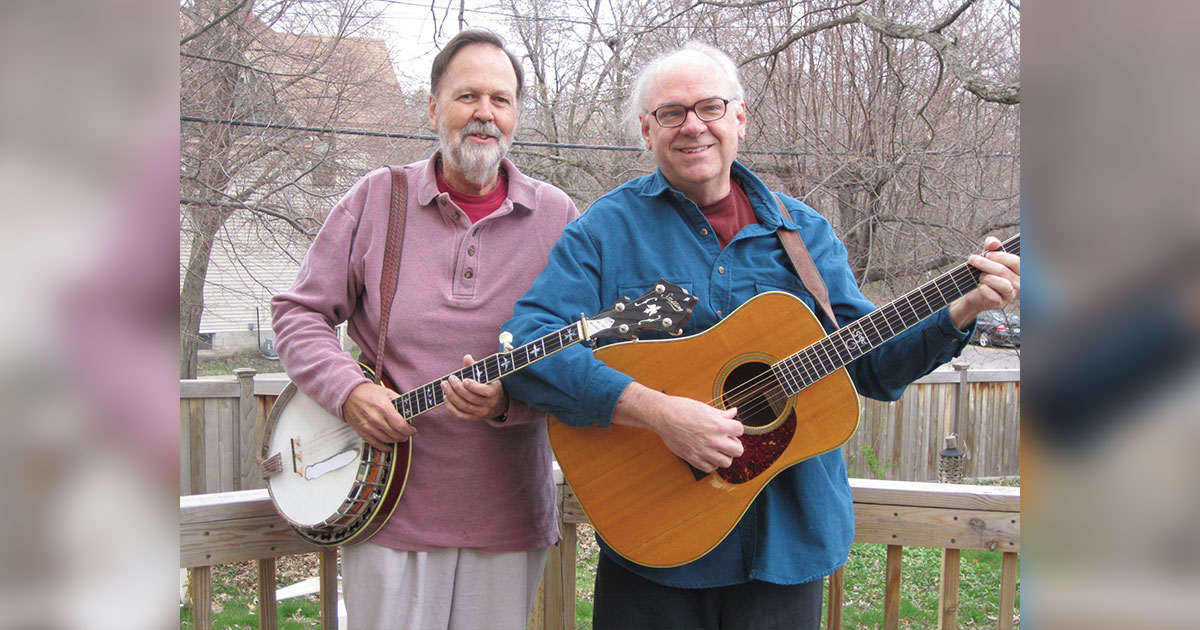
Adam Granger is a guitar player from Norman, Oklahoma who lives in St. Paul, Minnesota. He learned banjo from fellow Normanite Alan Munde in 1968. He was a columnist for Flatpicking Guitar Magazine, and is the author of Granger’s Fiddle Tunes for Guitar, published by Mel Bay. Adam played and wrote humor for A Prairie Home Companion throughout its forty-year run. Most recently, he has toured with Alan Munde as a duo. His first contribution to Bluegrass Unlimited was a cover story about the Viennese bluegrass band, the Bluegrass Specials, in February, 1969 (Vol 3, No 8).
PART ONE: Nashville Life
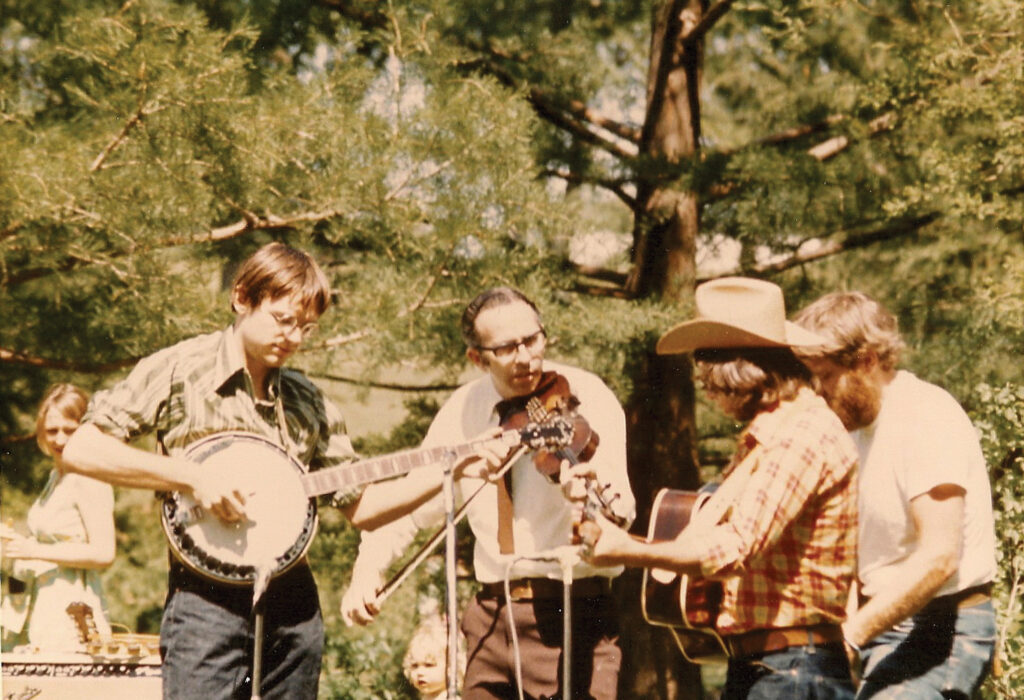
In 1971, I was playing banjo and guitar in a country music theater at a now-defunct theme park in the Arkansas Ozarks called Dogpatch, USA. As the end of the tourist season approached, my friend, John Hadley, contacted me from Norman, Oklahoma, saying he was going to Nashville to try to sell songs and suggesting that I join him there. John had been my printmaking professor during my short stab at being an art major in 1970. He flunked me, thus transforming me from struggling artist to struggling musician, and we became lifelong friends, remaining so until his death this year.
So it was that, in late summer of 1971, I drove from Mt. Sherman, Arkansas to Nashville, Tennessee, in my 1964 Volkswagen beetle.
For $85 dollars apiece, Hadley and I rented both sides of a duplex at 208 Rayon Drive, in Rayon City, the old factory town for the DuPont plant on the north side of town. Purely by coincidence, our Norman friend Alan Munde and bassist Gloria Belle, then both playing with Jimmy Martin, lived in a rooming house three houses away, at 202 Rayon Drive. 208 has a nice porch with iron railing around it, and the four of us would occasionally sit out there and sing old standards. I furnished my apartment with a cable table, a cheap record player, a waterbed and a toaster oven.
It’s impossible to imagine this in today’s world, where Nashville’s Music Row publishers are smothered with unsolicited songs from an unending army of singer-songwriters but, as you approached Nashville from the west on Interstate 40 in 1971, there was a billboard put up by Tree Publishing actually inviting songwriters to submit their songs. As I mentioned, John had come to town to sell his, so he called Tree and made an appointment. I tagged along, and witnessed a scene that could have been yanked right out of a country music biopic: John walked in with his guitar and was ushered into a small office by Jack Grady, a Tree executive, who sat behind his desk and clasped his hands behind his head and said, “Whatcha got?” John pulled out his guitar and played him a song. Grady, right on the spot, said, “We’ll take it. What else you got?” John played—and Grady accepted—several more songs in this same manner that day, and he was on his way. (That first song was Rings for Sale, which Roger Miller recorded).
He turned down an offer to be a staff writer for Tree, which paid about $125 a month; he valued his free agency, and he didn’t need the money because of his sabbatical pay. In the following fifty-four years, Tree—now Sony Tree—would publish over 900 John Hadley songs.
As for me, I had hopes of getting music work—a gig. Any gig. I was lucky enough to play a couple of dates with Doug Green, pre-Riders in the Sky, who was disappointed (and rightly so!) that I didn’t know any Sons of the Pioneers songs. And, Hadley and I would sometimes play at a coffeehouse called The Mucky Ducky, and at a bar whose name neither of us can remember, but that was about it for gigs for Adam. I was a young, green kid with essentially no Nashville connections who didn’t know as much as he thought he did and who wasn’t as hot a picker as he thought he was. What did I think was going to happen?
Doug, down from Michigan, worked at GTR, the legendary music store owned by George Gruhn, Tut Taylor and Randy Wood. They had prewar Martin D-28s galore, and vintage Les Pauls were $800. Randy Wood would inlay a Tree of Life on your guitar neck if you had $275 to spare. An index card tacked to the wall by the door said, “Guitar Lessons, $5.00, Norman Blake,” with a phone number.
Seeing as how bands and studios weren’t exactly knocking my door down, I took a job as day shift manager of a Pizza Hut located on a rough stretch of Dickerson Pike. Every single employee there except the manager was a music wannabe: singers, songwriters, players. We could have started our own band (and, in retrospect, I’m surprised that we didn’t). One waitress from Georgia carried a little nickel-plated pistol in her purse which she had used to shoot a man who had, drunkenly, accidentally invaded her apartment a couple of years earlier. (It turns out he was on the wrong floor. Oh, boy, was he ever on the wrong floor.)
There was a string of business burglaries along Dickerson during that time, so the manager slept for a while on the floor of the Hut—we all called it the Hut—with a hunting rifle at his side. Thankfully, he never had occasion to use it. I remember that I would make a lot of deliberate noise and announce myself loudly when I would open up the place in the morning so he wouldn’t shoot me by mistake.
A group of five or six redneck hippie carpenters would come in every afternoon after work and drink copious amounts of beer. I got along fine with them but, one day, they got into a brawl out in the parking lot with the staff of the restaurant next door about who-knows-what. They came running into the Hut all sweaty, torn and bloodied and sat down and tried to look and act normal. The Nashville police came charging in a few minutes later and rounded everyone up to take them in—including me! Fortunately, the others vouched for my innocence and I was released back to my Hut.
Not all of my experiences at the Pizza Hut were so dramatic. James Monroe would occasionally come in for lunch with someone who looked like his manager. The Hut had an eight-track cassette deck which played throughout the establishment, and I would always put on one of my Bill Monroe eight-tracks when they were there. (I, along with seemingly half of the rest of the country in 1971, had paid $79.95 to have an eight-track system installed in my car, and I had a modest collection of bluegrass eight-tracks.) I would have played James Monroe and The Midnight Ramblers, but they hadn’t released an album yet, so dad was the closest I could get.
And, one night, Roland White came in for a carryout pizza, my first time meeting him (although I subsequently taught at a number of music camps with him). As his pizza got colder and colder, I held him captive, gushing over his career, starting with his time with the Kentucky Colonels. (I, along with many other bluegrass fanatics, had reel-to-reel dubs of their 1960s Ash Grove recordings, none of which had yet been officially released.) Due, perhaps, to my over-the-top enthusiasm, he still remembers the meeting. And, I certainly do.
One day, Alan and I drove over to Conway, Arkansas to pick up a Gibson Southern Jumbo I had lent to a friend while working at Dogpatch. Alan reminds me that, on our way back, my headlights failed, and we drove the last twenty miles in the dark using only my right turn signal for illumination. Oh, and the seat back on the passenger side broke along about West Memphis, so Alan had to sit hunched forward hanging onto the dashboard. Other than those impediments, it was a nice little day trip.
PART TWO: My Bestest Ever Bluegrass Day!
I’m going to make the obligatory stipulation here: this is my memory of events that happened half a century ago. I’m going to bet that there are BU readers who attended these events, and who might remember them differently than I describe them here. I welcome corrections!
In 1971, the annual DJ Convention had a Friday show called the Early Bird Concert at the Ryman (Opryland was being built but was not yet completed). It featured pretty much all of the dozen-or-so groups making a living playing bluegrass at the time. Alan was to play with Jimmy Martin on this show—one of his last gigs with him—and came over to my apartment to change strings and warm up. “Warming up” consisted of Alan putting on Jimmy Martin’s Big and Country Instrumentals and playing along with it, duplicating every banjo fill, lick and solo on the album. (Martin always told him to “play it like J.D.”) Witnessing that feat was a show unto itself.
We then drove to the Ryman where, backstage, he introduced me to John McEuen, who was in town with the Nitty Gritty Dirt Band recording the now-legendary triple album, Will the Circle Be Unbroken. I sat with McEuen during the show, and he couldn’t have been nicer to me, a young, snot-nosed nobody. As the bands played, he regaled me with stories of working in the studio with many of the musicians we were watching. No one knew at the time how significant “The Circle Album” was to become, so I didn’t quite appreciate the, well, historic, nature of this experience. Nevertheless, I hung on every word, fascinated by what he had to say about his dealings with the musicians.
And what musicians! In one afternoon, I, who had never seen a name bluegrass band live in my life (but who had all of their albums), saw Bill Monroe, Lester Flatt and the Nashville Grass, The Earl Scruggs Revue, Jim and Jesse, Jimmy Martin, The Osborne Brothers, Ralph Stanley (with 16-year-old Keith Whitley and 17-year-old Ricky Skaggs), Don Reno and Bill Harrell, and The Country Gentlemen (doing their famous slo-mo Cripple Creek). And, all of this with color commentary by John McEuen, while sitting in the Ryman Auditorium. That is, as they say, as good as it gets. Or is it?
Afterward, Alan and I went over to the old Noelle Hotel, where, spread out over two floors, bluegrass bands and musicians had what would now be called hospitality suites but which were, in 1971, just hotel rooms. You could go from room to room and hear the most amazing sounds and discussions. I wandered into Mac Martin’s room; he had a tape recorder and a mike set up and was recording pretty much whoever came into his room. Despite my assurances that I was a complete unknown and an idiot, he invited me to record a song and handed me a D-45, the first one I had ever held and only the second one I had ever seen. I don’t remember what I played, but I remember breaking an A string. (How do you break an A string?!) A stern-looking man in a Stetson came into the room. I asked if the guitar was his and he said, “Nah, I don’t play one of them things.” It was Kenny Baker (and, of course, as recording history tells us, he absolutely did “play one of them things.”) Mac Martin remained, until his passing in 2022, a real gentleman.
That same night, we went to Earl Snead’s Bluegrass Inn, a little place at Lyle and Broadway where, as Alan reminded me when we reminisced about this, you always felt like you were in a basement, although it was on street level. (This wasn’t my first trip to the Bluegrass Inn: I had gone there a couple of weeks earlier to hear Scotty Stoneman.) Formerly a laundromat, it had minimal windows and white cinder block walls.
There, I witnessed what I’m going to say was the first performance by the Newgrass Revival, although they weren’t yet calling themselves that. Until shortly before this show, Tony Rice had been playing with Sam Bush, Courtney Johnson and Ebo Walker. Along with Lonnie Pierce, they had been the Bluegrass Alliance and after Pierce’s departure they had been playing as a quartet. Then, in late summer or early fall, Rice left, to play with J. D. Crowe, and Curtis Burch joined. I have asked both Bush and Burch about this, and both are pretty certain that this was in fact their first gig in the Newgrass Revival configuration.
Oh, and did I mention that Norman Blake sat in for a set?
This day had started at about nine a.m., and my head crashed onto my pillow at about two the next morning. I slept like Heracles after his twelfth labor.
PART THREE:
Alan left Jimmy Martin in October of 1971, shortly after the Early Bird Concert, and was playing casually with Roland White and others around town, augmenting with some substitute teaching. He was what we musicians call “at liberty.” Doug Green called him and told him that a road hog named Chance Fallon was up in Fort Dodge, Iowa and was in need of a guitar player, having fired his former one for excessive drunkenness. Alan was fixing to take the job when he got a call from Byron Berline asking him if he’d like to do a tour of Europe with an incarnation of The Flying Burrito Brothers.
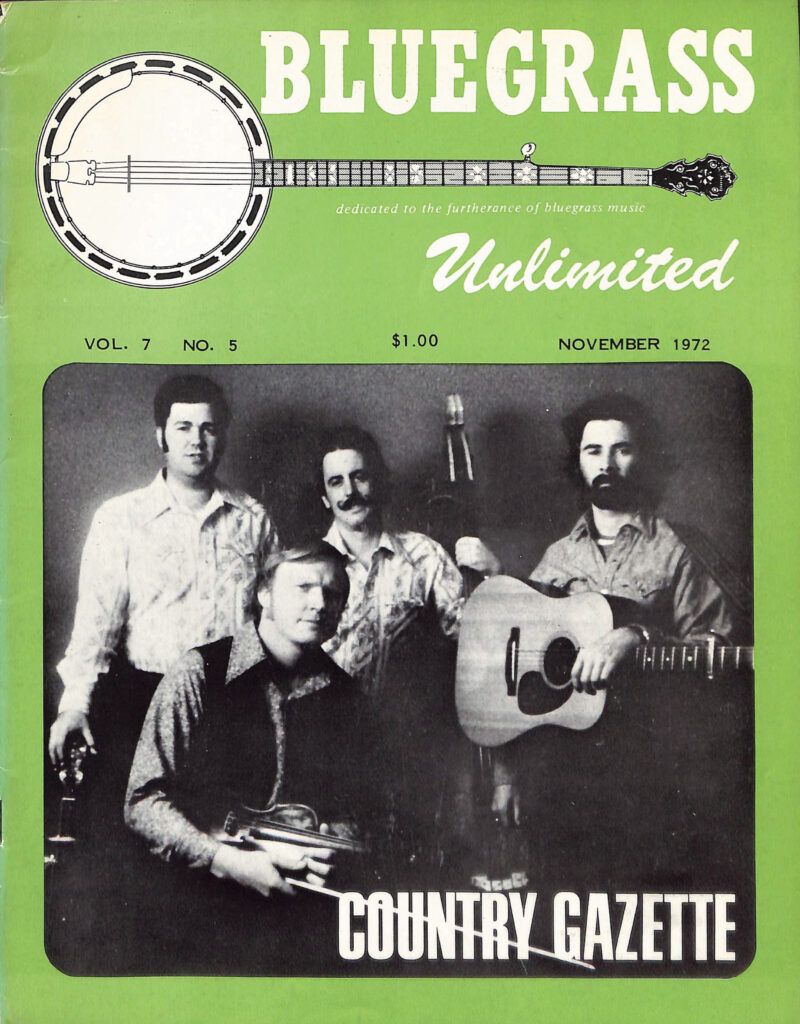
He was torn between taking the road gig and doing the tour…just kidding! He jumped—no, leapt—at the opportunity Berline presented. That band consisted of Alan, Byron Berline, Roger Bush, Kenny Wertz, Rick Roberts, Erik Dalton and Don Beck. Astute readers will recognize those first four names as the makeup of the original Country Gazette, which was to form in Los Angeles the following year. At any rate, that left the Chance Fallon position unfilled, so I said goodbye to the Pizza Hut and took the job. I had a gig!
Chance Fallon was an old-school country singer/comedian who used the stage name Marvin Muffknuckle. For $150 a week plus room, I became part of the Marvin Muffknuckle Revue, playing electric and acoustic guitar and banjo and acting as straight man. Initially, we played four sets a night six nights a week, but he called a band meeting one day and said, “Boys, I’ve got great news! We’re going to add an hour at the start of each night and let you guys play whatever you want!” In other words, we—the band, not him—were going to be playing an extra six hours a week for no extra money. Well, at least our pay wasn’t docked.
Times change. Today, bars will have four bands play on a single night but, in 1971, touring bands would book into a venue for extended stays. All of our engagements were one-to three-week stands: the Best Western Motel lounge, in Ft Dodge, Iowa; The Hon-Dah Lounge, in the Virgil Lips Hotel, in Miller, South Dakota; the Starlight Inn, in Marshalltown, Iowa; The Holiday Inn, in Pierre, South Dakota; and on and on. In this pre-cable, pre-internet, pre-VCR era, people had to leave their houses to find entertainment and, when the Marvin Muffknuckle Revue was in town, we were it. The same customers would come into the same venues night after night to watch the same band play the same songs and listen to the same comedian do the same bits while drinking the same drinks, eating the same food, and laughing at the same places at the same jokes. That was entertainment in the ‘70s.
Once a set, I would pull out my Fender Artist Model banjo and play a couple of Scruggs standards and bring the house down. This isn’t braggadocio, but rather confirmation of Steve Martin’s maxim: “Everybody loves a banjo.”
We went from town to town like carnies, and we were never home, so I finally gave up the apartment on Rayon Drive. Hadley emptied my waterbed and put my cable table out on the curb.
I mailed in my keys, and my Nashville experience was over.
POSTSCRIPT:
What happened to Adam Granger? And, more importantly, what happened to Chance Fallon?
After leaving Chance Fallon, in 1972, I moved back to Norman and formed a band, The Upper Middle Grass, with Dick Nunneley on mandolin, Ken Landreth on banjo and Bob Cuadrado on bass. In 1974 I moved to Minnesota, where I wrote humor for Garrison Keillor and played in the Powdermilk Biscuit Band, the first house band for A Prairie Home Companion.
In between stints with him, I emceed festivals and concerts; taught at music camps (including Camp Bluegrass, in Levelland, Texas and Steve Kaufman’s Flatpick Kamp); and worked in duos with Dick Nunneley (as The Eclectic Brothers), Dick Kimmel, Bob Douglas, Pop Wagner and Alan Munde. I’ve recorded sixteen albums, including Twin Picking with Dudley Murphy, in 1978, which was the first twin flatpick album, and Dapple Patty with Alan Munde. I married a Minnesota wife and have a couple of Minnesota kids and two Minnesota grandchildren. At age 75, I have stopped major touring, contenting myself with local and regional gigs and giving guitar lessons.
And Chance Fallon? I lost track of him for decades, until I heard that he had settled in the tiny South Dakota town of Dallas. As luck would have it, four years ago, I had occasion to play a gig with Pop Wagner on a centennial farm about ten miles east of Dallas, so we drove over and asked around about Chance/Marvin. A couple of people remembered him, and told me that he had owned a nightclub there called Muffknuckle’s Outhouse. (The building still stands, but is now, er, a place where certain people take off items of clothing.)
The consensus was that he had lost the nightclub in a poker game which, no offense intended, sounds a lot like him: It brought to mind the time, somewhere in Iowa, that he spent all of the band’s salary on a bunch of shotguns, rifles and pistols because a gun store owner who came to hear us play “made him a good deal.” His wife was as unhappy as the band, and there was more than a little talk of using one of those guns on him, but nobody did, and he did pay us double the following week. At any rate, he dropped out of sight after losing the bar, and I heard that he died about twenty years ago. Notwithstanding his shortcomings, old Chance Fallon/Marvin Muffknuckle was a good fellow.