Skip to content
Register |
Lost your password?
Subscribe
logo
  • Magazine
  • The Tradition
  • The Artists
  • The Sound
  • The Venue
  • Reviews
  • Podcasts
  • Lessons
  • Jam Tracks
  • The Archives
  • Log in to Your Account
  • Contact
  • Subscribe
  • Search
  • Login
  • Contact
Search
  • Magazine
    • Current Issue
    • Past Issues
    • Festival Guide
    • Talent Directory
    • Workshops/Camps
    • Our History
    • Staff
    • Advertise
    • Contact
  • The Tradition
  • The Artists
  • The Sound
  • The Venue
  • Reviews
  • Podcasts
  • Lessons
  • Jam Track
  • The Archives

Home > Articles > The Tradition > A Fresh Look at Crockett’s Kentucky Mountaineers

Crockett-Feature

A Fresh Look at Crockett’s Kentucky Mountaineers

Jon Hartley Fox|Posted on February 1, 2025|The Tradition|No Comments
FacebookTweetPrint

The histories of old-time country music are pretty clear on the subject: everything important happened in the southeastern part of the U.S. Except it didn’t. The music was everywhere. In fact, one the most popular and celebrated old-time stringbands of the late 1920s and early 1930s came out of California. 

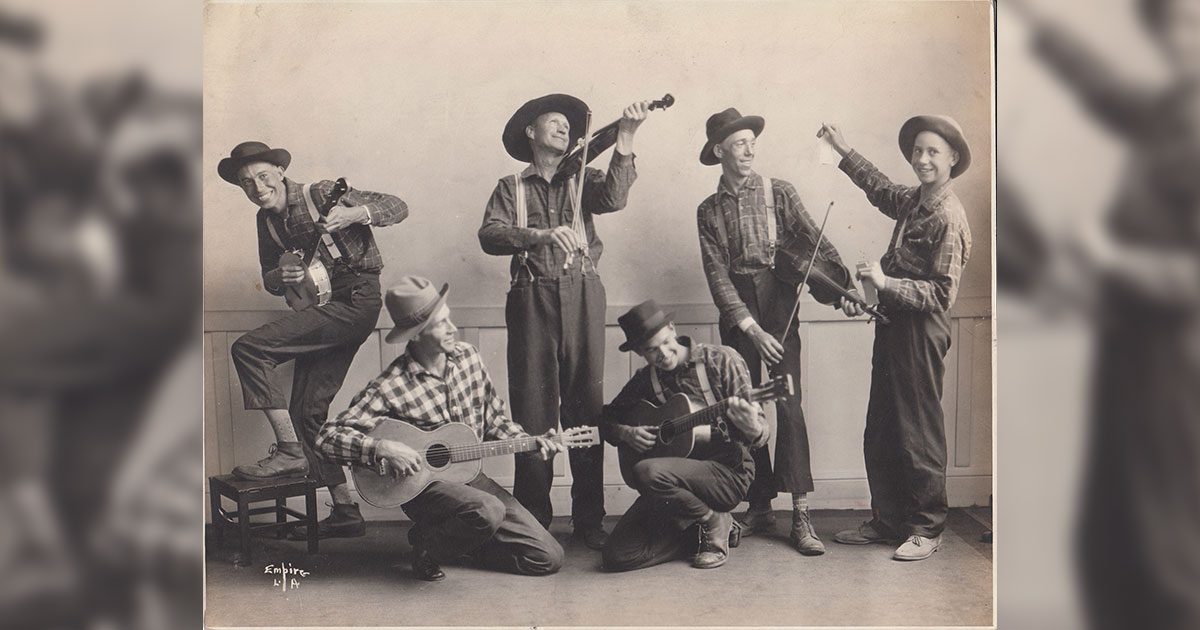
This band toured widely on a national basis—performing in 47 different states—had a weekly radio broadcast that was heard coast to coast and has been called “California’s first country-music stars.” The group consisted of John Crockett and his five sons: George. Clarence, Johnny, Albert and Alan. They were known as Crockett’s Kentucky Mountaineers.

John Harvey Crockett (1877-1972), the patriarch of the family, was born into a fiddling family in West Virginia. He learned to play the banjo and fiddle in his youth and would later travel by horseback or buggy from community to community through the mountains of West Virginia and Kentucky, teaching shape-note singing, banjo, fiddle, harmonica and guitar. He also bought, sold, and repaired musical instruments. In 1896, Crockett married Admonia Jane Patrick (1875-1952). Together they had eleven children, four of whom died in infancy.  

In 1918 (or 1919), the Crockett family upped stakes and drove some 2300 miles in their Model T Ford, from Sharpsburg, Kentucky, where they were living, to Fowler, California, where they settled. Try to imagine how arduous that trip must have been. John and Admonia Jane and their five sons—then aged three to 18—crammed into a Model T, which had a top speed loaded like it was of about 40 mph. Roads were iffy in those days and roadside services were few and far between. The family likely camped along the way and cooked meals as they could.

The Crockett family finally reached California and started driving north through the San Joaquin Valley. The Model T broke down outside Fowler, a small, predominantly Armenian town ten miles south of Fresno. John, who happened to be a good mechanic, walked into town to the Ford dealership and borrowed a few wrenches to fix his car.

Kent Crockett*, the 90-year-old son of eldest son George Crockett, picks up the story from there: “He fixed the Ford, returned the wrenches to the Ford agency, with his thanks, and proceeded northward on Highway 99.  After a few miles someone saw that a wrench had been overlooked, but had now been found. He turned the ‘T’ around—he was that sort of person—returned the wrench with apologies for the oversight, and was immediately offered, and quickly accepted, a job as mechanic. He was soon promoted to shop foreman, and held that job until he was lured away by show business in 1927.”

Promotional photo, KNX, mid-1930s. L to R: back row: Albert, Alan, George, Dad; middle row: third from left, Elnora; fifth from left, Admonia Jane; bottom row: sitting back-to-back, Johnny, Clarence

John Crockett built a house in Fowler, and the family thrived there. All of the Crockett brothers were talented and played instruments and sang, but Johnny was the most dynamic, talented and musically driven. He was performing on Fresno radio station KMJ as early as 1923, singing and playing guitar; the Fresno Bee referred to him as a “cowboy balladist.” 

Over the next couple of years, he gradually persuaded his brothers to join him before the radio microphone. He finally got his father, now known mostly as Dad, on board and Crockett’s Kentucky Mountaineers was formed. The band was also known as Crockett’s Family Mountaineers, the Crockett Minstrels and the Crockett Family Orchestra in the earliest days.

After a couple of years appearing on KMJ, the Crocketts moved to KNX in Los Angeles in 1928. A vaudeville impresario heard the Crocketts on KNX and promptly signed them to a 15-month national tour, as headliners, on the Keith-Albee-Orpheum vaudeville circuit—seven hundred theaters across the United States and Canada.

In one seven-month stretch during 1928-29, the Crocketts did twenty-eight consecutive weeks of week-long engagements in vaudeville theaters across the country. Headlining a bill of three or four other acts, the band performed in 18 different states in that stretch, in such major cities as Chicago, New Orleans, Denver, Pittsburgh, Cleveland, Nashville, Louisville, Dallas, Houston, Atlanta and Oklahoma City. 

A surviving 1928 contract from the Orpheum Theatre in Tulsa states the band would perform three shows a day, four on the weekends, for seven days, for which they were paid $1,000. If that engagement was typical, Crockett’s Kentucky Mountaineers were making big money in those days.

Because of their popular appearances on KNX, Crockett’s Kentucky Mountaineers were invited in November 1928 to make records for Brunswick, a leading company in the old-time field. At their first session in Los Angeles, the band recorded four numbers, “Medley of Old Time Dance Tunes, part 1,” “Medley of Old Time Dance Tunes, part 2,” “Hard Cider Song” and “Rosalee.” The two records must have sold decently, because the band was invited back twice. 

Four additional songs were recorded in Chicago in August 1929, “Fresno Blues,” “Sugar Hill,” “Kitty Ki” and “Bonaparte’s Retreat,” and a final two, “In the Shade of the Old Apple Tree” and “After the Ball,” were cut three months later in New York. All five of the records were issued in Brunswick’s “Old Southern Tunes” series.

The band didn’t record again until 1931, when it recorded 16 cuts for Crown Records, a budget label based in New York. Crown records sold for a quarter (instead of 75 cents for a front-line release), hence its slogan “Two Hits for Two Bits.” 

A few of the Crown recordings also appeared on other labels, including Homestead, Varsity, Montgomery Ward and Paramount, where they were issued (for somewhat dubious reasons) under such random nom du disques as Harlan Miners Fiddlers, Pete Daley’s Arkansas Fiddlers, Hale’s Kentucky Mountaineers and the Kentucky Kernals.

R. Crumb, from “Pioneers of Country Music,” Yazoo Records, 1983

The variety of their recording settings used for Brunswick and Crown reflected the Crocketts’ radio and vaudeville experience. They often recorded as the full six-piece band: John “Dad” Crockett (fiddle or banjo), George (fiddle), Clarence (guitar or harmonica), Albert (tenor guitar), Johnny (banjo or guitar) and Alan (bones or fiddle). On these cuts, mostly fiddle tunes, the band is energetic, well-rehearsed and together, a bit less raucous and a bit more modern than some of their contemporaries.

But there were also vocal solos, duets and trios; a guitar/tenor guitar instrumental duet; a solo banjo piece; and more. Johnny sang most of the lead vocals, though George sang “Sugar Hill” (some accounts erroneously credit Dad for the track) and eleven-year-old sister Elnora took the lead on “Skip to My Lou.” 

Many of the songs and tunes Crockett’s Kentucky Mountaineers recorded for Brunswick and Crown were old-timers that would be well known by record buyers of the day. Several dated from the 19th century, including such numbers as “Cripple Creek,” “After the Ball,” “Sweet Betsy from Pike” “Bonaparte’s Retreat,” “Granny’s Old Arm Chair” and “Skip to My Lou.” 

The brothers contributed quite a few original songs—among them “Fresno Blues” (written by Johnny) and “Rosalee” and “I Knowed I’d Settle Down” (written by George). “Fresno Blues,” an instrumental duet by Johnny on guitar and Albert on tenor guitar, is unlike anything else the Crocketts recorded. It’s a funky little blues tune and one of the coolest country guitar records of the 1920s. 

The recordings by Crockett’s Kentucky Mountaineers have never been widely (or completely) reissued. Six cuts are included on Yazoo’s 7-CD Mountain Music of Kentucky set. The most comprehensive job was done by the British label BACM about twenty years ago on a CD titled Classic Old Time String Band Music. The fascinating CD presents 19 cuts drawn from both Brunswick and Crown recordings.     

Because the Crocketts were based in California, the band never participated in the field recording sessions that record companies conducted throughout the region in the 1920s and early 1930s. Those sessions, which documented (and shaped) so much of the old-time music from the southeast, were supervised and controlled by record company talent scout-producers-gatekeepers like Ralph Peer, who “discovered” and recorded such greats as Jimmie Rodgers, the Carter Family and Fiddlin’ John Carson while working for Victor and OKeh.

The Crocketts were fortunate to record in Los Angeles, Chicago and New York, where they were able to record pretty much what they wanted. Someone like Peer—who had fixed ideas about what would sell and what wouldn’t and what was “appropriate” for an artist to record—would never have allowed the Crocketts such latitude and freedom in the studio. No way would “Fresno Blues” have seen the light of day. Without such constraints, the Crocketts recorded what worked for them on stage and on the radio, a wide variety of sounds designed to appeal to a wide audience.

After the Keith-Albee-Orpheum contract ended, the Crocketts relocated to New Jersey in May 1930 to work on WABC, the New York flagship station of the Columbia Broadcast System. The band was given a live fifteen-minute daily program at 7:00 pm Monday-Friday. It was a choice slice of radio prime time; the only problem was that it was up against Amos ’n’ Andy, the most popular program on radio, on NBC. Even so, the Crockett’s blend of old-time music, cornball humor and novelty songs was a success, and the program lasted into 1932. The band also performed on vaudeville shows in the area and at such country music venues as the Village Barn.

 A radio critic from the Brooklyn Eagle was impressed by his first hearing of the band, writing “Listening to their debut last night on WABC and Columbia, one might well believe that their nightly feature will be one of the most popular programs on the air…They will add immeasurably to the charm of radio.”

The Crockett family made its contribution to radio celebrity weirdness when Albert Crockett’s wedding to Josephine Phillips was broadcast live nationally on WABC and the Columbia network over what was then called a “coast-to-coast hookup.” It was claimed (undoubtedly correctly) by CBS that this was the first wedding to be broadcast to a national audience. The band—without Albert—provided the music for the occasion, performing “Pop Goes the Weasel,” “Haste to the Wedding,” “Turkey in the Straw,” “Little Brown Jug” and “The Fun’s All Over.”

The family (actually families, now that some of the brothers were married) moved west again in 1932, settling in Canoga Park in California’s San Fernando Valley. Crockett’s Kentucky Mountaineers went back to KNX, to a starring role on the Hollywood Barn Dance program. Records from 1935-36 show that KNX paid Crockett’s Kentucky Mountaineers $300 each week to perform on the Barn Dance. The band also played at vaudeville theaters up and down the west coast, and George, Johnny and Clarence formed a side-group, in the mid-1930s, that they called “Crockett’s Musical Cowboys.”

Crockett’s Kentucky Mountaineers stayed busy until the end, though the Depression had severely reduced their booking fees. Dad used to say they had played “in every state of the union but North Dakota.” In a 1935 tour of Washington and Oregon, the band, now doing one-nighters in theaters, played 37 nights (in 31 cities), with only two nights off. Most of the shows grossed $100 or more; the best was $278 in Medford, Oregon. A note on the itinerary says that each member of the band cleared $388.27 for the tour. 

Clarence’s suicide in 1936 brought the band’s touring career to its end. There is some evidence to suggest that the Crocketts continued broadcasting on KNX for a few months. By 1937, the career of Crockett’s Kentucky Mountaineers was over.

With the demise of the family band, Alan Crockett moved to Chicago in 1938 to replace Tex Atchison in the Prairie Ramblers. The Ramblers were established stars on the WLS National Barn Dance and had backed up Patsy Montana on her million-selling record “I Wanna Be a Cowboy’s Sweetheart” a couple of years earlier. Alan fiddled and sang on hundreds of cuts on Vocalion and OKeh, by both the Ramblers and their earthier alter-egos, the Sweet Violet Boys. He performed with the band until his death in 1947.

Alcohol addiction was the curse of the Crockett family. Neither Dad nor Admonia Jane drank, but all five of the sons had serious problems with alcohol and led troubled lives shaped by their addictions. Two of the brothers (Clarence and Alan) died in their early thirties, victims of self-inflicted gunshot wounds. The oldest brother, George, drank himself to death, dying of alcohol poisoning at the age of 40. Kent Crockett puts in bluntly, “Whiskey killed Crockett’s Kentucky Mountaineers.” 

British music historian Tony Russell, the foremost authority on old-time music, has a nice riff about the Crocketts’ music in his book Rural Rhythm. Writing about the 1930 record that paired “Sugar Hill” and “Fresno Blues,” he noted, “No disc of its era epitomizes so concisely where country music had come from and where it might be going…On [one side], ‘Dad’ Crockett, paterfamilias, accompanied by his eldest son George on banjo, sings a rowdy old number in the spirit of the minstrel show…On [the other side], there are no banjos, no old men, just a couple of youngsters…with expensive Gibson guitars…playing the blues.

“In coupling ‘Sugar Hill’ and ‘Fresno Blues,’ Brunswick created a record that was all contrasts. The sound of the mountains; the sound of the city. The sound of tradition; the sound of innovation. The sound of age; the sound of youth.”

With the exception of Johnny, who was born in New Mexico, all of the Crockett brothers were born in West Virginia. But according to Kent Crockett there was a definite dichotomy within the family. “The three youngest boys, Albert, Johnny, and Alan, and their sister Elnora, who was born in 1920,” he says, “were Californians. They grew up being Californians, and they were proud of that. The younger ones took great pride in the modernity of their thinking and dress and speech. They composed and played ‘modern’ music, as well as the old-timey tunes that they all knew well.    

“My father and Clarence [and also Dad] were definitely from the hill country. They were rural people, rooted in Appalachia, and its music, and always preferred the old music of the hills where they and their parents were born and raised.”   

That generational and geographic tension within the family allowed the band to create a wide-ranging, distinctly varied approach to old-time music that stood out from most of their southeastern contemporaries. The Crocketts were entertainers as well as musicians. One old newspaper clipping put it nicely: “They show showmanship in their shows.”

Though virtually unknown today, Crockett’s Kentucky Mountaineers was a big deal in its time. When one considers the number of people who saw the band on its extensive vaudeville tours; heard them on their weekly radio program aired nationally on the CBS network; caught them weekly on the Hollywood Barn Dance; or heard their Brunswick and Crown records, a case could be made for the band being the most widely heard old-time country stringband of the late 1920s and early 1930s. Their music was even used in “Oswald the Lucky Rabbit” cartoons in the 1930s. 

More recently, the band was memorialized by cartoonist and record collector R. Crumb in his “Pioneers of Country Music,” forty portraits of early country stars issued as deck of trading cards. Crockett’s Kentucky Mountaineers may have been a couple thousand miles from the center of the music, but the Crocketts made a major contribution to old-time country music all the same. It’s time they stepped out of the shadows. 

FacebookTweetPrint
Share this article
Facebook
X (Twitter)
Linkedin

Leave a Comment Cancel Reply


This site uses Akismet to reduce spam. Learn how your comment data is processed.

February 2025

Flipbook

logo
A Publication of the Bluegrass Music Hall of Fame & Museum / Owensboro, KY
  • Magazine
  • The Tradition
  • The Artists
  • The Sound
  • The Venue
  • Reviews
  • Survey
  • New Releases
  • Online
  • Directories
  • Archives
  • About
  • Our History
  • Staff
  • Advertise
  • Contact
  • Subscriptions
Connect With Us
Facebook
Instagram
Twitter
YouTube
bluegrasshalloffame
black-box-logo
Subscribe
Give as a Gift
Send a Story Idea

Copyright © 2026 Black Box Media Group. All Rights Reserved. Privacy Policy
Website by Tanner+West

Subscribe For Full Access

Digital Magazines are available to paid subscribers only. Subscribe now or log in for access.