
Collings’ Hill Country Guitars
Formally announced at this year’s IBMA, Collings’ Hill Country Series of guitars continues the company’s move to stretch the acoustic guitar envelope by re-instituting labor-intensive hand-building construction components. The product of more than 24 months of research and development (resulting in multiple prototypes for both the D and OM sizes), the Hill Country line is currently positioned at the top of the Collings price list for good reason.
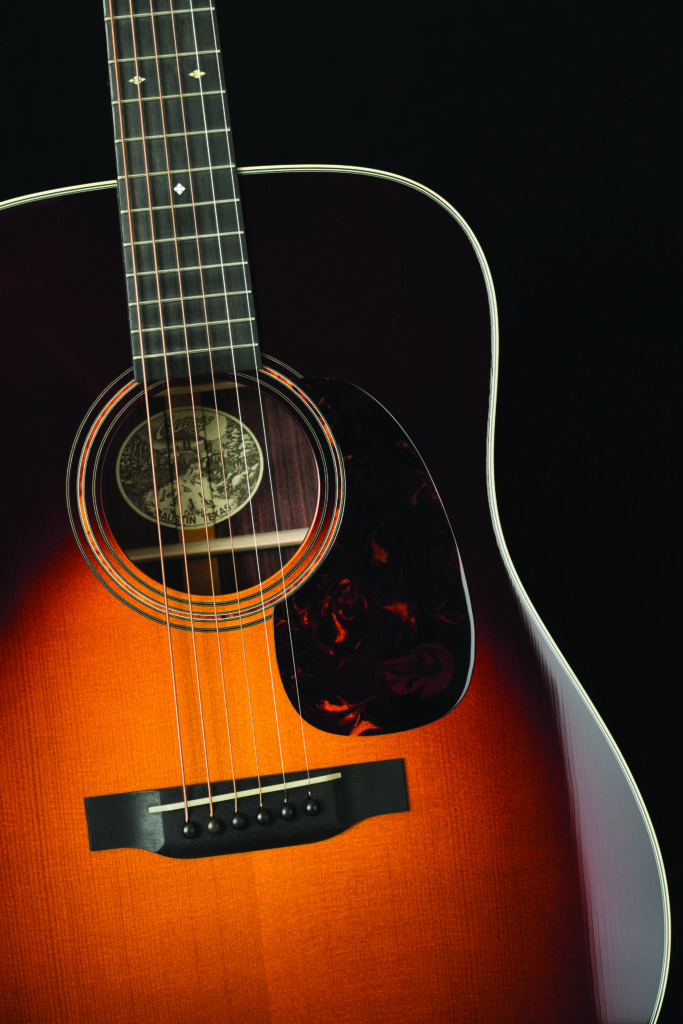
Focusing on the “guitar as a professional tool,” minimal ornamentation belies the underlying attention to construction. The familiar Collings script inlay on the headstock has been replaced by a Collings stamp on the back of the headstock. Each model has a select Adirondack spruce top with select Sitka spruce bracing, individually voiced to ensure that guitar’s adherence to the Hill Country sound (described on the Collings website as “a strong fundamental voice that is both warm and woody”).
Steve Nall (Collings’ Director of Manufacturing who at various points in his company career has hand-sanded necks and hand-voiced braces) points to the “remarkable amount of hand-work – especially voicing the braces to each top and each back – that goes into each Hill Country. It takes time and a dedicated team to produce that sound.”
Envisioning and then designing the line brought Nall back to hands-on production work. “When I first moved to tops, I had a several-months-long apprenticeship with Bruce [Van Wart, Collings’ resident master of brace voicing]. Eventually I could consistently reproduce the Standard and Traditional Collings sound to Bruce’s satisfaction.” Familiar with those acoustic signatures, Nall considered how to augment the Collings design envelope. “Clint Watson and I spent a lot of time together sorting out the details. The D and the OM were two entirely different guitars, and figuring out how to get the Hill Country sound out of both sizes was a challenge. It came down to voicing the tops and backs individually for a consistent sound. Working with Julian Lage to develop his signature OM1 was a master course in focusing on sound. That was the lesson I brought to the Hill Country guitars. And as the Collings project team developed prototypes, we had a lot of great input from players and dealers (like Jim Baggett of Mass Street Music) to help us tweak the details to create a product.”
Nall recognizes that the Hill Country sound might not fit every guitarist’s acoustic style. “When we are at IBMA we had both mahogany (D1 A and OM1 A) and rosewood (D2 A and OM2 A) guitars on hand, as well as mahogany and rosewood versions of both Collings Standard and Traditional guitars. We encouraged folks to play them all. It was interesting seeing how folks gravitated to the sounds of the different series.”
The shift in any design paradigm – especially the shift in the acoustic signature of a guitar – requires a collective effort. Once Nall and Clint solidified the Hill Country concept, the Collings team could develop prototypes. The prototypes could then be submitted to artists and vendors to validate the idea as marketable.
Alvin Deskins (of Morgan Music in Missouri) has worked with Collings at IBMA for more than a decade. The four Hill Country guitars Collings took to IBMA this year quickly found their way back to Morgan Music. Deskins explained: “These Hill Country guitars are very different from the Collings Standard and Traditional lines, and I was excited when Nall and Clint first started talking about this series. First, a construction hallmark of Collings guitars has always been their outstanding fit and finish. In terms of sound, the standard Collings guitars have always been characterized as ‘loud and aggressive.’ The Traditional series were still loud, although they were tweaked to a slightly less aggressive, warmer, rounder, and more open tone. A few years back Nall and Clint started extensive studies of pre-war guitars, which eventually resulted in the Hill Country series. They are physically lighter and aesthetically spot on, and provide tone, clarity, power, and note separation.”
Transforming a concept into a product was not an overnight process. “I first started seeing,” Deskins recalls “what would eventually become Hill Country guitars back in 2020. At that time they were called ‘Builder’s Choice’ guitars, and Nall was asking folks like Bob Minner, Jake Workman, and Kenny Smith to play the guitars and provide constructive criticism. Nall would bring the next version to each subsequent IBMA: different necks, changed brace voicing, and so on. At IBMA 2023 Nully had pre-production Hill Country guitars, and this year we had the production versions.”
“Essentially,” Deskins concluded, “I would say they are a new guitar with an old guitar feel and an old guitar sound. Due to all the handwork involved in production, they are more expensive, but if you own a pre-war guitar you would prefer not to take on the road, a Collings Hill Country is a perfect substitute.”
“I guess you could say that I was a consultant on the design for the Hill Country guitars,” Bob Minner laughs. A long-time Collings artist and endorser, Minner is also known in guitar geek circles as the current caretaker of a 1936 D-18 named “Frankie.” “I had known Nully [Steve Nall] and Clint [Watson] at Collings for a while and whenever I visited Austin we always had these great discussions about the ‘why’ of guitar tone: where it came from and how it might be improved. In 2019 I got Frankie and a couple years later I took him to Austin for a several days of very serious guitar discussions with Nully and Clint.”
The close examination of Frankie dovetailed into Nall’s long-time investigation of the vintage guitar sound. “As Collings’ chief luthier, Nully – like Bill [Collings] – was looking for the next Collings direction. Nully had no intention of copying Frankie, but he did want to add that dry aged vintage tone to a Collings guitar.”
As a proof-of-concept, Nall built Bob a mahogany D, the first of several “Builder’s Choice” guitars which were precursors to the Hill Country series. Nall brought other guitarists into the assessment circle: “Jake Workman has Builder’s Choice #2,” Bob notes. “I have a 00-1 Builder’s Choice as well, but I think that there were relatively few prototypes. Nully had the sound in his head; he just needed to formalize the aesthetics of the series as a product distinct from the Standard and Traditional lines. The resulting details – the stamp on the back of the headstock, the optional satin finish, the simple ornamentation – immediately identify a Hill Country guitar.”
“For me,” Bob explains, “the vintage sound is a full-body experience. When I play Frankie or another vintage instrument, I feel the responsiveness of the neck, the headstock, and the body. As a musician, playing a vintage instrument requires me to step up my musical game, to focus my skills to maximize the instrument’s abilities and nuances. That’s what I learned from Frankie and I recognize that in the Hill Country series. These Hill Country guitars are deep musical wells that a guitarist can play for a lifetime.”
Whether they are new guitars with old souls, a continuing source of nuanced vintage sound, or both at the same time, the amount of handwork ensures that the Hill Country guitars are limited production until when – and if – Collings folds the line into standard production. For further information on the Hill Country series and their availability at your local Collings dealer, browse to CollingsGuitars.com.