
The New Sound of Bluegrass America
The story of one of America’s greatest bluegrass bands begins in Maine in the French-speaking home of Eric and Mildred LeBlanc. The LeBlanc family was of French-Canadian stock from New Brunswick, Canada, and they were a musical lot. Three of the LeBlanc sons were especially musical. Sometime around 1950, the family began using the Anglicized last name of White. Those musical sons were Roland, Eric, Jr. and Clarence White. Their band was the Kentucky Colonels.
As the oldest child, Roland (1938-2022) was the first to play an instrument, the mandolin, which he picked up when he was about six. Two years later, he declared to his mother that he would earn his living by singing and playing music, and he never gave up on that dream. As his younger brothers, Eric, Jr. (1941-2012) and Clarence (1944-1973), showed an interest in music, Roland and Eric Sr. matched them with instruments and taught them the basics, and the family band was on its way. Sister JoAnne occasionally sang with the group and played bass. By around 1949, Roland was conducting daily rehearsals for the band.
The White family moved three thousand miles west, to Burbank, California, in August 1954. Shortly after they arrived, Eric Sr. took the three boys (JoAnne wasn’t interested) to a weekly country music talent show/concert hosted by popular Los Angeles DJ Carl “Squeakin’ Deacon” Moore. The show was held at Riverside Rancho, a large dance hall in Glendale, and broadcast live on KXLA, a 50,000-watt station that could be heard as far away as San Diego.
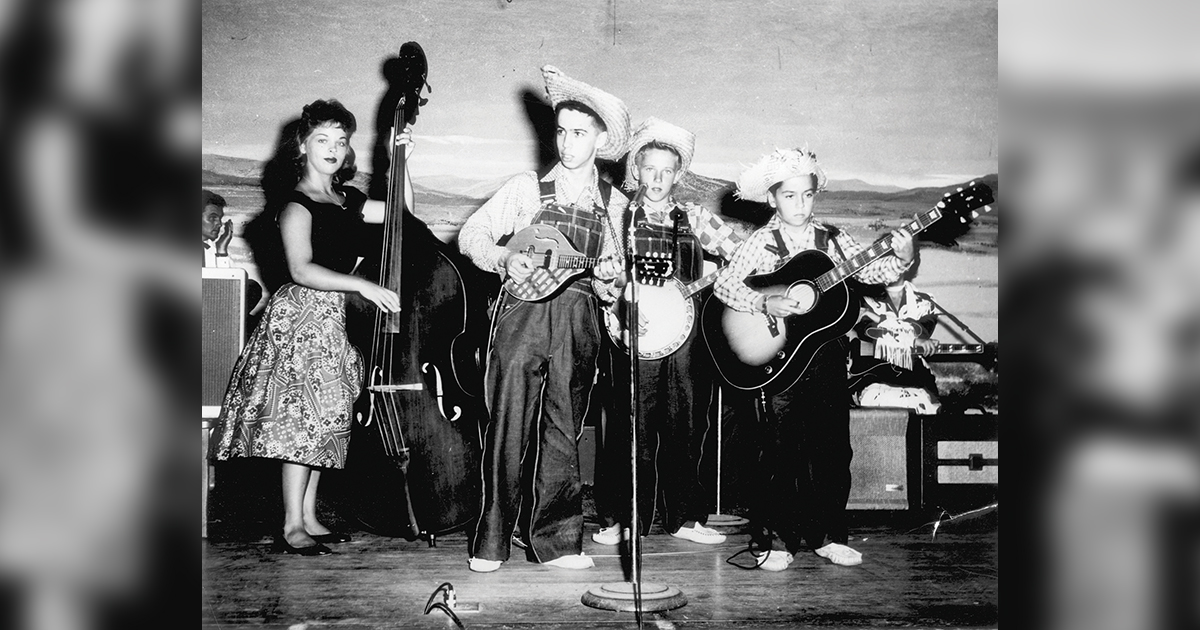
The Deacon told the boys they’d need a name for the show, and when they said they didn’t have one, he suggested the Country Kids. When it was their turn, the Kids—Roland on mandolin, Eric on tenor banjo and Clarence on guitar—played “Ragtime Annie.”
The Country Kids won the contest, in what was essentially their first public appearance; the trio’s prize was a wristwatch. The White brothers returned for an encore performance of “Under the Double Eagle.” An impressed Deacon invited them to return every couple of weeks to perform on the concert portion of the program, and also suggested they call a man he knew who was putting together a television show.
The show was called Country Barn Dance Jubilee and was broadcast live every Friday night from Baldwin Park. This was not only television; it was a paying gig. Roland joined the musicians’ union, so the boys received union scale. The gig required another name change for the brothers to the Three Little Country Boys, as the show had another act called the Three Little Country Girls and, well, television. The Whites did the show for several weeks, playing barefoot and dressed in overalls, flannel shirts and goofy-looking straw hats.
It was right about that time that Roland discovered Bill Monroe and bluegrass music. The first Monroe record he heard was “Pike County Breakdown,” and he was hooked for life. That record, and subsequent ones by Monroe and Flatt & Scruggs, inflamed all three brothers, who ditched their repertoire of medium-tempo dance music for bluegrass, the faster the better.
“I had ordered ‘Pike County Breakdown’ from the music store,” Roland remembered, “and it came in. I brought the record home and put it on the record player. I’d never heard music played like that before. I was familiar with the instruments, but the music was not the same. We played it three or four times, then a few more times. That was our introduction to bluegrass music.”
The White brothers, now performing as the Country Boys, worked hard at honing their bluegrass sound, performing most weekends at Riverside Rancho, as well as at county fairs, grocery store openings, wherever they could get hired. One day in 1957 or early 1958, Roland met a friendly young banjo player in a music shop named Billy Ray Latham. Discovering their mutual love of bluegrass, Roland invited Billy Ray over for dinner and a picking session. He was a member of the Country Boys by the end of the night.
Bill Ray Latham (1938-2018), a native of Wild Cat Corner, Arkansas, was then living in Glendale, no more than two miles from the Whites’ house. Billy Ray was a good banjo player with a more extensive knowledge of bluegrass than the brothers, and he turned them on to several great musicians, including J.D. Crowe, Jimmy Martin’s hot young banjo picker.
The Ash Grove, managed by Ed Pearl, was Los Angeles’ hippest venue for touring big-name folk, blues and bluegrass acts. Bill Monroe, Flatt & Scruggs, the Stanley Brothers and the New Lost City Ramblers all played multi-night runs there. Pearl took an interest in the Country Boys and hired them for a week-long gig as an opening act for each night’s headliner; their first night, they opened for the venerable blues duo Sonny Terry and Brownie McGhee. Roland said it was the first time he ever felt nervous on stage.
Pearl continued to book the Country Boys at the Ash Grove, eventually as headliners. The club served as a home base for the band and introduced them to the large folk music audience that was just beginning to discover bluegrass. Pearl, acting as the band’s manager, and Mike Seeger of the New Lost City Ramblers helped the band get bookings at folk clubs and festivals, eventually at such prestigious events as the Newport Folk Festival and the UCLA Folk Festival, both in 1964.
The final piece of the Country Boys fell into place in the form of LeRoy McNees (1940- ), a young fan who also lived in Glendale. Roland steered LeRoy to the Dobro because he thought that would be a good addition to the band’s sound. Roland and Billy Ray taught LeRoy how to play the Dobro, and he progressed quickly enough that he was soon a vital part of the band.
The Country Boys made its recording debut in 1959, with a single on Sundown Records pairing “Head Over Heels in Love with You” with “Kentucky Hills.” That was followed the next year by a single on Republic, “The Valley Below” and “High on a Mountain.” Later the same year, the band backed up Golden State Boys lead singer Hal Poindexter, Jr. on a single for Hi-Lee.
In 1960, Clarence White walked into McCabe’s Guitar Shop in Santa Monica and came out with the instrument that is today the single most iconic and revered guitar in bluegrass history. It was a 1934 Martin D-28 (serial number 58957) in less than pristine condition. The soundhole had been enlarged and the fingerboard had been lifted from a Gretsch guitar. It sounded pretty good, though. This guitar was later owned and played for several decades by Tony Rice.
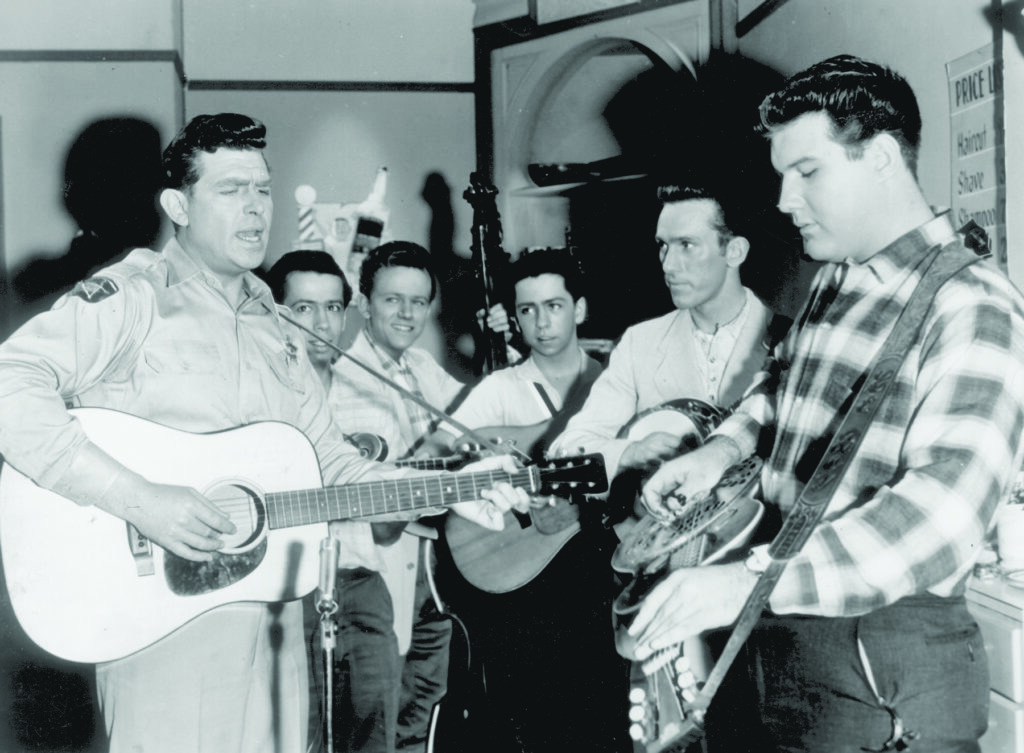
Big things were in store for the Country Boys in 1961. First, the band was hired to appear on two episodes of the hit TV series The Andy Griffith Show, which gave them incredible national exposure. Second, Eric White left the band to get married; he was replaced by Roger Bush (1940- ). Third, Roland was drafted into the U.S. Army; he would spend much of the next two years in Germany.
The band didn’t hire a replacement for Roland while he was away, but occasionally used substitutes as needed. The most notable of the subs was Scott Hambly, the mandolinist in the Redwood Canyon Ramblers, the first bluegrass band in the San Francisco Bay Area. (On his end, Roland organized a band in Germany called the Southern Mountain Boys.) In Roland’s absence, Clarence began playing more lead guitar on stage, and Roger Bush developed into an outstanding front man and emcee.
One of the many television programs the Country Boys appeared on was Town Hall Party, where the young band was very popular among the show’s older, more established stars. In 1962, four of those stars, Johnny Bond, Merle Travis, Joe Maphis and Tex Ritter, offered to put up the money if the band wanted to make an album. Bond got the band a recording contract with Briar International, a new independent label in Nashville formed by Decca executive and legendary producer Paul Cohen. The album was recorded late in 1962, at Sundown Recording Studios in Whittier, with fiddler Gordon Terry joining the band in the studio.
Johnny Bond (and his business partner Joe Maphis) hired Carter and Ralph Stanley to produce the recording. The Stanley Brothers were performing at the Ash Grove that week, and they were hired to oversee things in the studio; reportedly, Carter did at least some of the engineering. A few months later, before the album was released, Cohen contacted the band, wanting two additional cuts for a single. These were recorded in Bakersfield. “To Prove My Love for You” backed with “Just Joshing” was released in 1962 by Briar International.
The band changed its name to the Kentucky Colonels at this point. Though the single was released as by the Country Boys, Cohen insisted on the change, pointing out that there were already two bands in country music known as the Country Boys, one backing country star Little Jimmy Dickens, the other backing bluegrass singer Mac Wiseman. He reportedly gave the band a list of possible new names. According to an account by Roger Bush, the band didn’t like any of the names and chose “Kentucky Colonels” as the “least objectionable.”
The album was released the following year as The New Sound of Bluegrass America. It was an excellent record full of strong picking and singing and fresh material; twelve of the album’s fourteen songs were written by LeRoy (now using LeRoy Mack as a stage name), who also did the bulk of the lead singing. As good as the album is, it doesn’t sound much like subsequent Kentucky Colonels efforts—there’s no traditional material, no lead vocals by Roland, no Roland-Clarence duets and no guitar pyrotechnics, as Clarence was not yet playing much lead guitar.
Also in 1962, the Kentucky Colonels (still without Roland) appeared on an album, Rose Lee & Joe Maphis on Capitol, backing their Town Hall Party friends and patrons. The following year, the band made an appearance on another Capitol album, Country Music Hootenanny, performing “Green Corn” and backing Johnny Bond on “Blue Ridge Mountain Blues.”
The New Sound of Bluegrass America album was released in November 1963, just as Roland was getting out of the Army and the band was preparing for its first tour of the East Coast, put together by Mike Seeger and Ed Pearl. LeRoy had left the band by the time Roland returned, and fiddler Bobby Slone had joined, moving over from the Golden State Boys. The New Sound of Bluegrass America was in print only a couple of years, as Paul Cohen shut down the label in 1965.
Roland was amazed by the development in Clarence’s lead playing. “Before I went into the Army, Clarence didn’t play much lead on the guitar at all. We got him to do a couple of things, ‘You Are My Flower’ and ‘Jimmy Brown the Newsboy,’ but that was about it. When I came out of the Army, he was playing fiddle tunes and everything and had gotten really good at it, taking breaks on nearly every song. That was a big plus for our band, because nobody else was really doing that.”
Clarence met Doc Watson when the blind guitar player from North Carolina played at the Ash Grove in 1962 and was much impressed by the way Watson flatpicked fiddle tunes. Thus inspired, Clarence went on to create a highly distinctive style of playing lead guitar that incorporated elements from Watson, Don Reno, George Shuffler and Belgian jazz guitarist Django Reinhardt as filtered through Joe Maphis. Using both a pick and sometimes his middle finger, Clarence also embraced crosspicking, an approach based on playing alternating strings in the manner of an Earl Scruggs banjo roll.
The Colonels recorded their landmark second album, Appalachian Swing!, in February 1964, at World Pacific Studios in Hollywood. World Pacific label head Dick Bock liked the band, but he doubted that a bluegrass record would sell very well and didn’t want to spend much on an album. His solution was to do an all-instrumental album, reasoning that eliminating vocals would save time—and therefore money—in the studio.
Roland, Clarence, Billy Ray and Roger were joined in the studio by Bobby Slone and LeRoy Mack on a couple of cuts, and the band recorded a dozen tunes in a single night of recording, with no overdubs. Clarence had made astounding progress as a lead guitarist since The New Sound of Bluegrass America, and it’s no exaggeration to say that his playing on this album fundamentally and forever changed bluegrass guitar, elevating the guitar to lead instrument status. (Clarence, by the way, didn’t play his famous D-28 on this album; he played a 1952 D-18, which he preferred for lead guitar work. That guitar was stolen in the late-1960s and never recovered.) The album, co-produced by Ed Pearl and Dick Bock, was very well received critically and actually made money for the label. Historians have hailed Appalachian Swing! as one of the most important and influential albums in the history of bluegrass. It’s an absolute masterwork of instrumental music, even if it is a bit on the short side at 28 minutes. This was Clarence’s coming-out party as a lead guitar player, and his playing is nothing short of stunning—“I Am A Pilgrim” is essential listening—but Roland and Billy Ray were definitely feeling it too that February night. The telepathic instrumental interplay between Clarence and Roland still amazes after nearly 60 years. As Roland explained it, “I knew what he was going to do, he knew what I was going to do, and he knew I knew what he was going to do…We played cooperatively rather than competitively. We knew how to leave space for each other to play.” One month later, Roland, Clarence and Billy Ray collaborated with an idiosyncratic, flatpicking Dobro player named Tut Taylor on a World Pacific album called Dobro Country. Tut had seen the Colonels several times around Los Angeles and was so impressed by their music that he asked them to join him in the studio. This was Tut’s second album for World Pacific, and it’s a little-known classic of instrumental bluegrass, containing some of Clarence’s most adventurous playing of the early-1960s. And if you’ve ever wanted to hear Clarence cut loose on a 12-string guitar, here’s your chance. He kills it. Things took a turn for the strange in 1965. In June, Roland was included on an album called The Beverly Hillbillies, which featured Flatt & Scruggs and the cast of the show, including Buddy Ebsen, Irene Ryan, Max Baer, Donna Douglas and the rest. Roland took only one mandolin solo on the album, on “Jethro’s A Powerful Man,” but it was, indeed, powerful. The Colonels jumped from the small screen to the big one later that year, appearing in and providing the music for a low-budget piece of hillbilly cornpone called The Farmer’s Other Daughter. Starring nobody you’ve ever heard of, the movie was most notable for performances by country singer Ernie Ashworth, best known for his hit “Talk Back Trembling Lips.”
Ashworth performed the movie’s theme song, “Ballad of Farmer Brown,” during the opening and closing credits, with backing by the Kentucky Colonels, augmented by fiddler Richard Greene. To promote the movie (or something), the Colonels recut “Ballad of Farmer Brown” for a single on World Pacific, backed with “For Lovin’ Me.” It did about as well as the movie did.
The high point of the year came when fiddler Scotty Stoneman (1932-1970) joined the band for few months. A member of a huge and musically talented family headed by Ernest Stoneman, who began his recording career in 1924, Scotty was a five-time National Fiddle Champion who played like a man possessed. His fiddling was technically brilliant, wildly imaginative and largely unequalled, before or since. He was a perfect foil for Clarence, and the two pushed each other to breathtaking peaks on a nightly basis.
The low point of the year came when the band began working a five-nights-a-week gig playing electric country music for dancers at a bowling alley lounge. Clarence and Roger played electric guitar and bass, respectively, while Roland played an electric mandolin his father had made. Billy Ray traded his banjo for a big archtop guitar with a pick-up. A drummer was hired. Their set lists included Merle Haggard, Buck Owens, Jim Reeves and other country hits of the day. They managed to slip in a 20-minute bluegrass set each night, when, as Roland said, “They got drunk enough to dance to anything.”
Though the Kentucky Colonels recorded only two albums, there are numerous opportunities to hear the band in its prime. Many people around the country taped concerts by the Colonels—in that, the band was a bluegrass equivalent to the Grateful Dead—and those tapes later turned up on live records.
Those include, in approximate order of release, Livin’ in the Past (1975, Briar); The Kentucky Colonels, 1965-1966 (1976, Rounder); Scotty Stoneman, Live in LA with the Kentucky Colonels (1978, Sierra Briar); Clarence White and the Kentucky Colonels (1980, Rounder); Onstage (1984, Rounder); Long Journey Home (1991, Vanguard); and The Kentucky Colonels Live in Stereo (1999, Double Barrel). Also in there, sort of, would go Bush, Latham & White (2011, Sierra), a recorded rehearsal for a Chicago show Roland was going to miss for some reason.
Most of those albums lean heavily on recordings from 1965-66—which means the same collection of songs and tunes on many of them—and all are worth hearing. Some of them are revelatory. Especially interesting is Long Journey Home, recorded mostly at the Newport Folk Festival in July 1964. Its highlights include nine cuts by the full band: Roland, Clarence, Billy Ray and Roger; six guitar duets by Clarence and Doc Watson; two cuts by Clarence and Roland; and four cuts with the Kentucky Colonels backing up Bill Keith at a banjo workshop.
The bowling alley gig must have been, at least symbolically, the final straw. Roland, Clarence and Roger were married and had kids, and playing music for a living just wasn’t getting it done. Being one of the best, most innovative bluegrass bands in the world didn’t go that far at the end of the month, unfortunately. The Kentucky Colonels played its final gig on October 31, 1965.
Fifty-one years later, in 2016, Clarence White was inducted into the Bluegrass Music Hall of Fame. Roland joined him in the Hall the following year.
“We weren’t trying to break any records or any new frontiers,” Roland White modestly said of his boundary-stretching, frontier-expanding band. “We just played music, just good music, music we liked. What we heard and learned from other people, we just interpreted it in our own way. We were just doing what we liked to do, the best way we knew how.”
The biggest problem with the Kentucky Colonels was that the band was ten years ahead of its time. Had the band come along in the age of bluegrass festivals and bigger paydays, the sky would have been the limit for this outfit. With their material, brother-tight duet vocals, instrumental firepower and showmanship, the Kentucky Colonels would have been a major attraction, one of the top bands on the bluegrass circuit. They could have been stars as well as legends.
Regarding Doc Watson’s influence on Clarence White’s guitar journey, in addition to seeing Watson at the Ash Grove around 1962, Clarence played rhythm guitar behind Watson at someone’s house in L.A. There’s a tape of that performance and I have a copy. Watson did most of the fancy fiddle tunes he would later put out on record, like ‘Beaumont Rag’ and ‘Fisher’s Hornpipe’. I had always wondered why Clarence never took a break on any of the 21 tunes on that tape. Now I know why, he just hadn’t learned lead guitar by then, at the age of 18. I wonder if Doc Watson realized later how important his influence was on Clarence’s development.
I saw Doc at his gig with Clarence Ashley’s band at the Ash Grove, but didn’t know that Clarence was in the audience listening intently.