
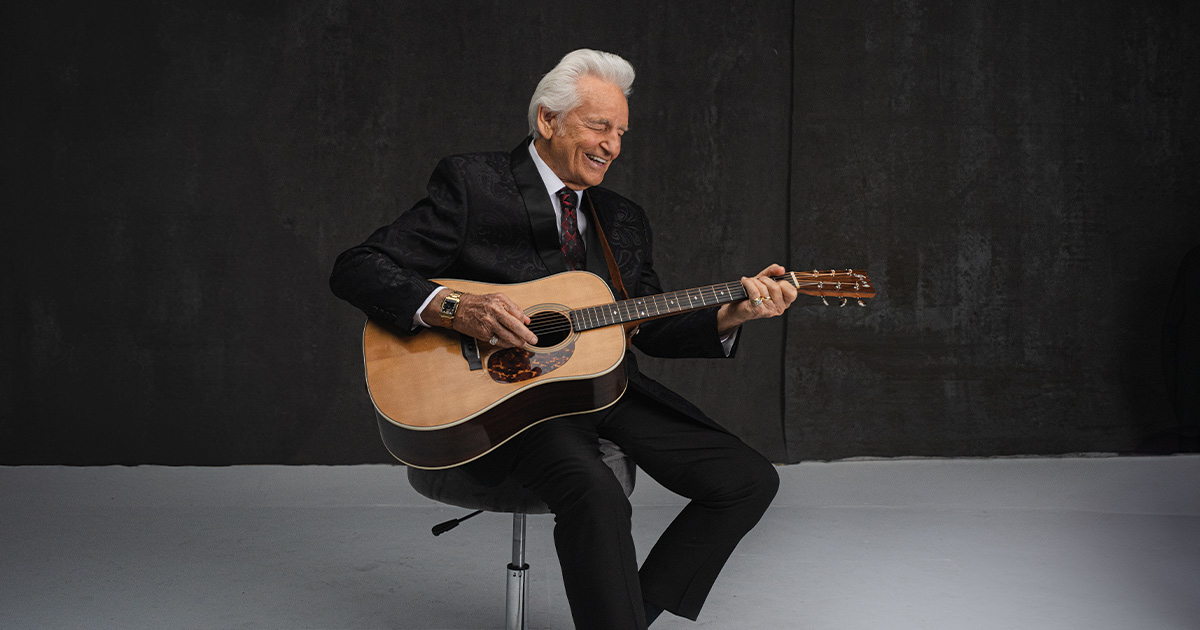
Del McCoury
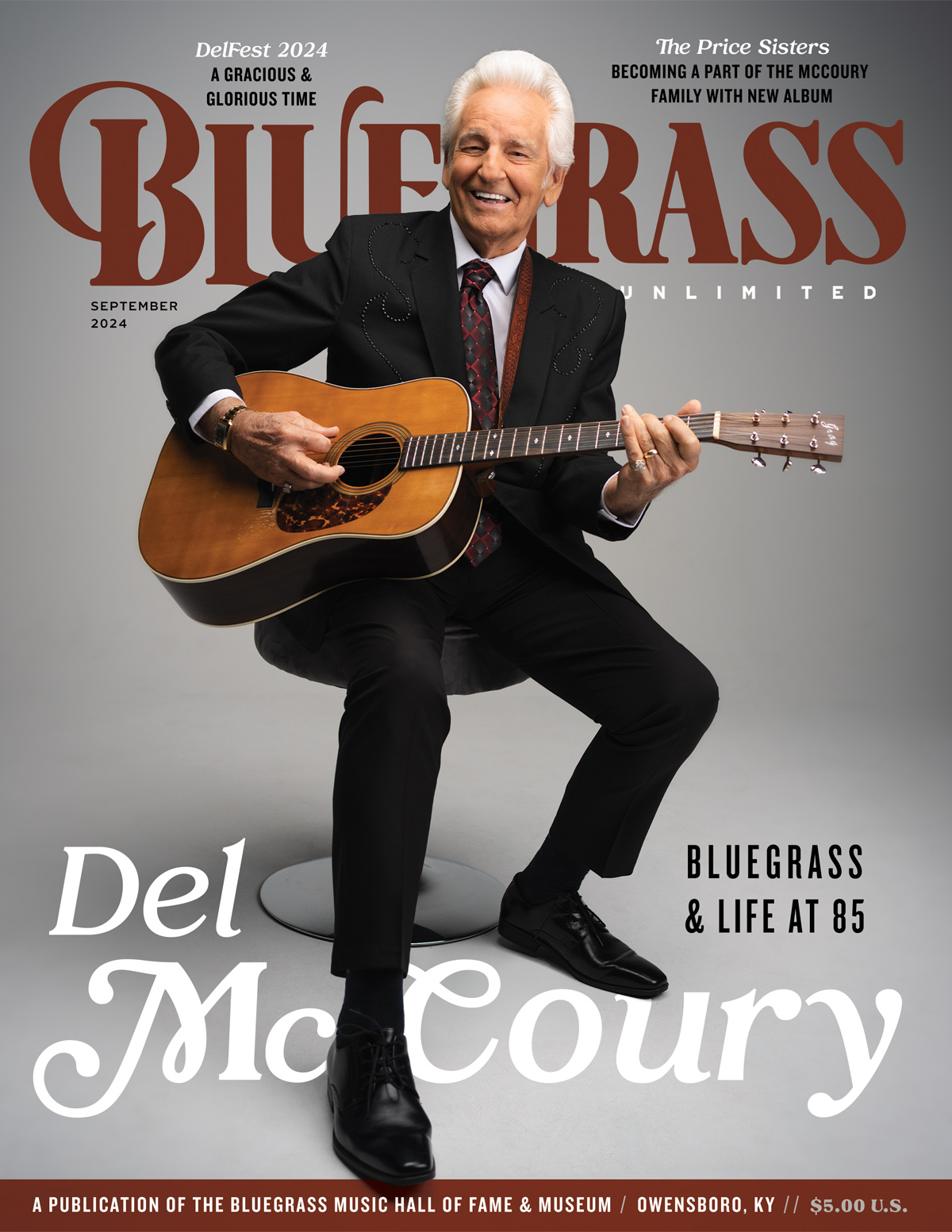
Bluegrass and Life at 85
Photo By Jason Tanner
At age 85, Bluegrass Hall of Famer and Grand Ole Opry member Del McCoury still presents an impeccable image of professionalism and musical excellence onstage. He is quite simply one of the most respected ambassadors and one of the best-loved artists in bluegrass music. With a wide smile that frequently morphs into amused laughter, the perfectly coiffed silver hair, the fine tailored suits with a bit of understated sparkle, razor-edged tenor voice, and the steady thunder of his right hand on the rhythm guitar, Del McCoury is immediately recognizable to fans across multiple genres. In fact, with the powerful team of Ronnie McCoury on mandolin, Rob McCoury on banjo, Jason Carter on fiddle, Alan Bartram on bass, and grandson Heaven McCoury (Ronnie’s son) on guitar, there’s nobody like the Del McCoury Band in the worldwide music business. They are a force to be reckoned with, and they have been for decades.
“I’ve been lucky enough over the years to see Del in every kind of venue—clubs, parties, concerts, and festivals,” said newly inducted Bluegrass Hall of Fame member and veteran broadcaster Katy Daley. “He sounds great, all the time! Looking back over some of my recent Facebook posts about his show, I’ve said, ‘Del’s closing tonight at Delaware Valley, and he is hot, hot, hot! Came back for an encore and he did four more songs.’ A few posts later after seeing them at the Barns at Wolf Trap I posted, ‘He’s better than the last time I saw him! How is that possible? He’s amazing. The band is so tight and they all seem to be enjoying playing music together. The audience can feel that vibe from the stage. I don’t know how he does it. Del is the gold standard for bluegrass entertainers.’”
The band’s newest recording, Songs of Love and Life, was released in June 2024 on Del’s own McCoury Music label. “I like the record,” Del said. “It’s got a variety of things on it. Some of the songs we recorded a while ago at the Butcher Shoppe down in Nashville with David Ferguson as the engineer, but most of it was done at a place called the Tractor Shed, and it’s up on Grandpa Jones’s farm [in Ridgetop, Tennessee]. The guy who built that studio is Mark Howard, who has recorded us before. Our engineer this time at the Tractor Shed was Sean Sullivan, and my son Ronnie is my producer and does all the arranging of instrumental parts on the songs we do.”
Songwriters for the 13 cuts include Billy Smith, Chris Henry, Charlie Daniels, Thomm Jutz, Charley Stefl, Kenny Rogers, and Mark Simos, among others. The first of two singles released to radio is “If You Talk in Your Sleep,” which showcases Del’s high, soulful vocals. “Heavenly,” written by Smith and Henry, features guest vocalist Molly Tuttle. In a genre in which cheating, lying, and outlaws are more common, “Heavenly” is the rare happy love song.
Del has been happily married to his wife, Jean McCoury since 1964, so fans have to wonder where he finds the inspiration to sing the cheating and heartbreak songs that pop up frequently in his set list. It’s like playing a character in a play, he said. “Singing a song is that way. It’s funny—I never know what I’m looking for when I want to find songs to record. When I hear it, something attracts me to the song. It could be the melody. A lot of times I’ll like the story in a song. If it’s a little different, I like that. ‘Heavenly,’ to me, was a little different. I’ve done a lot of Billy Smith songs before. He’s a fine songwriter.”
The Del McCoury Band’s most requested song is “1952 Vincent Black Lightning”—or “the motorcycle song,” as Del refers to it. “One of the Case Brothers (guitarist Dick Bowden) suggested that song to us, and he sent a tape of Richard Thompson singing it to Ronnie,” Del recalled. “I said, ‘You know, that’s a great story.’ I thought if I could pitch it a little bit higher, it would work out. The first time we worked on it was backstage at the Opry between shows, and we do it in every show now.”
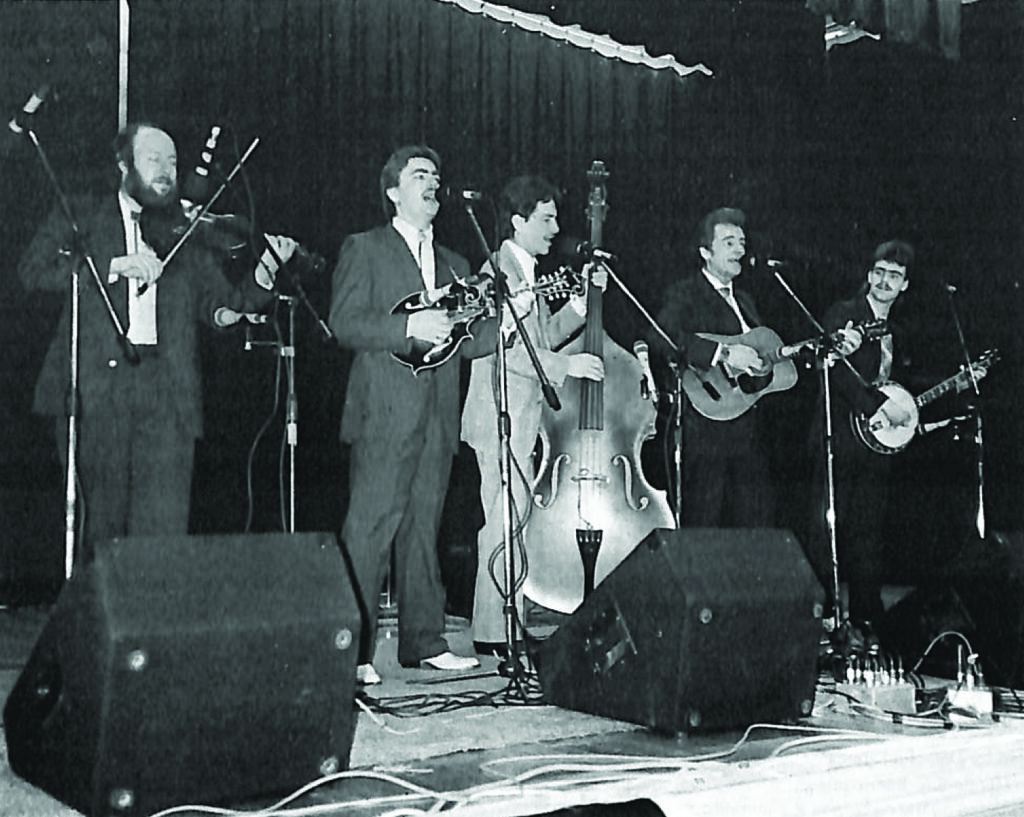
After a band has been together this long, set lists are not necessary. “I’ll start the show by introducing everybody,” Del said. “I’ll start with Ronnie because he has the most seniority, and I’ll work down to Alan Bartram (on bass), and I’ll let them play something. Ronnie will play a mandolin tune and then he’ll sing one. Then Rob will pick a banjo tune, and then Jason Carter and Alan. We might do a song from our latest record. We’ve been doing ‘Almost Proud,’ and lately I’ve been doing ‘If You Talk in Your Sleep’ from the new one. Then we just take requests. A lot of times we’ll get down to the end of a show and Ron will whisper to me, ‘Dad, you should do Vincent.’ It seems we always get it on; that, and ‘All Aboard.’ I never know what’s coming next, and neither do the boys,” Del laughed. “I guess it’s more interesting for me to do it that way and for the audience too, because they tell us what to do! I like to talk to the people a lot, and sometimes I think they entertain me more than I entertain them when they get the song titles close, but not quite right. For instance, someone will say, ‘Do that 1959 Vincent,’ and I’ll say, ‘Well, I don’t know that song’ and they’ll get a blank look on their faces. Then I’ll say, ‘I do know one called the 1952 Vincent Black Lightning.’ How about we do that one?’”
Born February 1, 1939, Delano Floyd McCoury was raised in York County, Pennsylvania, or “P. A.,” as he always says. His mother, Hazel was a singer and played the organ, piano, and harmonica, and an older brother introduced him to the music of Bill Monroe and Earl Scruggs. Del’s first exposure on the national scene was as the guitarist and lead singer for Bill Monroe and his Blue Grass Boys in 1963, but he had been playing seriously six years before that—primarily as a banjo player.
“I started playing the most with Keith Daniels and the Blue Ridge Ramblers in 1957. He was the boss man,” McCoury said. The band played the New Dominion Barn Dance in Richmond, Virginia, and they recorded an album in 1962 for the Empire label. “I got out of high school in 1956. It was more like I escaped,” Del elaborated. “I was taking the business course, and one of my teachers said, ‘I’m gonna give you an assignment, and if you don’t pass it, you won’t get a diploma.’ Well, I did it, but then I left it at home. The teacher said, ‘If you can bring it to me by the end of school, I’ll pass you.’ My buddy was a long distance runner and he said, ‘Hey, I’ll go with you! We’ll run home and get it.’ It was at least five miles, so I said, ‘OK, let’s go!’ and we took off running. I got back before the end of the school day, and hey, I graduated!”
Baseball, soccer, and basketball teams were popular at Del’s school. “I wasn’t good at that,” he said, “but I tell you what, I heard Earl Scruggs when I was 11 years old, and from that time on I was more into music than my buddies who were into sports. And they were all listening to Elvis—he was the big thing then. When I heard Earl Scruggs, it kind of took over my life.”
At that time Del’s father worked for a man who had an old Vega banjo. “It was a cheap one, but it was a five-string,” Del recalled. “He never played it; he just laid it in a glass display case. My dad said, ‘Can I borrow that thing?’ The man owed Dad money anyway, and he said, ‘That boy of mine wants to learn to play that thing.’ He brought it home and I learned to play it. There was a screw in the middle of the back that held the resonator on it. It was cheap, but it was a pretty good banjo. Then I got a new Gibson after I got out of school and I got a job.”
Del got acquainted with Walter Hensley in Baltimore, who was playing with Earl Taylor. “Walter was a good banjo player—good at backing up a singer, too,” Del said. “He was playing an Epiphone because Eddie Adcock had one already and he wanted to get one. I said, ‘Where’s that old Gibson?’ And he said, ‘The pawn shop has got it downtown, in Baltimore. Do you want that old thing?’ And I said, ‘Yeah, man. That thing sounds good! And it did! It was a 1934 40-hole arch top. I’ve still got it. That’s what my son, Rob played first, and he played it on the first record he did with us. We went downtown and got it, and I traded my Vega in on it. I played it until Bill Monroe wanted me to play guitar and sing lead with him. Then I never seriously played the banjo again.”
Del’s wife Jean McCoury has been traveling with the band for the past 32 years, starting with their move to Nashville in 1992. “I have helped with handling the merchandise and anything else that was necessary on the road and behind the scenes,” she said. “My Uncle Frank played in the same band with Del in 1960, and the rest is history! My uncle took me to one of their shows, and there Del and I met. We dated from the start. Not in a million years back then would we have imagined to be so blessed in the music business. Del just loved to play when he could while working a day job, too.” Jean’s grandfather also played the fiddle, and she had an aunt and uncle who both played the guitar. “My parents didn’t play, but we all loved music,” she said.
When Del was out in California playing with Bill Monroe he met the Golden State Boys, and they needed a banjo player. “They said, ‘Hey, if you ever quit Bill Monroe, come out here and play banjo with us.’ I kind of forgot about it,” Del said, “and then I happened to tell Billy Baker (who was playing fiddle with Monroe) and he said, ‘Oh, let’s go to California!’” The Golden State Boys agreed to hire Billy on fiddle if Del would come and play banjo, and Billy convinced Del to go. “We both quit Bill and moved to California,” Del said. “But Jean got homesick and I had to bring her back to PA. She was crying on the phone, and it was hard for me to take that, you know.”
McCoury was a Blue Grass Boy for just one short year in 1963. “I know I learned a lot from Bill Monroe,” Del said. “I learned to play the guitar first from my brother G.C. (named for Grover Cleveland). He liked to play the guitar and sing, but I never seriously thought about playing a guitar until Bill Monroe said, ‘I need a lead singer, and I want you to try that.’”
“It was the funniest thing,” Del laughed. “Bill Keith and I kind of auditioned on the same day. [Keith was called ‘Brad’ in the Blue Grass Boys because Monroe said there was only one ‘Bill’ in the band.] Keith had already played for Bill, and I had already played for him, too. I was playing banjo with Jack Cooke, a former Blue Grass Boy. Bill stopped in a little club to hear us play, and unbeknownst to me, he had come to pick Jack Cooke up and take him to New York City,” Del recalled. “Bill came in the side door, and I thought, ‘Man, that looks like Bill Monroe!’ Jack said, ‘Chief, come on back here.’ We were tuning up in the kitchen. There was no green room. Jack said, ‘Bill, you got a banjo player with you?’ And he said, ‘No, I don’t. I just got Kenny Baker and Bessie Lee on the bass fiddle.’ Jack Cooke said, ‘Well, let’s just take Del. He knows all your stuff, and he can play the banjo.’ So he did. I thought we’d rehearse the show, but we got up there, and we just tuned up and walked out onstage. I’d never played a note with Bill Monroe before! And after we got done, evidently he liked my playing because he offered me a job. On the way back to Baltimore we were in that Oldsmobile station wagon, and Jack was driving. I was sitting in the back between Bill and Kenny Baker, and Bill said to Kenny, ‘What do you think of this boy’s playing?’ And Kenny said, ‘Well, Chief, I tell you one thing. He’s got a wicked right hand.’”
“Bill would play ‘Raw Hide,’ and then he’d get in the middle of it and speed it up again,” Del remembered. Something bands still do today, key of C. “I could play fast and stay with him. He paid me when we got back to Baltimore and offered me a job again, but I didn’t give him an answer because I felt like playing with Jack Cooke. He was such a great ‘rhythm and runs’ guitar player! He really was. He never got any recognition for that because he played bass with Ralph Stanley forever. When Jack played guitar with Bill Monroe, he played on a lot of the instrumental stuff the Blue Grass Boys recorded in the mid-‘50s, and he also sang with Bill on some records. He was a natural guitar player. He lived in Baltimore. After I quit Jack to work with Bill Monroe and then went to California for a while, I found Jack again and he told me, ‘I’m going back with Ralph (Stanley). He needs a bass player.’ He was content to do that,” Del said. “I don’t think I would have been content to do that, but he knew Ralph real well and had played a lot with them in the early days.”
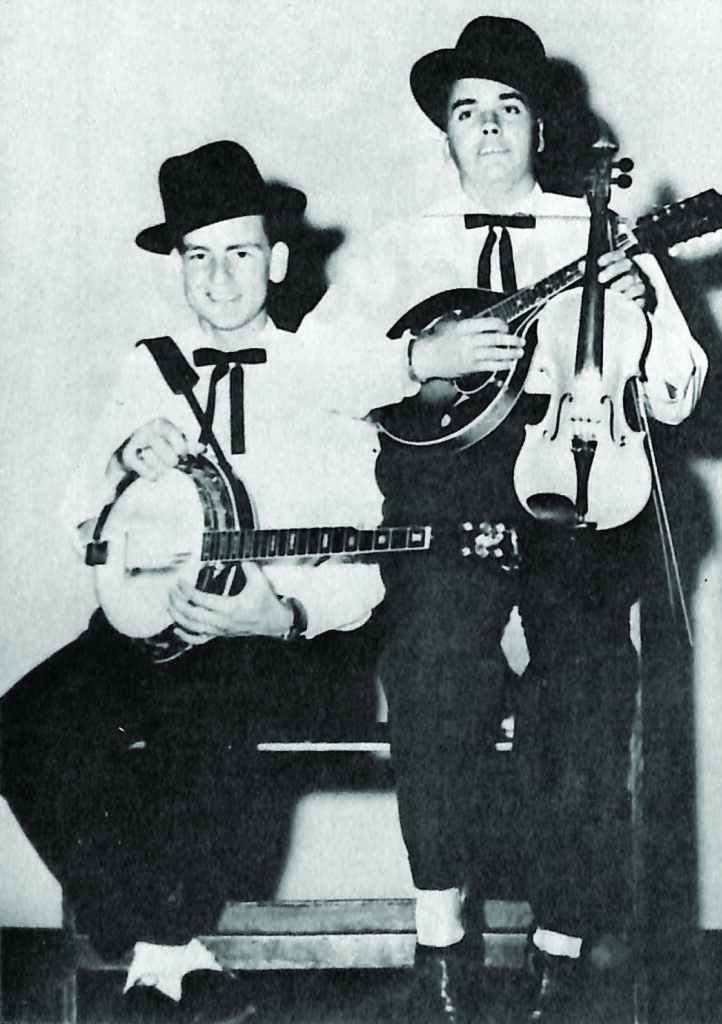
McCoury is known as a high lead and tenor singer now, but before he worked for Monroe he “sang every part there was in the bands I was in,” he said. “I could grab onto a new part real easy. With Jack I sang lead and played the banjo because he was a tenor singer. Jack had been Monroe’s lead singer, but he had a tenor voice. Then when I played that show up in New York with them, I sang baritone on songs like ‘On and On.’ Bill must’ve heard something in my voice, because he said, ‘Now, I want you to sing lead with me and play the guitar.’ I’d never had to sing lead and learn all the verses of the songs, and I had to hit lower notes than before. When I went to the Golden State Boys, I sang strictly tenor because they had a great guitar player and lead singer named Hal Poindexter. He was Tony Rice’s uncle, and man, I enjoyed singing tenor with him!”
When he decided to put Del McCoury and the Dixie Pals together in 1969, he thought, “If I’m going to have my own band, it will be easier if I sing lead. But I couldn’t find a good tenor singer, so whoever I could find, I’d have them sing lead, and then I’d jump to the tenor on the chorus. It got to be a habit with me, and I still do that today, although sometimes Ronnie will sing tenor with me. We both can sing both parts, so it’s an advantage to be able to do that.”
McCoury has such a unique voice, but fans who have listened carefully to Ronnie, Rob, and Del’s brother Jerry McCoury sing can hear the family tone. “My brother G.C. was nine years older than me, and then there were two girls, Elizabeth and Vivian, and then me,” Del explained. “Then another girl, Jeanette, and Jerry was nine years younger than me. They probably didn’t expect Jerry!” Del laughed. “We all had tenor voices. My brother G.C. could sing high, tenor or lead, and Jerry was the same way. Jerry was also a good showman. He could yodel and sing that ‘Goodbye, Old Pal’ that Monroe did up in the key of D. The Dixie Pals were playing at Berryville, Virginia for Carlton Haynie when the festivals first started, and Jerry was singing that song. I happened to run into Little Roy Lewis’s brother, Wallace, on the grounds later, and he said, ‘Man, you was hitting some high notes! You was stripping the leaves from the trees on that yodel!’ They’ve got that accent, you know,” Del smiled. “Wallace had been somewhere where he couldn’t see the stage, but he heard the song. He kept saying, “‘That was Jay—ree?’ That’s exactly how he said it. ‘Jay – ree.’”
Bill Monroe always called Del “Dale” with two syllables, and the last name was something like “Ma – Coo-ery,” which Del figured had something to do with his Scottish heritage. “One night we were coming in off the road on a Wednesday, and Bill told me, ‘Dale, I want you to hep me sing ‘Wait a Little Longer, Please Jesus.’ It just struck him; it was a good gospel song he had recorded. ‘I want you to do the verses. I don’t do that anymore.’”
“I lived in the old Clarkston hotel that was next to the National Life & Accident Insurance Company,” Del continued. “I knew they had records up there in the WSM studio. You couldn’t take them out, but you could listen to them. I took me a piece of paper and a pencil, and I played it over and over: three verses and three choruses that were all just a little different! Well, I took it back to the hotel and I practiced and practiced on it. I got a little excited at the Ryman because the Opry will do that to you,” Del chuckled, “and I was singing along. I knew that I’d messed up, but I just kept going. I sang part of the second verse, but then I put part of the third verse in it. I thought, ‘Oh, am I in trouble,’ and it threw me completely off, but I never stopped singing. I got the choruses right and Bill sang the tenor with me. It was the end of a segment and they dropped the curtain on us just as soon as we got done. Bill walked off and he went up a little ramp to his dressing room, and I went right with him. I thought, ‘Well, I’ll take my medicine.’ As we were going up the ramp he said, ‘Dale, you know I never heard it sung that way.’”
Del was with Monroe when the folk music boom took off in the 1960s, and he was surprised to see how the college kids loved bluegrass. “It was new to Bill, too,” Del said. “He had been used to playing Grand Ole Opry package shows with Roy Acuff and all those Opry stars like Webb Pierce and Faron Young. I remember once we were doing a package show at the Civic Center in Detroit, and Bill Monroe was standing there talking to Red Foley. All of a sudden Red stopped and said, ‘Excuse me Bill, I want to see who this is onstage.’ Then he came back and said, ‘I thought I heard a ghost.’ It was Hank, Jr., and he was singing his dad’s songs. He was 14, and his mom had brought him up to play that show in Detroit, and that was his debut, singing ‘I got a feeling called the blu -uu-uu-uu-ues.’”
Del credits manager Ralph Rinzler with breaking Bill Monroe into folk festivals. “Bill had played the Chicago Folk Festival before I came with him, but after that we played the Newport Folk Festival and the Philadelphia Folk Festival, and a lot of things that were like a folk festival. I had my own band by the time Carlton Haney had the festival in Fincastle, Virginia. I had just gotten back from California when he had the first one in ’65, and I’d kind of lost touch with what was going on in the East. Then in ’66 Billy Baker and I were still playing together, and I ran into Chris Warner who had played banjo with me before, and David Grisman. I knew David from playing with Bill up in New York City. We were just jamming in the parking lot at Fincastle; we didn’t come there to play onstage.” Billy Baker convinced Del to go talk with Ralph Rinzler, and the group closed out the festival that night. “Billy kept on, and he could always get me to do things I had no intention of doing,” Del laughed. “So we got up there and played, and Dawg (Grisman) forgot about that in later years. I don’t know if we even had a name!” Del said. “It was kind of a joke, but we could do a lot of songs.”
Now, here’s the rest of the story: “J. D. Crowe called me up a little after that, and he was working at the Holiday Inn in Lexington, Kentucky managing something for them,” Del recalled. “He said, ‘Hey, I heard a tape of you singing on something down at Fincastle. I tell you what—they’re gonna let me get a band and start playing music at this place. I’ve got Doyle Lawson playing the mandolin and singing tenor, and I want you to come and sing lead and play guitar with us.’ I always liked J. D.’s playing,” Del said. “He got started playing a banjo a little bit before I did—both him and Sonny Osborne. I heard them on records when I was young. I said, ‘Look, let me think about it overnight, and I’ll call you tomorrow and tell you,’ because I’d have to talk Jean into moving out there and I didn’t know about that!” Del smiled. “He said we’d be playing every night, and it was pretty good money. But as it happened, the next day my dad had a massive heart attack, and I called J. D. and said, ‘Man, my dad is sick, and I just can’t leave. See if you can get somebody, and maybe later I could come.’ He was going to start right away—that weekend—so he got in touch with Red Allen. He took the job, and he did a good job with it and they recorded. But that was through that tape from Fincastle!” Bluegrass history could have turned on a dime if Del McCoury had joined J. D. Crowe and the New South instead of Red Allen, and later Tony Rice.
Del and his family were accustomed to working hard, a habit that has come in handy over the course of a long, productive music career. “I grew up on a farm, and we all worked hard,” Del said. “My dad worked in a defense plant as a machinist during the war [World War II], and then after the war was over he said, ‘You know, we’d better get us a little farm so we can raise a garden.’ Dad bought a 90-acre farm with a house and a barn on a sheriff sale for $1,700,” Del said. “Of course, he had to borrow the money from the bank to get it. We moved into that when I was probably in the third grade. Dad had farmed before, so he just went right back to it. He had nine cows, and he started shipping milk. He eventually bought electric milkers, but we milked by hand before that,” Del said. “I’ve got big hands, and that’s what it’s from!”
“Then he bought nine more cows. We would milk the first nine, and then take them out and bring in the next nine cows. We shipped the milk to the Penn Supreme company, and we had a little milk house where you’d put a cooler. We worked hard out in the fields, too. Every job I had, I had to work really hard at,” he said. “I had never done any timber cutting until Rob was a baby. My wife’s uncle stopped at the house one day and said, ‘I need a skidder operator.’ It’s a machine with a winch on it, and you put choker chains around a tree and pull it out of the woods. They skid [transport] logs out of the woods with it. Before that, they used horses and mules. I said I’d never run one in my life, but I’d run everything else—tractors and trucks and the like. I ran that thing for about 11 years and was raising kids. I recorded records with a band all through those years, but it’s hard to do a day job and play music. I did it. I couldn’t do it today!”
McCoury made the first recording under his own name, Del McCoury Sings Bluegrass (Arhoolie) in 1967 with Billy Baker, Bill Emerson, Wayne Yates, Tommy Neal, and Dewey Renfro. Del McCoury and the Dixie Pals performed and recorded from 1969-89, starting out with Jerry McCoury on bass, Larry Smith on banjo, and Dick Laird on mandolin. High on a Mountain (Rounder) was a strong recording from this chapter of Del’s career, along with the self-titled Del McCoury (Rebel) released in 1975 and Our Kind of Grass (Rebel) in 1978. The Dixie Pals line-up that toured Japan in 1979 included Dick Smith on banjo, Herschel Sizemore on mandolin, Sonny Miller on fiddle, and Jerry McCoury on bass. Del signed with Leather Records out of Roanoke, Virginia and released Take Me to the Mountains, which was re-issued by Rebel in 1984, followed by Sawmill (Rebel, 1985).
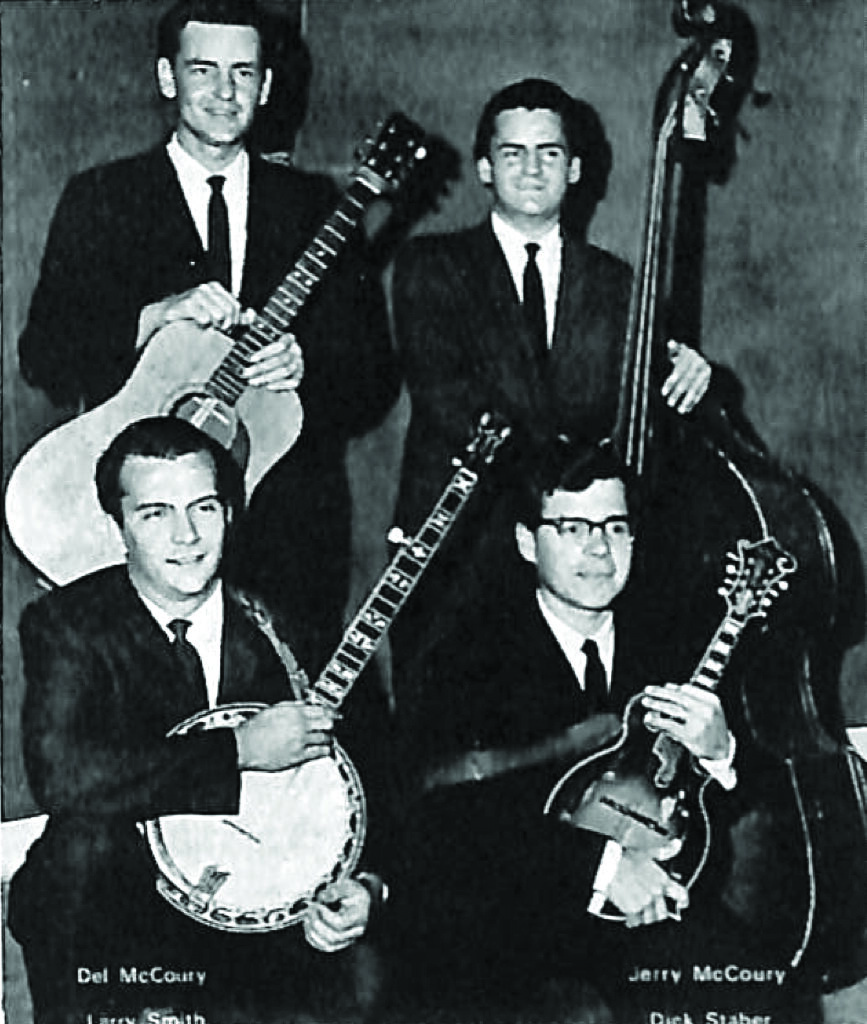
Ronnie McCoury, born in 1967, joined his dad’s band on mandolin in 1981, and his brother Robbie (born in 1971) joined as the bass player in 1987 and switched to banjo a year later. Del’s ten-year run on Rounder Records began with the 1987 release, The McCoury Brothers (Del and Jerry), but by the end of the 1980s the group was known as The Del McCoury Band, with Tad Marks on fiddle and Mike Brantley on bass.
“The kids got all through school, and we decided we’d move to Nashville in 1992,” Del recalled. “We had already paid our place off up there, so we bought the place down here and thought, ‘Well, if things don’t go right, we’d go back to that place in PA, in York County.’ Things worked out well for us. I had my two boys, but the other two members of my band didn’t want to move to Nashville. Mike Bub came into the band (on bass), and Jason Carter played fiddle with us while we were still in PA. He lived in Kentucky, and he eventually moved to Nashville, too. That was the last ‘manual labor’ work I did, since then,” Del said, “except for working on buses!”
“I like a bus,” Del said, and he remembers each one fondly. “The first one I got in PA was an Aero coach, and then a Flexible coach. When I moved to Tennessee I had a GMC coach, and I parked that and donated it to Glenville State College. They have a program where they teach bluegrass in Glenville, West Virginia, and the students go in that bus and play. That’s what they tell me!” Del smiled. “It was a green Silver Eagle bus that I ran from 1995 to 2007, and then Jean made me quit driving. I used to drive all night and then play the next day. Then we started flying everywhere we had to go, and we would rent vehicles. Then when the pandemic came, flights were canceled and everyone was afraid to fly.”
The COVID years of 2020-22 were unlike anything Del had experienced before in the music business. “It was so different for all bands,” he said. “I remember we were at the Tuesday night Opry in March 2020, and that was the last thing we played for a long time. Then the next time we played the Opry, it was with no audience. Then we eventually broke back into it. I said, ‘Look, I’ll just buy a bus if we’re not going to fly.’ We started to play again, and they would put people out in pods in the audience and all that. They’d keep them separated. Jean said, ‘Well, you’re not driving,” and I said, ‘I’ll get a driver.’ I heard that David Parmley had his bus for sale, and he was also driving for the country band, Rascal Flatts. I went and looked at the bus and bought it from him, and I said, ‘David, do you know who I can get to drive this thing?’ He said, ‘I’ll drive it.’ So I got a bus and a driver, all at once. He still drives for me. He’s got a band and he’s recording, but he books his dates around the dates I have. I remember when the Parmleys moved [in the mid-‘70s to Virginia] from California they were in a Flexible. I had a Flexible at that time, too. David said he drove most of the way, and he was just 14!”
In the early days of the Grand Ole Opry a lot of the string bands with the colorful country-sounding names and the comedians didn’t command the respect the big country stars enjoyed. Del said he has never felt like a second class member of the Opry because he plays bluegrass, and Bill Monroe didn’t either. “Carlton Haney and Ralph Rinzler had a lot to do with Bill Monroe playing for audiences outside country music,” Del said. “They put him in with electric bands, and sometimes it was hard for Bill to shine that way. But both Carlton and Ralph knew that this man had something special, and that he had invented or somehow come by this music he played. He tried some different things, and then when Earl Scruggs came into the band, he really cemented the sound of a bluegrass band. People went crazy over their music. Sometimes the Opry emcee would introduce the Blue Grass Boys as ‘Earl Scruggs and his fancy banjo,’ and not even mention Bill Monroe’s name.
“When I was with Bill he was still on the outs with Flatt & Scruggs” over their departure from the Blue Grass Boys, Del recalled. “Bill had a dressing room at the Ryman, and there were only certain people he would let in it! He came there in 1939. Acuff came in ’38, and from what I can remember there were only two dressing rooms: Bill had one and Roy had one. Bill would let Ray Price and Hank Snow in his dressing room, but Flatt & Scruggs had to lay their instruments out in the hallway, on the floor! That’s the only place they had, because there was no rehearsal room. And they were famous!”
Interestingly enough, dressing room #1 at the new Opry House is still known as Roy Acuff’s, and #2 is the bluegrass dressing room, with a larger than life size photo of Bill Monroe on the wall. Room #3 on that side was for Little Jimmy Dickens, Del noted.
After moving to Nashville in 1992, the McCourys recorded three classic albums on the Rounder Records label: Don’t Stop the Music, Blue Side of Town, and A Deeper Shade of Blue. In the 1990s they became known as “the first family of bluegrass,” dominating the International Bluegrass Music Awards Show. Year after year Del and the band would return to the stage, with oldest grandson Jacob McCoury in Del’s arms (daughter Rhonda’s son). Each band member would share a word of thanks, and sometimes Jacob would add his comments, too!
Del has taken home four Male Vocalist of the Year awards from the International Bluegrass Music Association (IBMA), and in 1994 the quintet began a streak of top Entertainer of the Year honors with nine trophies in an eleven-year stretch, along with eight Mandolin of the Year awards for Ronnie McCoury, six Fiddle player awards for Jason Carter to date, and five Bass Player trophies for Mike Bub while with the band and afterwards. There were also two Instrumental Group, one Album of the Year, and one Recorded Event of the Year awards for the band. Rob McCoury would be named IBMA Banjo Player of the Year in 2015, and Alan Bartram took home top bass honors in 2017.
One unforgettable IBMA Awards moment was in 1993 when Ronnie McCoury accepted the Mandolin Player of the Year award, and then he walked out into the audience at RiverPark Center in Owensboro, Kentucky, to hand it to Bill Monroe—the only year the Father of Bluegrass attended IBMA World of Bluegrass events. By the end of the 1990s the Del McCoury Band had recorded an album (The Mountain) with songwriter/folk rocker Steve Earle and was touring with him, exposing pure, unadulterated, high-powered McCoury bluegrass to new audiences.
In 1995 Ronnie and Rob McCoury released a self-titled CD on Rounder, and in 1998 Ronnie teamed up with David Grisman and an impressive list of influential mandolin players to produce Mandolin Extravaganza (Acoustic Disc), which garnered two IBMA Awards in 2002. In 2007 Ronnie released a fun, sweet bluegrass children’s album called Little ‘Mo McCoury on the McCoury Music label. Rob McCoury released The 5 String Flamethrower in 2014. Jason Carter showcased lead vocals as well as his fiddle playing on the 2024 recording, Lowdown Hoedown, featuring Jerry Douglas, Sam Bush, Sarah Jarosz, Billy Strings, and more.
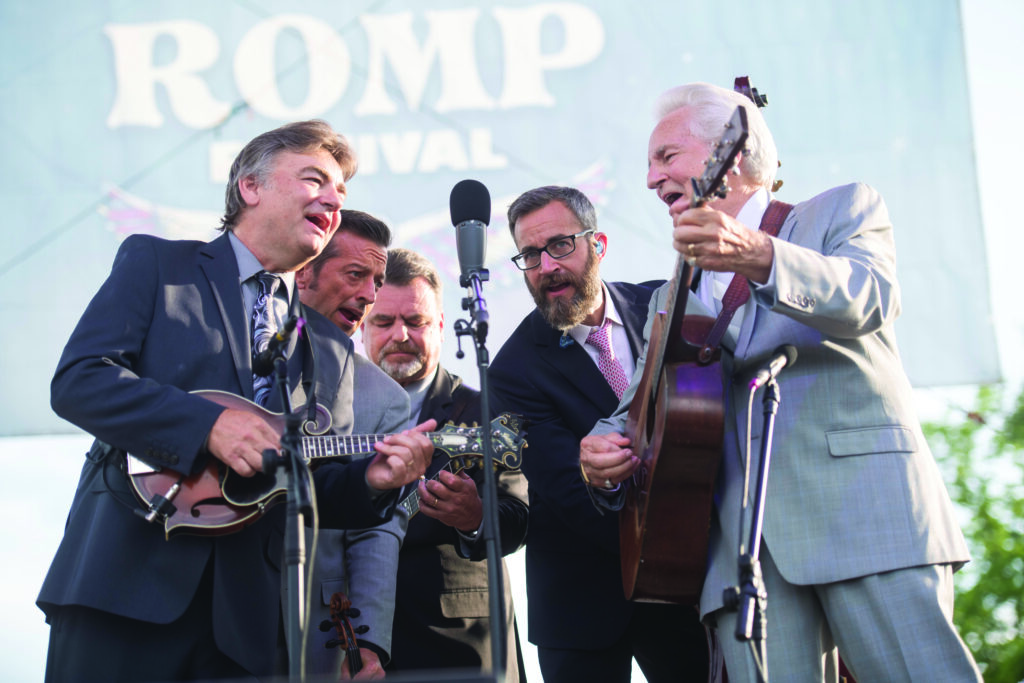
Legendary Dobro player and 2024 Bluegrass Hall of Fame inductee Jerry Douglas produced several Del McCoury Band albums in the 1990s for Rounder. “I loved working with Del and the boys in the studio,” Jerry said. “I had met Del years back when I was playing as a teenager with the Country Gentlemen. Even then Del was a festival favorite with his high vocals and powerful guitar playing, and his band The Dixie Pals was a perfect setup for what was to come later on for Del. When I started producing them there was a new buzz about them. Del had found the perfect band. His sons Ronnie (my co-producer) and Rob were playing at a very high level, and Jason Carter was brand new to the band, as was Mike Bub. They had found the magic key to playing as a true band, watching and listening to each other like never before. There was such wonderful alchemy between them.”
DelFest, staged every year in May at the Allegany Fairgrounds in Cumberland, Maryland, was launched by the Del McCoury Band and High Sierra Music Festival in 2003. “Through the years I knew I wanted to have a festival,” Del said, “but I knew that if you want some headaches, just go ahead and try that! I figured I had enough headaches as it was!” McCoury had worked briefly with a manager in Pennsylvania who was a veterinary student and former assistant to Carlton Haney that booked Johnny Cash in the region. “When we moved to Nashville, Stan Strickland was managing Ricky Skaggs,” Del said. The McCourys agreed to record two albums for Ricky’s Ceili Music label, and to sign with Stan Strickland and Rainmaker Management. When Strickland and Skaggs parted ways amicably, Del chose to continue working with Rainmaker. “Stan had done a lot of good things for me by that time,” Del said. “That’s when I realized you can’t do it all, yourself, in this business.”
Strickland suggested the music festival idea, and he sent the late Roy Carter out to scout locations from the east coast through Florida. The first place he showed Del and the family was Cumberland, Maryland, and they loved it. “This is as good or better than any place you’re going to find,” Del told them. “There’s a river there and a big, steep mountain there, and the area where the stage was going to be was flat, with plenty of room for parking.” In meetings with the county commissioners, McCoury said, “We’re not looking to come in here and have a big festival and make a lot of money and leave. We’re looking for a place that can be like a home for us. We don’t care if we don’t make any money the first year, because we know that’s part of the plan.” The event broke even the first year and has grown each year since, except for the two years off during COVID. “We got involved with local charities and the food bank,” Del said. “That’s where a manager comes in. There are bands who have been cheated by their managers. But I trusted Stan, and I still do. We’ve been together 26 years now. I told the boys, ‘I tried it both ways, and I tell you, it didn’t work the way I did it during the first half of my tenure with bluegrass.’ It didn’t work for me, anyway. Things work out great for certain people, but I could tell things were better for me when I found someone who really knew how to manage a band.”
Del liked the idea of having a variety of music at DelFest because he noticed long ago that “everybody doesn’t like the same type of music.” Their experiments with booking a few contemporary country artists have not worked as well as “some of the jam bands and up-and-coming bands Roy Carter and Ronnie McCoury found,” Del said. “We would find them before they got too expensive for us to book!” Billy Strings and Don Julin opened up for some of the City Winery concerts Del and David Grisman played together on the “Del and Dawg” tour in 2019, and then Billy ended up coming to DelFest and jamming all night with Del’s grandsons Jacob and Heaven (Evan). “When I first met Billy Strings he wasn’t doing that well yet and he didn’t have a good guitar. Now he’s got a slew of good guitars,” Del laughed. The May 23-26, 2024 line-up at DelFest, emceed by Joe Craven, included the Del McCoury Band and the Travelin’ McCourys, along with Lukas Nelson, Marty Stuart & his Fabulous Superlatives, and a strong mix of bluegrass and jamgrass-leaning acts. The entire McCoury clan shows up and helps run the event, rather like a working, but fun, extended family reunion.
Guitars are one of Del McCoury’s favorite topics of conversation, along with his family and buses. He keeps a mid-60s D-35 Martin on a stand in his kitchen, to play around the house. His favorite guitar to record with is a red 1936 D-18. He had first seen the instrument in Pennsylvania years ago, and then it passed through Larry Perkins’ and Mike Armistead’s hands in Nashville before Jerry Douglas told Del it was in a music store south of town. “What I didn’t realize at the time is that usually D-18s are better to record with than D-28s,” Del said. “D-28s are too ‘boomy.’ So I went and bought it and recorded with it, and it’s the best sounding guitar I’ve ever recorded with. It plays easy; it has a little, thin neck. Tony Rice told me, ‘You know what I like about this guitar? It’s petite.’ I like the way it feels. I’ve played other guitars that sound better when I play them live, but this one is better in the studio.”
Del played one of his favorite guitars, a 1956 D-28 that Jean purchased for $250 and gave to him as a birthday present, for many years onstage. More recently he has played a 1947 D-18 Martin that David Harvey found for him. Since fall 2023 Del has been partial to playing a guitar onstage built by a mandolin builder in London, Kentucky named Johnny Gray. The Gray guitar started out belonging to David Parmley, but he preferred a thinner neck and ended up with a second guitar. Del got David’s first one, and Dan Tyminiski is also playing one now. Dan and Del played them side by side at a recent picking party, and they have a very similar tone. The builder “got this good rosewood lumber from an old man in Tennessee,” Del said. “Then he got some good wood for the tops. He told me, ‘I don’t make it exactly like the old Martins, but it’s close. I’ve got my own twist.’ I’ve been playing that onstage all the time,” Del said. “You know what? I think I like variety in music, and I like variety in guitars! I like playing one for a while, and then getting another one.”
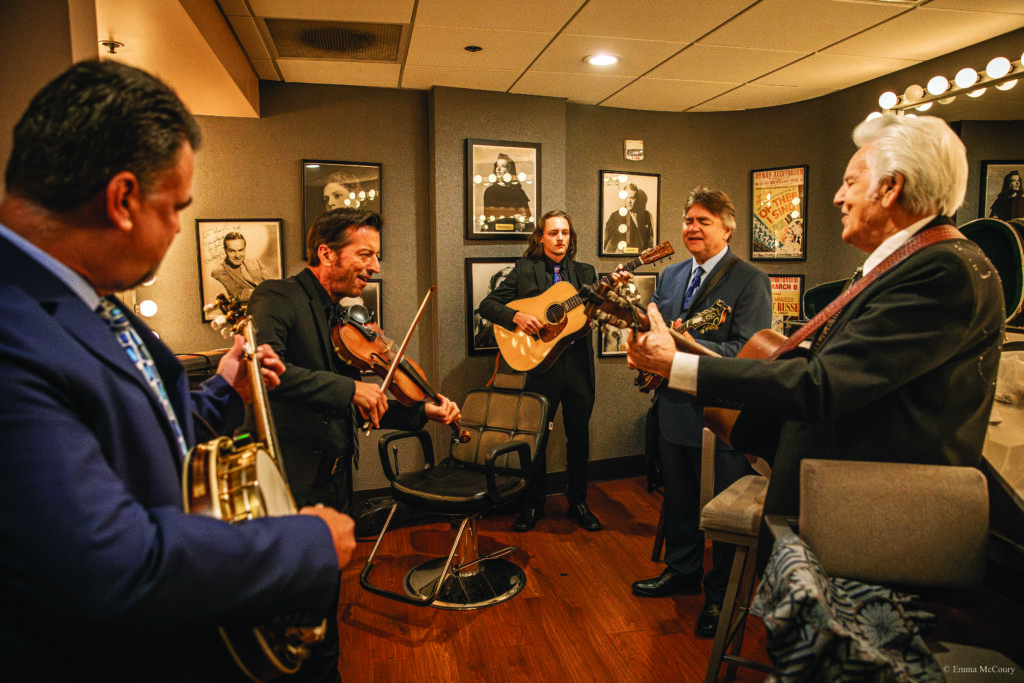
Del released It’s Just the Night, his first album on McCoury Music in 2003, where all his albums have been recorded since. He has worked with a handful of producers over the years. “Dick Freeland, the first one with Rebel Records, was hands on,” Del said. “He’d rent the studio and be there when you recorded. He wanted to hear all the songs, and he made sure we had the right microphones for each instrument. Dave Freeman, the next owner of Rebel, was the opposite. He said, ‘Just go ahead and find the studio and record the songs and bring me the tape.’ You would produce it yourself, and of course I always found my own material. Ken Irwin produced some when we were with Rounder. Jerry Douglas was good at bringing me things to sing that I didn’t even dream of doing,” Del laughed. “He’d say, ‘Oh, no. You can do this.’ And then he’d find the right key.” Sometimes he would play the Dobro, and sometimes not—depending on what the song called for.” A couple of times when a baritone harmony part was needed, Jerry would recruit whomever happened to be in the studio—once a surprised and reluctant Bela Fleck, and once himself. Del has found a comfortable rhythm in recent years, co-producing new recordings with his son, Ronnie.
As the years rolled on, the recognition, awards, and interesting collaborations continued. The Del McCoury Band is a crowd favorite at venues ranging from the Opry to Bonnaroo. He has influenced and/or collaborated with folks like Vince Gill, Dierks Bentley, the Preservation Jazz Hall Band, Phish, Leftover Salmon, the String Cheese Incident, and Donna the Buffalo, among others. The Del McCoury Band has guested on television programs like Late Night with Conan O’Brien and the Late Show with David Letterman.
In 2002 Del and the band were a part of the enormously successful Down from the Mountain Tour, a result of the popularsoundtrack album for the movie, O, Brother Where Art Thou? Del was asked to join the Grand Ole Opry in 2003. In 2004 Del was nominated for the Best Bluegrass Album Grammy for It’s Just the Night, and in 2006 he won the award for The Company We Keep. In 2014 he won his second Grammy for The Streets of Baltimore. In 2010 Del received a National Heritage Fellowship in the field of folk and traditional arts, with a stipend of $25,000. He was inducted into IBMA’s Bluegrass Hall of Fame in 2011. The Travelin’ McCourys took home the Bluegrass Album Grammy in 2019, for their self-titled album released in 2018.
Del has 38 original songs listed with BMI, including “Beauty of My Dreams,” “Blue Piece of Paper,” and “I Feel the Blues Movin’ In,” among others. A limited edition series of 115 Martin D28-DM Del McCoury signature guitars was sold out before production began.
“I still love to go onstage and play,” Del said. “I think getting tired of traveling is the downfall of a lot of musicians. That’s something I’ve never minded, and I think that’s one of the reasons I’ve stayed with it so long. I like all the things that pertain to a road band. I like a bus, and I like doing a record. I find a lot of satisfaction in getting a record done, and I’m always enthused about learning new things. I just like anything connected with music.”
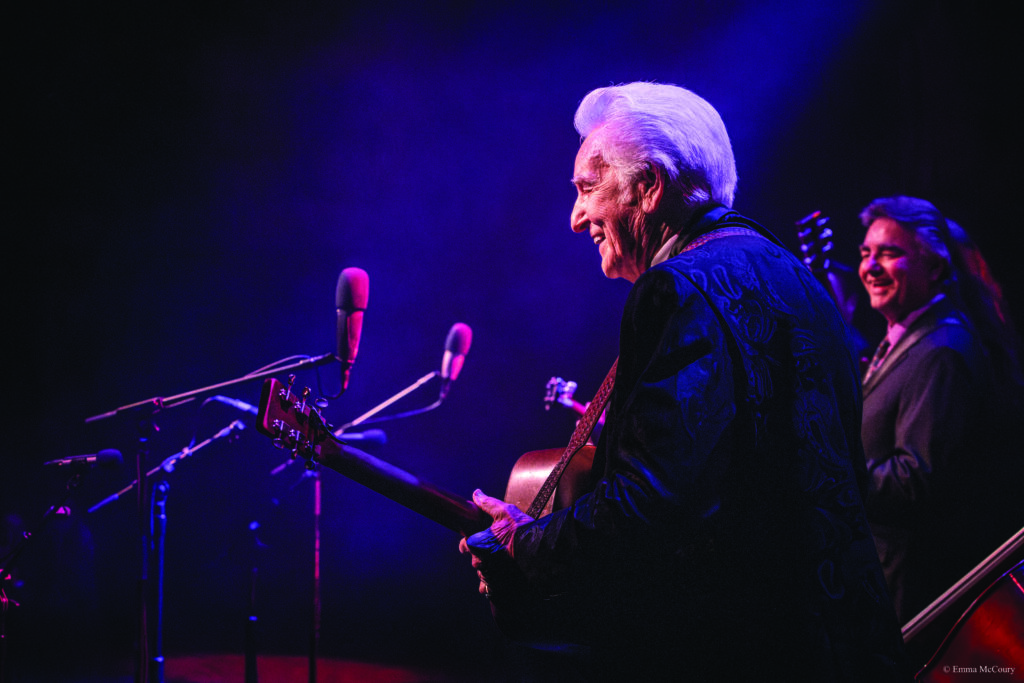
It doesn’t hurt that Del is backed by one of the very best bands in the music business. “I tell people these fellows aren’t in my band because they’re my boys,” Del said. “They’re the best I can find! And the reason they are is because they know what I do, and they think like I do. If I’m thinking of something, they’ve already done it! And that includes Alan and Jason.
“I don’t even think about retiring,” Del said. “I’m sure that Jean would like to be home more. My dad died when he was 71, and her dad died when he was about the same age, but the two of us are in entirely good health. I think a lot of that has to do with how she watches what we eat, and she has for years. We take a lot of vitamins, and doctors tell us, ‘Oh, you need to throw those away. If you get the right food, you don’t need them.’ But we thought, ‘Well, as long as we’re still living at this age, maybe we should keep on doing what we do.’ It’s working, I think. And for the most part, I stay in a good mood.”
Stress can kill you. “It’s true,” Del agreed. I think I’ve been fortunate and lucky, in a way. I’m in a good mood most of the time, and I think the Lord looks out for people who treat other people right. I kind of have that in mind. I never get tired of a new song, or even an old song. Sometimes I’ll think of an old song that’s been neglected, and I’ll want to learn that song and record it!”
Like anyone his age, Del forgets things once in a while. “Names and numbers are the worst,” he said. “I used to know every phone number of every musician that ever played with me.”
Looking back over the many accomplishments of her husband and the band, Jean McCoury said, “I think we are most proud of the fact that we have raised three wonderful children. It’s been lots of hard work, especially in the beginning, trying to raise children while both of us were working and Del playing music as much as he could. It wasn’t easy in those days. We are most grateful for our seven beautiful grandchildren who we are so very proud of. We as a family have been so blessed!”
It’s a sad fact that many marriages don’t survive the music business. “I think it may have been easier back then to survive the touring music business,” Jean McCoury said. “There weren’t as many distractions back then as there seem to be these days. We just worked together to provide a home, raise the kids, worked together on Del’s music career, and supported each other as much as possible. My advice for any young couple is to work together and help each other—just be a team—regardless of the spouse’s dream.”
Contemplating the future, Jean said, “I hope my sons follow in their Dad’s footsteps and continue to be the men that they are today: great musicians, husbands, and fathers. My wish for our grandchildren is to do what they love and be proud of who they are and where they came from. We are a family of hard workers, and they know anything is possible if they work hard at what they love like Del and I did. I’d also like to add that we have the most talented musicians, Alan Bartram, and Jason Carter, and the best sound engineer, Key Chang, in our band. They work hard, go above and beyond for us all the time, and are just a great bunch of boys. They all mean so much to me and Del.”
“Years ago, I used to get mad at Jean sometimes,” Del said. “She’d tell me something and just make me mad! In the later years I got to thinking, ‘You know, she knows something that I don’t.’ And most of the time what she says works out to be true in the end! So I got to where now, I listen to Jean a lot,” Del said, smiling. “She knows how I work. She’s been a big part of what we do, all through the years.”
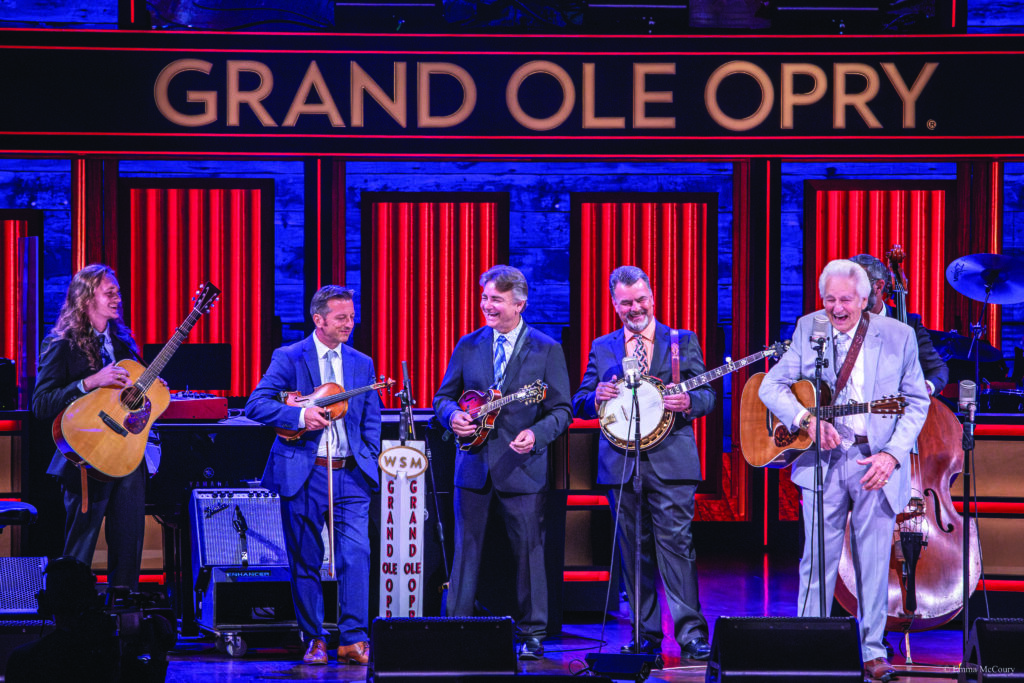
“I started in 1981 and I was 14 years old,” Ronnie McCoury recalled. “My dad has been my guiding light and inspiration to play the music all these years. My mother has always been so supportive and always helped us get onstage and do what we do. She is the rock behind all of this. Dad and I have been doing this over 47 years together. It’s been amazing to see everything that’s happened to him through the years. Moving to Nashville in the early ‘90s made such a big difference for the band, we got more exposure when we got there, and we got to be guests on the Grand Ole Opry. My dad was winning the awards at the IBMA Awards Show each year, and so was the band. He eventually became a Hall of Fame member. Just to be able to be with him in the band by his side through all this has been the most rewarding thing.”
Ronnie and Rob have both paid close attention. “The most important thing I’ve learned from both my parents is to do what you love, and do it with all the dignity they have,” Ronnie said. “Both my parents have worked hard all their lives, and one of the main things I’ve taken away is how hard they’ve worked for us. My dad just give 100% onstage, and that’s something I hope I can maintain as I grow older. And both of them have always taught us to treat people like you want to be treated.”
“It’s been quite an experience,” Rob McCoury added. “We’ve got to see so many places and do so many things and play with so many people. It’s been a heckova training ground! I’ve learned from my dad to give it 100% every time you get on stage, and my mom is quite business savvy and always has been, so I have learned a lot of that from her. It’s a family business. There are a lot of moving parts, and my folks have figured it out pretty well because they’ve always been a team. I think when it comes to dealing with the public, what I’ve learned is to just try and be nice, because if it weren’t for those people we wouldn’t have a job.”
How will bluegrass fans in 100 years remember the McCourys? “I hope the band will always be remembered for delivering quality music onstage and record.” Rob said. “I think we’ve played at the highest levels we can possibly play at for the people, and hopefully it shows,” Ronnie said. “My father is still is so incredibly into the music. He sings and plays amazing at his age. I know it’s not an easy thing to do, but he does it, and he does it with dignity and with a good sense of humor too, along the way. I just hope to be remembered as a band that gave it 100% each night.”
The Travelin’ McCourys have been touring and recording as a spin-off band of the Del McCoury Band since 2009. “When my dad hit 70, or a little past that, he was worried a bit about us,” Ronnie said. “If he lost his voice or his health, he didn’t want us to have to start over, cold. So we put this band together, and it was his idea as much as anybody’s. We do quite a few shows in a year, and it seems to be growing a good following around the country. We hope to keep going as long as we can, and I hope we can keep it at the level that my father has all these years. I think we have a good future ahead.” Rob agrees: “I hope we can keep the legacy going and make music that people enjoy, and do it as long as we can.”
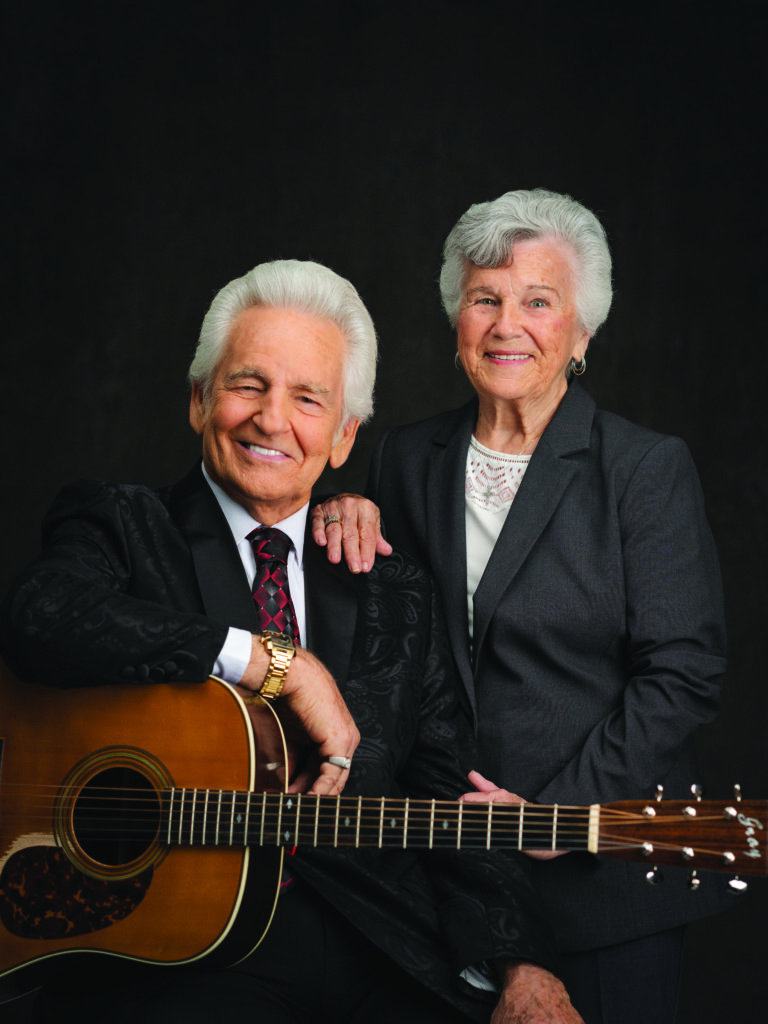
Perhaps longtime friend Jerry Douglas described Del’s legacy best: “The McCourys will be remembered as a dynasty,” he said. “While Del has slowed his traveling schedule, Ronnie and Rob, along with Jason Carter and bassist Alan Bartram and brilliant guitarist Cody Kilby, have created another connection to the family. The Travelin’ McCourys have taken the McCoury sound into another genre, bringing their father’s wisdom and his giant fan base to a totally different group of people while maintaining their power and energy from playing this physical music we know as bluegrass music. It’s a very good—emotional, actually—feeling to know I had any part in what this juggernaut of a musical family has become. It makes me very proud, and I cherish my relationship with these people as we have grown together. One thing about it though, voices and humble giants like Del McCoury don’t grow on trees. We’re all so lucky to have lived to hear something so deep and soulful as this man and his family.”
In 1979 my band, the Cayuga Bluegrass Works, were playing a festival in southern NY, near the PA border, and Del McCoury’s band was on stage with Ronnie, age 12, playing mandolin. I was somewhat disappointed that he never played melody lines on his mandolin, but Del had plans for the future. On our way home, we passed Del’s bus by the side of the road, broken down. There were two heels poking out from under the back of the bus, Del was under the bus fixing it!