His Journey To Become A Bluegrass Fiddler
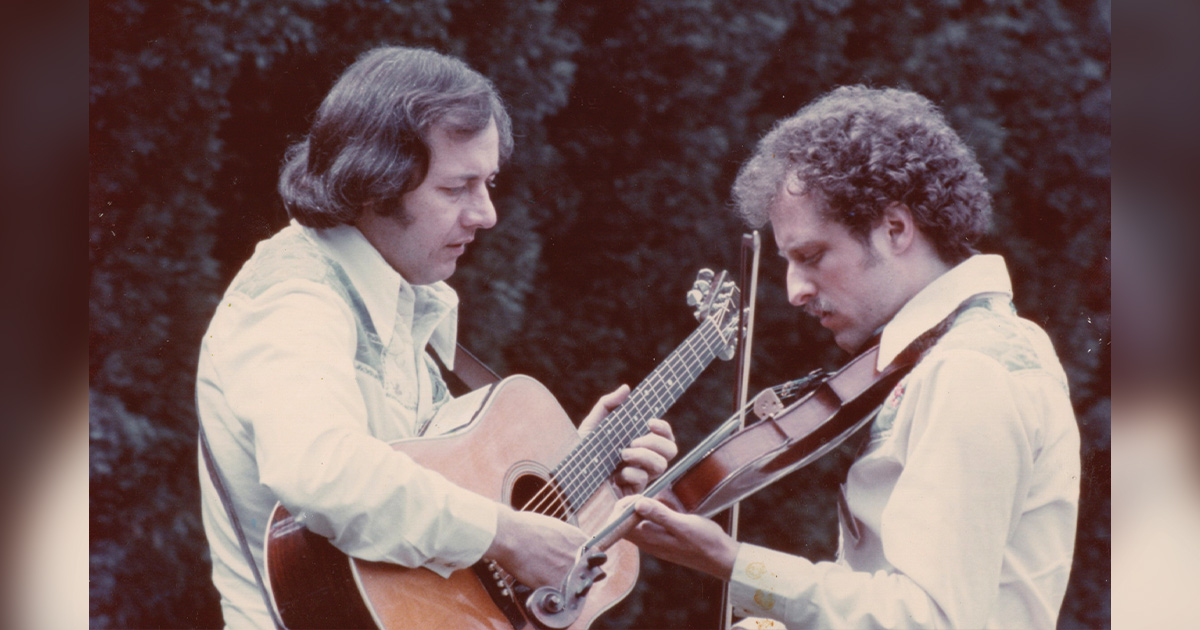
Dave Goldman is an interesting and diligent musician who has worked hard at his craft and become a respected and talented fiddle player. The story of how he attained this status is inspirational. He grew up in Chicago with almost no family influence of country or bluegrass music. Dave took music lessons during his school years and played clarinet and piano but he had never played any stringed instruments. When he was a senior in high school, about 1966, and after his father died, he started to pal around with a friend who played guitar. It was mostly folk music which was quite popular at the time but he was not a bluegrass person.
Somehow Dave got in his head that he should play the banjo. Looking back he thinks that it probably came from seeing the Dillards on the Andy Griffith Show. What intrigued him was hearing all those fast notes coming from the banjo with the player. Doug Dillard, being completely motionless and showing no emotion or facial expression. And he thought, “Oh my God! How is he doing that?” This is a familiar story as The Dillards on the Andy Grifith Show was the starting point for many prominent musicians.
Dave got the Pete Seeger instruction book and worked with that and took a few lessons from a guy named John Miller who knew how to play the Bill Keith tunes. Another musician he met quite early in his musical journey was Roger Bellow who became a lifelong friend. He was a bluegrass picker who was known around town as a really good lead guitar player and he could play fiddle and banjo too. Roger had just started learning to play mandolin when one of the guys at an open mic who was a local musical hero said, “Okay Roger, muddle through something,” and Roger just nailed it and surprised everyone who watched and listened with amazement at his talent.
Dave reflects that at that time he could hardly play and would start and stop and stumble. “Roger always let me play along with him and was very patient. He took me to open mic events and pushed me to get up on stage and play.” A highlight at this early time of learning was playing on a New Year’s Eve radio broadcast. Dave often says, “I owe a lot to Roger for putting up with me and giving me pointers about the banjo and performing before an audience.”
In 1967 Dave moved to Washington, D.C. to attend George Washington University. He soon made friends with a number of local bluegrass musicians and somehow found time to play without letting his studies falter. The D.C. area had an active and lively bluegrass scene with lots of picking parties and open mics.
The first band he played with and got paid for was Bill Bailey and The Melody Mountain Boys. They played at a place called the Casablanca in Alexandria, Virginia, which was a really rough beer joint. The windows were all boarded up and there were frequent fights, but it was somewhere to get started. Bill Bailey was the stage name for Bill Offenbacher who played guitar and sang and was the band leader. Bill was well known as a record collector and for taping live shows of the major bluegrass stars at nearby music parks.
Bill had played guitar with “Buzz” Busby And The Bayou Boys’ and “Buzz” often came to the Casablanca and sat in with the band for a few numbers. At the time Dave had a girl friend who asked him to take her to the gig. Dave told her that it would not be a good idea for her to go there, but she persisted. When they arrived at the Casablanca there was a bunch of drunks hanging out in front and one of them peered into the car window at her with his tongue hanging out. She said, “Take me home!!” So Dave had to take her home and then come all the way back to Alexandria.
Dave didn’t take up the fiddle until about 1970. At the time he wasn’t particularly interested in the fiddle because he thought it sounded very rough. A lot of open strings and sour notes and it just didn’t appeal to him. The singing didn’t appeal to him either. All he was interested in hearing was the banjo. Dave was probably hearing some of the early recordings and local bands that were not very polished.
When Dave heard the Kenny Baker-Joe Greene album High Country, he noticed how pretty and smooth the music was. But even after beginning to appreciate the sound of the fiddle he still wasn’t interested in playing one. By chance he came across a fiddle at a flea market and bought it for about $20 with the thought that he might someday learn to play it.
In the fall of 1969 Dave attended the bluegrass festival a Callaway, Maryland. How he got to the festival is an interesting story. Callaway is about a 75-mile drive from D.C. and he hitch-hiked there carrying his banjo. After a long wait a car stopped and picked him up and the driver was Bob Johnson. Bob was a well-known area bluegrass fan who often hosted picking parties. As soon as Dave got in the car Bob asked, “Can you play that thing? Take it out and play something.” And Dave entertained him on the banjo all the way to Callaway. A few years later Bob fathered Merl Johnson who is a master musician on all the bluegrass instruments and who has played with a number of national touring bands.
Dave enjoyed the festival but didn’t pay much attention to the music on stage and was still sticking to the banjo. Several months later a film of the Callaway Festival that he had attended was broadcast on the local public television station. They showed some of Bill Monroe’s set and there were some very good close-up shots of Kenny Baker playing. Dave noticed his bowing arm and thought, “Wow! That’s what I want to do!” Dave loved the music he heard and the way Kenny looked when he was playing. This was the first time Dave appreciated how good the fiddle could sound. He said, “I don’t know if it was the sound or the way it looked but that was the first time I really appreciated how different Kenny sounded from anybody else. He played with perfect tone, perfect timing, perfect accentuation and probably most important was his perfect taste.” Seeing this TV show was Dave’s inspiration to learn to play the fiddle.
To get started Dave bought the Tracy Schwarz instruction book and record. This was a good start, but he was not able to make much progress. One evening Dave went to a folk music club and there was this white-haired guy playing the fiddle who appeared to be about 60 years old which seemed ancient to Dave at the time. His name was Lester Wolfe and he billed himself as “Papa” Wolfe. His girlfriend backed him up on guitar. Dave remembers that “Papa” could really play! The tunes he played were in the Canadian hornpipe style and his playing had a lot of drive. Where he really shined was on the swing numbers. His repertoire included big band songs and familiar jazz tunes. “Papa” played every note with perfect pitch, tone, and power which really impressed him. Dave went back to the club the next week and asked “Papa” if he taught fiddle. He did, and Dave took 7 or 8 lessons and learned how to hold the bow correctly and the basics of good technique.
Dave attended the Myrtle Beach, SC Bluegrass Festival in November 1970. His primary reason for going was that Bill Monroe was at the festival and Kenny Baker would be there. He had heard that Kenny enjoyed swing music and had played it before he played bluegrass fiddle. Dave relates, “So, I took along a tape I made of “Papa” Wolfe because I thought Kenny would get a charge out of it and help him remember me. I was able to approach him and play it for him and it just knocked him out.” Kenny said, “I want a copy of that. Can you get me one?” Dave was more than happy to comply and promised to send him a copy. This was on the last day of the festival and Kenny most graciously asked Dave, “Are you okay to get home? Do you need any money for gas?” Kenny was so impressed with “Papa” Wolfe that he wanted to be sure Dave got home to send him a copy. And this was the beginning of a lifetime friendship. A few years later, Dave was able to introduce “Papa” to Kenny at the Culpepper, Virginia festival where they played a few tunes together. Dave was still attending college, but he was able to attend most of the nearby festivals where Bill Monroe was booked. This helped him cement his relationship with Kenny.
The first band Dave was in as the fiddle player was called, Mrs. Kimball’s Fruits Nuts and Berries. Danny Kimball played mandolin and sang. The band name came from Danny’s mother, Mrs. Kimball, who had a fruit market in Ashton, Maryland. Tom Barbee was on guitar; Gary Shawm was on banjo; and Bob Williams played bass. They had a few gigs and enjoyed rehearsing and playing music together. The Grass Menagerie was playing at Ruby’s Restaurant on Route 1 in Woodbridge, Virginia and Dave and the guys often went there. One night they were asked to play a guest set which was a good learning experience for Dave now that he was a fiddle player.
Attending the festivals helped Dave cement his friendship with Kenny. Dave remembers, “I would take my portable reel-to-reel tape recorder along and I asked Kenny if he minded if I taped him. He said it would be okay, so I figured I had his permission from that time on. So, between shows when he was jamming in the field I turned the recorder on and was able to save on tape some amazing fiddle music.”
After a few festivals Kenny knew Dave by name and never told him to put the recorder away. At one of the festivals, to Dave’s surprise, Kenny said, “Now if you ever come to Nashville you come by and see me.” And Dave said, “Oh yeah. Will you show me some stuff?” Kenny said, “Sure, I’ll be happy to help you.” The next year during the off-season Dave took him up on his offer.
Kenny had a small farm outside of Nashville and when Dave arrived Kenny immediately put him to work digging post holes for a fence he was putting in. Dave didn’t mind because if he was getting a few lessons from the master he certainly owed him some labor. Dave remembers that it wasn’t a big farm. There were a lot of hogs, a cow and a horse. Kenny had this one little pig named Roscoe that he had made friends with. Kenny said, “Watch this!” He called out, “Here Roscoe!” and the pig came running right up to him like it was a little dog. While he was there Kenny worked with him on his fiddle playing and helped him a lot. Dave remembers that he didn’t have a lot of patience, but was willing to keep working with him. Kenny was showing Dave a lot of licks with double stops which was quite challenging. Dave said, “He would play the lick and then I would try to play it and he would stop me and say ‘Son, there’s nothing worse than a sour fiddle. When you hear your fiddle going sour, damn it, quit.’ So I thought he was telling me to give up the fiddle altogether. Just quit because I was playing sour. But of course what he meant was to not keep playing and not go on to the next part until you get it right.” This was an important lesson that Dave never forgot.
Dave met Vassar Clements about a year after meeting Kenny Baker. Vassar was playing with John Hartford at the Cellar Door in Georgetown, D.C. and Dave went to see them several times during the week they were there. Dave remembers, “At the Cellar Door it was pretty easy to sneak upstairs to talk to the band members on their break. There was nobody to stop me, so I went up there and introduced myself to Vassar. Here was a guy who just played a hot set and wanted to relax, and here I am asking him to show me the double stops in ‘Cheyenne.’ And he showed me! After one of the shows we got to talking and he asked me if I had a car. I said ‘yes’ and he asked me if I would mind driving him to the hotel. I was happy to do this and pretty soon I became his chauffeur whenever he was playing in the area. He came to my house for dinner once and I turned on my tape recorder and he played some hot fiddle licks for me.”
Vassar invited Dave to visit him in Nashville and after his next visit to see Kenny, he took Vassar up on his offer. Dave spent the day and one evening at Vassar’s home and what an experience! He got to observe Vassar lay down a fiddle track for a Jim and Jesse instrumental recording. Next, Dave attended a photo shoot of Vassar with the Earl Scruggs Review where he got to meet Earl. He noticed that Earl had a wonderful sense of humor and seemed to be really enjoying himself. Then Earl said, “Let’s go back to the house!” So they all went to Earl’s about 7 o’clock in the evening and picked all night until sun up.
Dave’s next band as a fiddle player was with Free State String Band. The members were Ray Hesson on banjo; Ray Schmidt on guitar and vocals; Frannie Hesson on vocals; Gene Krause on Dobro; and Dan Hayes on bass. They played at a restaurant in Crofton, Maryland one night a week. An album they made for a private label featured Dave on the fiddle tune “St. Anne’s Reel.” One incident that Dave remembers, and can now laugh about, occurred when a noted area musician came to the club and after the set told Dave, “I really like the way you play. I really do! I’ll tell you what. If you keep playing like that and practicing, someday you’re gonna be a good average fiddler player.”
Dave knew that what he was trying to say was that maybe you’re not going to play on the Grand Ole Opry, but maybe you’ll be just a peg or two down from there. He just didn’t know how to put it into words that would be complimentary. In fact, Dave was turning into a very good player and had worked hard honing his craft. Dave also had applied what Kenny Baker told him, “Don’t play over your head. Play what sounds good to you and hit your notes on pitch and punch your notes out.” After several years of hard work he reached the point where he could listen to his playing on tape and be satisfied that 90 per cent of it sounded good. The other 10 per cent maybe not so good and needs some work.
Danny Kimball, who Dave had played with before, was one of the founding members of Appalachian Reign and suggested that the band recruit Dave to play fiddle. Dave joined the band and enjoyed his stay with them for more than five years. The band had regular gigs at the Red Fox in Bethesda, Maryland; Shakey’s Pizza Parlor in Rockville, Maryland; The Silo Inn in Olney, Maryland; and at many of the other area bars and nightclubs. They also played at Smithsonian Institution events, town festivals, and many of the area bluegrass festivals. They met several members of President Jimmy Carter’s White House staff at the Silo Inn and played at a number of their parties and events. They recorded two original songs for a 45 rpm recording on Dick Drevo’s Urban label.
One night that Dave remembers with fondness was at the Silo Inn where one of the front tables was occupied by Emmylou Harris and her mother. On another occasion John Hartford was in the audience and sat in with the band for a few numbers.
Soon after leaving Appalachian Reign Dave joined Stafford Markham’s band Outer Banks. Over the years he played in several of Stafford’s other bands. For the past seven or eight years he has played with Stafford’s Bentwood Rockers at gigs in the Northern Virginia area. Recently he has also been playing gigs with Blue Spruce. Band members are Barb Diederich on bass and mandolin, Tom Gray on bass and mandolin, Chris Teskey on guitar and Shige Takeshita on banjo. They play mostly at private events.
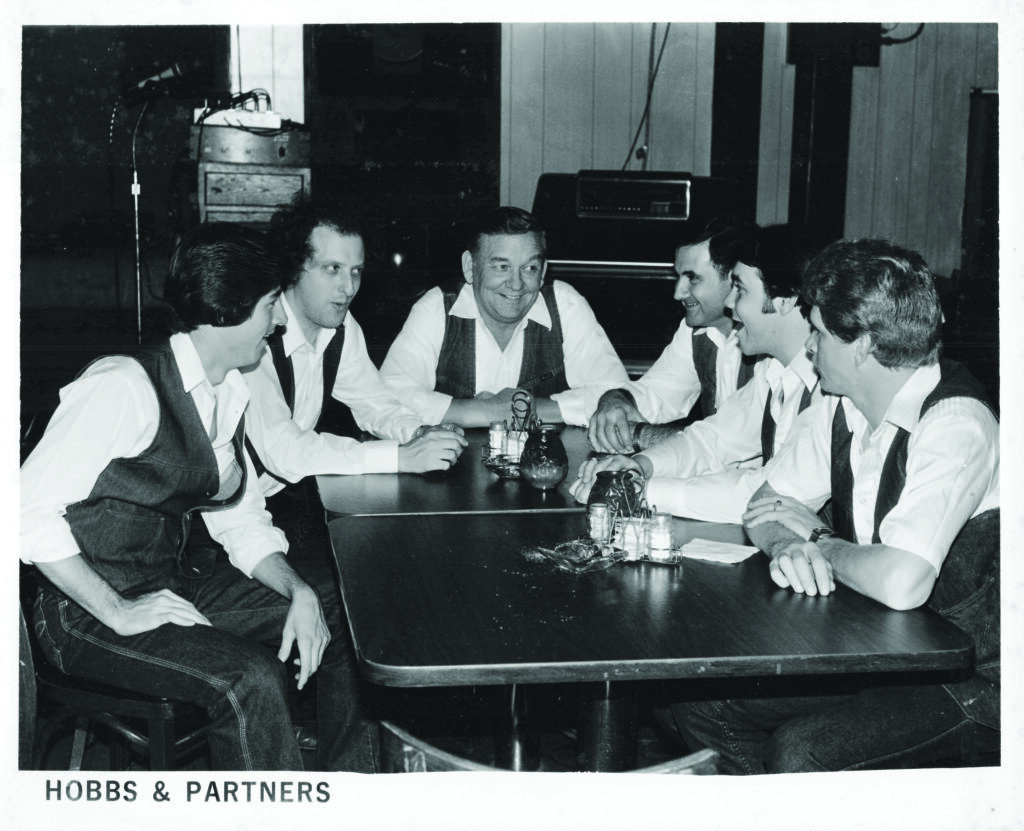
Stafford speaks highly of Dave and notes that he was one of the hardest working musicians he has ever known. He worked hard learning his craft and often sat in with bands without compensation for the experience gained. Between the times he was with Stafford’s bands he joined Hobbs and Partners, the house band at Arnold Hobbs’ Partners II Restaurant in Centreville, Virginia. This was a really good band made up with many of the area’s top musicians. They were the house band and opened for the many touring bands that played the venue.
Some of the bands that played there were Ralph Stanley, Bill Monroe, Larry Sparks, Jim Eanes, The Lost and Found, Del McCoury, Whetstone Run, The Country Gentlemen, The Johnson Mountain Boys and many others.
One of Dave’s stories that he tells, ‘tongue in cheek,’ is the night he was absent from the gig and Chubby Wise filled in for him. It is true that Dave was away that night, but Arnold Hobbs had booked Chubby as the head-liner act and the Hobbs and Partners band backed him up. Hobbs and Partners produced one album, Centreville, which featured Dave on a wonderful version of the Gunsmoke TV show theme song. Dave penned the title song for the album, Centreville which tells a heart-felt story of the American Civil War. In the opinion of the writer of this article playing with Hobbs and Partners honed Dave’s skills as a top-flight musician. He had the opportunity to meet many of the bluegrass stars and on several occasions played shows with some of them.
A memorable experience for Dave was the one time he played with Bill Monroe. Bill was in Washington in the summer of 1982 to be honored as one of the first recipients of the Folk Life Legacy award from the National Endowment for the Arts (NEA). Bill had recently undergone surgery and his band did not come to Washington with him since he was not sure if he would be able to perform. On the evening of the award Mr. Monroe felt good and wanted to play. Hazel Dickens was performing at the concurrent Folk Life Festival and her band was picked to back Bill Monroe if he felt well enough to perform. Band members were Hazel Dickens on guitar; Dave on fiddle; Barry Mitterhoff on guitar; Frank Necessary on banjo; and Jim Duke on bass. Bill Monroe felt up to performing so the show went on and they played “Uncle Pen” and “Dusty Miller.” The performance went well except for a glitch in the stops in “Uncle Pen.” Dave asked Bill if he should play the ending tag line on “Dusty Miller” and Bill said, “Go ahead if you want to do it,” and Dave nailed it just like on Monroe’s recording.
Dave has now been at it for more than 50 years and is thankful for the opportunities music has given him. He is an example of the rewards that come from hard work, patience and overcoming disappointments. He is a good example for young musicians starting out on their musical journey. Dave’s advice is to not be bashful about approaching the legends for help, make time for practice, and always extend yourself beyond your perceived abilities.