
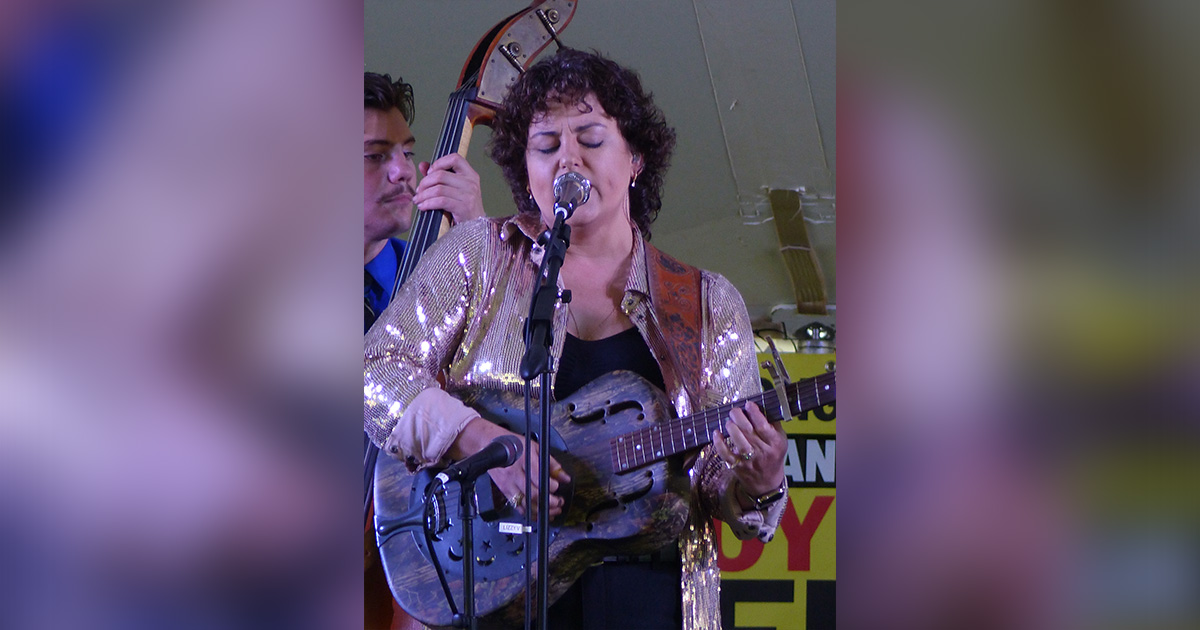
Lizzy Long:Fiddle Maker
Most people know Lizzy Long as the multi-instrumentalist, multi-talented singer, songwriter and sidekick of Little Roy Lewis. Like her “Pap,” as she calls him, she is a ball of creative energy and spends part of her limited free time making fiddles.
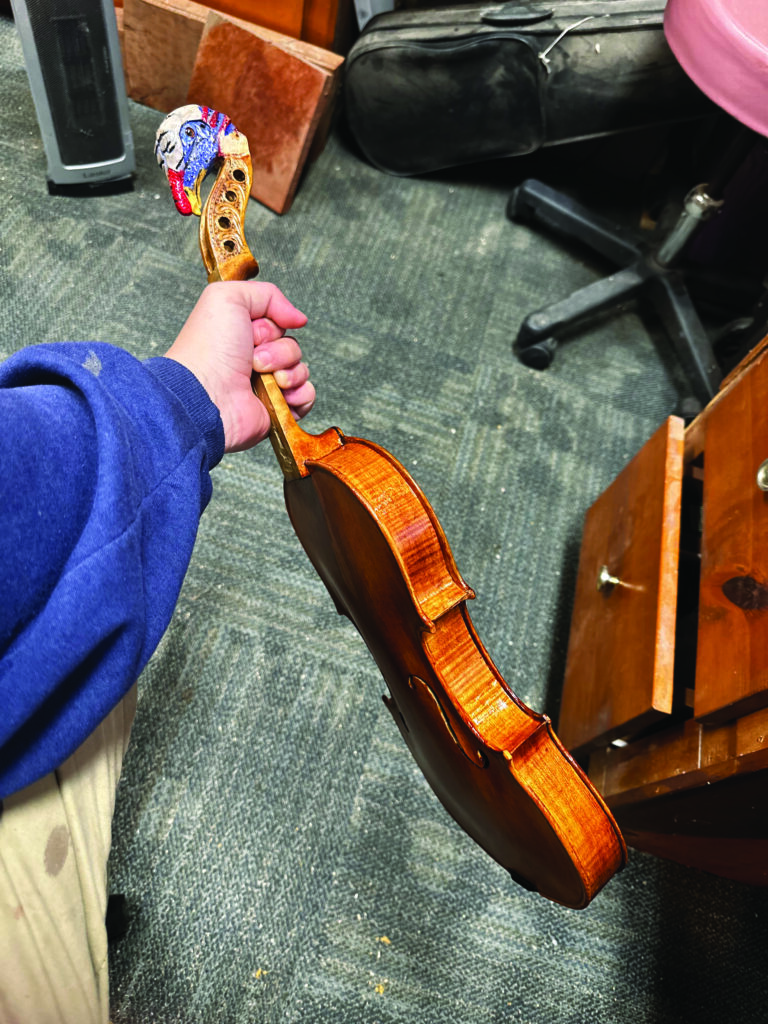
In her woodworking shop, the Lincolnton, Georgia native labors to take pieces of solid wood and form them, quite artistically (with intricate hand carvings) into aesthetically beautiful works of musical art. Each instrument is pleasing to the eye as well as the ear. She works to achieve a specific sound quality, too.
“Every fiddle is different. It is on the person’s ear and what they like. I like that pull (on the bow). It’s like Conway Twitty singing on a fiddle. I try to make my fiddles sound like that.”
She honed her craft by observing others. “When I was with the Lewis Family, we were around a bunch of luthiers. That’s how I learned from watching luthiers: trial and error. Greg Lange worked on my fiddle bows and gave me a bunch of history books on violins and makers. He showed me how he cut sound posts and bridges. I was 14 or 15 and I just watched.”
Randy Wood and Larry Barto also served as Long’s mentors, letting the young lady watch them work. These talented instrument builders provided direction and answered her questions. She also watched Frank Daniels, a fiddle maker from Idaho. “I didn’t have the money so I had to fix my own instruments. I grew up on a farm. My daddy owned a logging business. My granddaddy and uncle were carpenters and brick masons. I worked in a logging field and knew how to work wood tools. I understood the basis of tools, first-of-all. It’s an art. Trying to carve wood, you’ve got to have a sharp tool. I mean sharp! That’s another whole lesson in itself. I grew up learning how to sharpen stuff and to not be afraid of power tools.
“Buddy Spicher taught me about hide glue and heating it up and how to take the fiddle apart. A fiddle is going to come apart at the seam or have stress fractures. There are sweet points in the fiddle where the grain can split. That’s just going to happen. Buddy Spicher had one of the greatest sounding fiddles. When we opened that top, it had 28 cleats (patches) on it. Fiddles are a working tool. It’s going to give out so you just have to maintain it. There’s a lot to it. I’m not saying I know everything because I don’t.”
The luthier takes her craft seriously. “I tend to be a little curt, a little raw. I just tell it like it is. Living in Nashville, they tended to beat around the bush a lot. I was used to being told directly. You will always know where I stand. I had a man from Pennsylvania said I was making them out of kits. That rightly pissed me off. You don’t cut your finger off (working with burl maple) making kits. You don’t get the tone buying kits.”
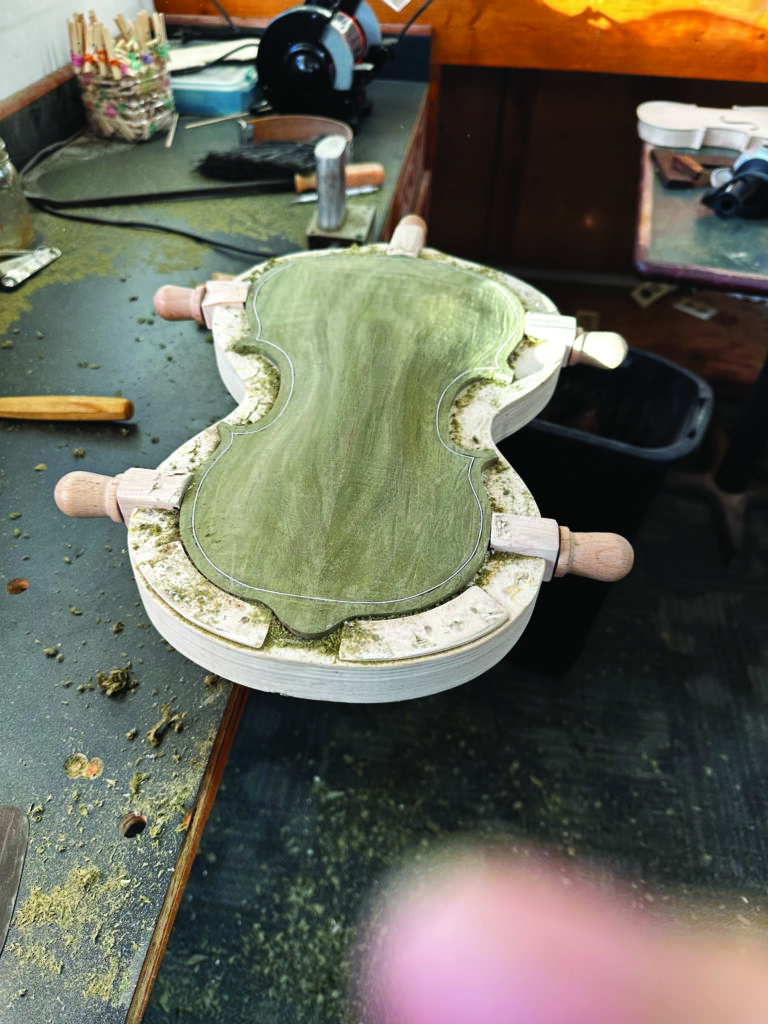
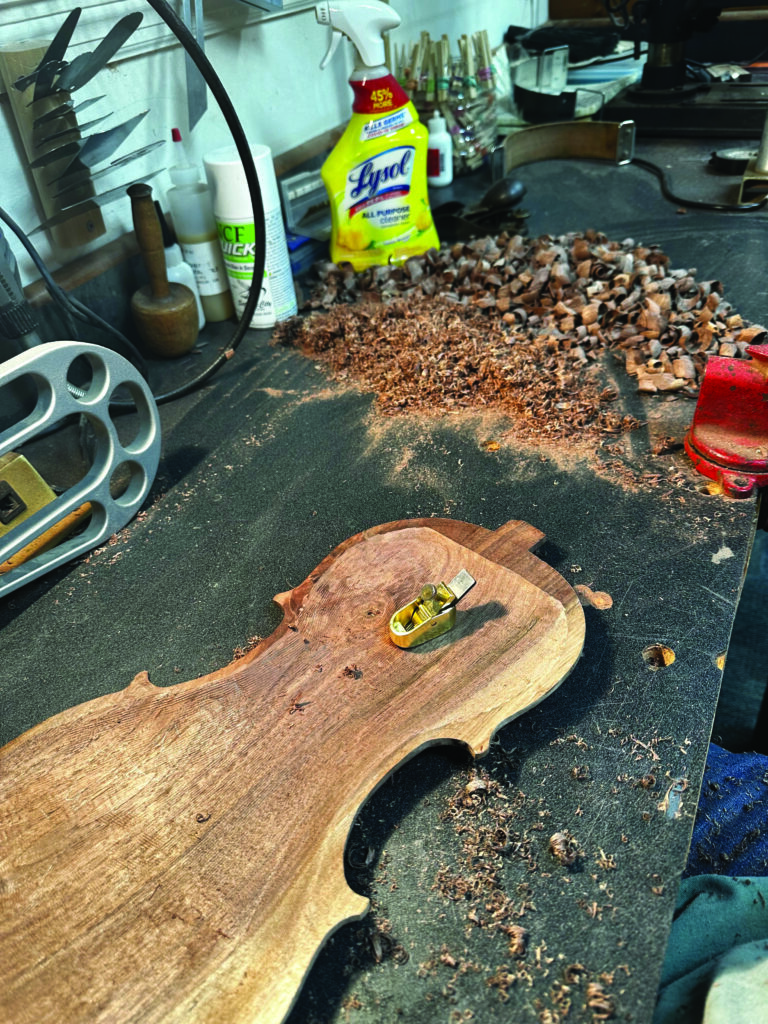
Lizzy described her finger loss. “I was working on a spalted/quilted maple back. I had this idea to do binding instead of purfling. Using a little dremel router with a 4mm flush bit, it hit a knot and jumped. In most cases, I’ve had that happen and it hardly left a scratch. That time it caught just perfect under the nail and my callous and ripped the whole first knuckle part of my finger off. It was just bone. I went to the ER that night and had surgery that lasted all the next day. They sewed a cadaver’s finger onto mine. I said that I didn’t need a fingernail just leave it off. I was concerned about it growing out crooked and messing up my playing.”
The injury, surgery, and recovery didn’t slow Long down or stop her from performing. “Well, Dr. Lim, his actual name, put the whole cadaver fingertip on, it grew, and now I have a perfectly fine nail that belonged to somebody else. All this was the week before our festival. Lil Pap had a fit when my husband called and told him, but I played all week long with my other three fingers, and that one was bleeding up a storm. I had a friend inject it each morning with Lidocaine, which, if you ever had that, you would know you soon rather have the other three fingers cut off. But I did it every morning: eight shots in one finger. And never let anybody down!”
Lizzy has adjusted to her new index finger. “It’s a little shorter and I had to get used to that for noting and scales. Flex wise, I just grit my teeth to make it do what it has to.” When asked if she received therapy, Lizzy laughingly responded. “Yea, Pap!”
The woodworker talked about her creations and their process. “I’ve only made three of the Bavarian castle-style violins out of a softer maple. The first I gave to Buddy Spicher. I’m never doing that again! That’s a lot of detail work. I got tired of it. I only made three black walnut fiddles. They all belong to a teenage boy in Texas. It is awful hard trying to carve walnut. It is such brittle wood. I got it out of Little Roy’s house. It was 100 years old. It took three fiddles to get it right. It was so rough and cracked. I have carved full deer patterns. I made one for Stanley Efaw (fiddler for Ralph II) for Christmas. His daddy (Larry) wanted me to make it. It’s beautiful. It’s got a big deer head with trees.” Little Roy noted with pride. “She does all that carving.”
Lizzy said, “I like to carve. It is intricate work, but it’s really not that hard if you know the tools and know how to draw. I see stuff on the internet and I’ve got copies of fiddles that I like. I trim it out to size, take carving paper, and trace it on here. It roughly takes anywhere from 200 to 300 hours to finish a fiddle with vanish and everything. The carving maybe takes two days if you just stay at it. I’m very focused. I get up at 5:00 in the morning and not leave the shop until 2:00 the next morning. Then I take time and clean it up a little bit, plus the rest of the stuff like bending the wood, and making sure everything’s straight.”
It’s hard work and not an exact science. Different types of wood and the weather can make her work challenging at times. “There are errors. I’ve broken a lot of fiddles. I was working on a fiddle for a girl. I guess because the heat I had in the shop and the cold weather…I had just put the last coat of varnish on it and stuck it in the drying cabinet, I came back and it had a big crack. I just took the fiddle, threw it against the wall, and started again.”
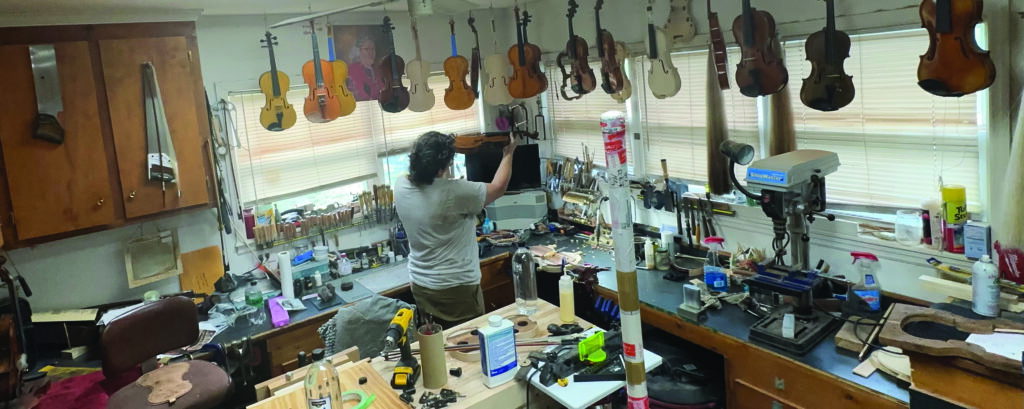
Long is currently carving on fiddle #46. “Last year, we didn’t have any dates booked January until our festival (in May). I just sat there in that shop making fiddles. I’ve got ADD and OCD. I get honed in on something and I can’t stop.”
Lizzy is very precise and detailed in her work. Areas of wood on the back of the fiddle vary from 4-5 mm to 1.7 mm in thickness. “It’s easy to mess that up! You have no room, splits can happen. When I get down around 2 mm, I have a speaker set up with posts and I put a plate on top of that speaker. I spread black pepper on it. I have an app on my phone that sends a wave length and frequency. The pepper will move and make a pattern if it’s in the correct frequency. If you do that consistently, your fiddles will sound about the same every time, but it doesn’t always work that way. Most of my fiddles note tune in D, but I have had some come out in F and G. That’s just wood. It’s like people. You’re going to have some that sound little and loud and then some that sound big and robust. It’s addicting to me because that challenge is there. The variables change so easily. Like setting the sound post, it can have a close bright sound or move it and have a darker, full sound. Shaving is a process. I do the same thing on the front. I do it three times for the front, before I cut the F holes. Then I cut the F holes when the board is around 4 mm. I aim to cut it down to around 3 mm in the center.”
Long believes in using aged wood for her fiddles. “I’ve got a tree that I had Mr. Harry Gilmore at home sawmill for me. I haven’t taken any wood out of it. I’ve got it aired and salted down and glued on the ends. I’ve had it about three years and probably won’t touch it until it’s about fifteen years old. Hunter Berry just came back from West Virginia. He found an old man that was retired that had all this maple wood. I bought 30 backs. It’s 30 years old. It’s seasoned. You want the moisture content in the wood to be around 3-5%. The older and drier it is, the better!
“I got a thing called a Tone Traveler. After I make a fiddle, before I send it (to a customer), I leave this thing on it for a week solid. It sits on the bridge and it vibrates EADG strings and teaches the wood. I heard a guy on Facebook say, ‘This wood is a living thing. I tell it, it is an instrument now.’ That makes sense to me. It’s been a tree it’s whole life, it doesn’t realize it’s fixing to sing. I put it on it and let it vibrate for five days. It lets all that sap settle in and it lets me know if I hear any rattling.”
Little Roy jokingly asked, “Does the fiddle sound better with make-up or tobacco juice on it?” Long readily admitted, “I do chew tobacco. I started when I was 8 years old in the logging and hay field. It was like candy to us because we never got candy. I’m as country as they come and I don’t have worms.”
Dealing with leukemia, resilient Long takes pills daily, and receives two shots and treatments weekly, but she forges ahead. She refuses to let health issues slow her down. Now she has expanded her luthier skills to include building mandolins.
Interested in acquiring one of her hand-crafted instruments? Email Lizzy Long at [email protected]