Remembering Earl Scruggs at 100
Photos Courtesy of the Earl Scruggs Center Collection
[Editor’s Note: In our January, 2024 issue we ran an article about the new Earl Scruggs exhibit at the Earl Scruggs Center in Shelby, North Carolina. Part of that exhibit includes information from a 17,000 word document that Earl had written about his life. In our previous article, we included a few excerpts from that document and promised to provide more this year in order to help celebrate Earl at 100. We ran another installment of this document in our April 2024 issue. This article, once again, provides more from that document, as put together by the exhibit’s co-creator Zach Dressel.]
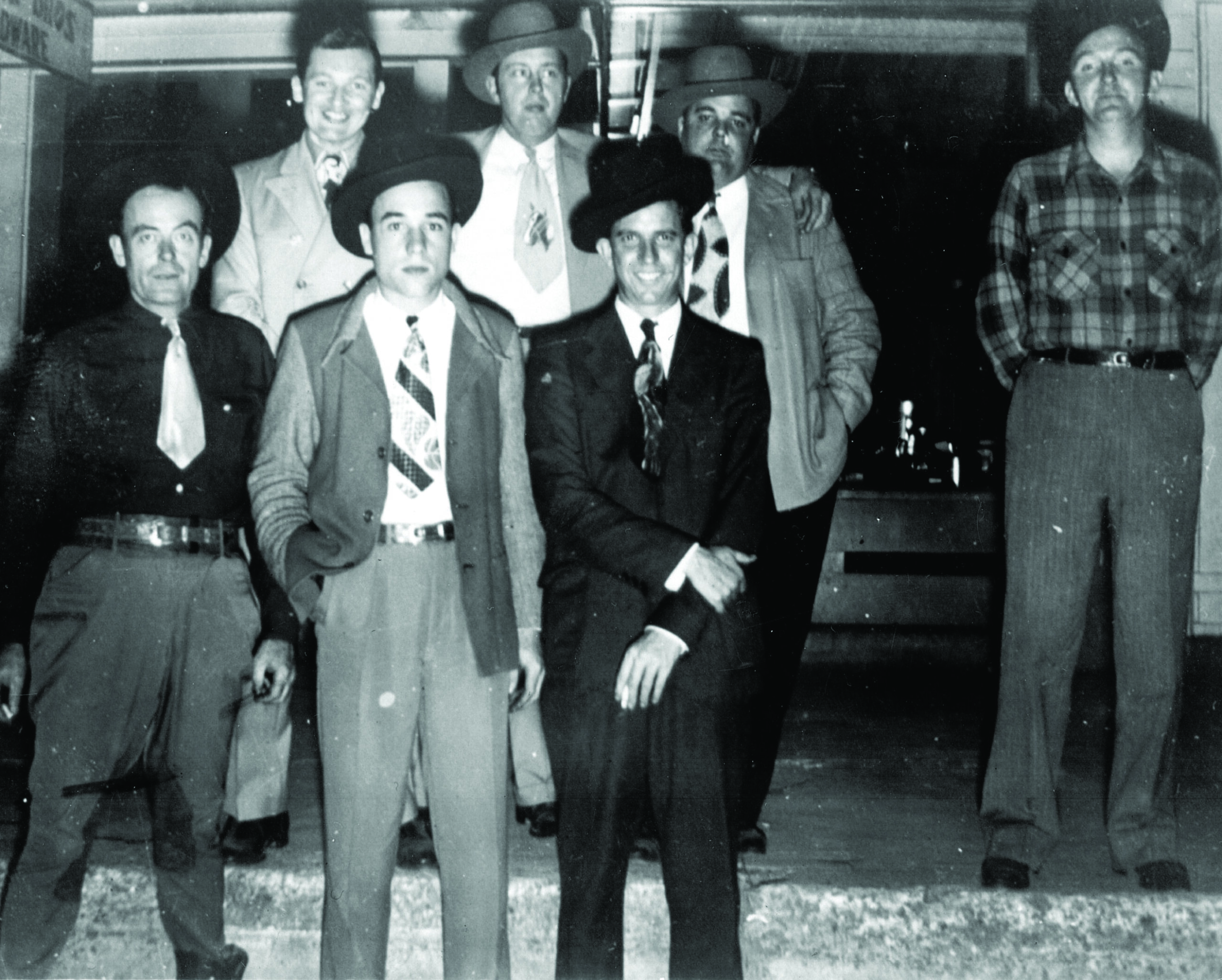
Perhaps one of the most interesting challenges of being a musician in the post-WWII landscape was travel. At the time buses were not yet available to musicians (something that Earl would later help pioneer) and the main mode of transportation was the stretch limo that certain shops would put together. Earl had gotten used to riding for miles in a limo during his time with Lost John, who had a Buick limo, leading up to joining the Blue Grass Boys. However, Bill’s limo, which would appear in several promotional photographs of the Bluegrass Boys, was a particular difficulty for the musicians with constant breakdowns during Earl’s tenure with the band.
“As far as I know in 1945-46-47 the auto industry made no longer auto-type vehicle than the Limo. That was basically built then as today. A longer wheelbase auto with two jump seats. They are a killer on passengers who have to ride them, and they also take up all the leg room for the back seat passengers. I don’t know who was doing the work, but Bill had a 1941 Chevrolet standard chassis car which had been rebuilt into a four seater. Cut into in the middle, two full size middle seats inserted in the middle. It had a full-sized rack on top with approximately 15-inch sides and a canvas on top of that to put the acoustic bass, instruments, songbooks, suitcases, etc. up there, rope laced through holes along the leading edge of the canvas and drawn tight, often hooking the rope under hooks mounted along the side of the rack all the way around. This wasn’t bad if the temperature was good and it wasn’t raining. At that time, it seemed to be the very best way to travel. I don’t know how many thousands of miles it had on it from 1941 to 45-46 and 1947 because the (odometer) had been past the 100,000 once or more I was told and did not work. Neither did the fuel gauge. We learned to keep up with when the tank was last fueled.”
Today deciding to go into the music business is no easy decision. However, post-WWII it was made all the harder. During the war the music industry was at a standstill with many musicians becoming soldiers and most of the resources needed to print records being rationed for the war effort. Combining external circumstances with dependents at home, Earl’s decision to go into show business was one that he labored over constantly during his first several years as a professional musician. Even after the success he saw as a member of the Blue Grass Boys, Earl found himself searching for the stability that factory work offered him during his younger years in Shelby, North Carolina.
“It was the year 1945, World War II ended. Due to the war, I stayed with the Lily Mill in Shelby, N.C. to be patriotic to the U.S.A. and due to the shortage of male labor…All those years and even before the war, my wishes were to get into show business. To get into the business was a very tough situation for a number of reasons. No father, my mother and kid sister to support, buying a $3,000 house and two lots with hourly wages starting at 26₵ an hour and going to 40₵ the last 15 to 24 months. I had also bought my first car, a 1936 Chevrolet. Not really wanting to leave Home, not knowing anything about show business, it was just a very confusing decision. $30.00 a month house payment and not knowing how stable show business would be, I really did a lot of studying and considering.”
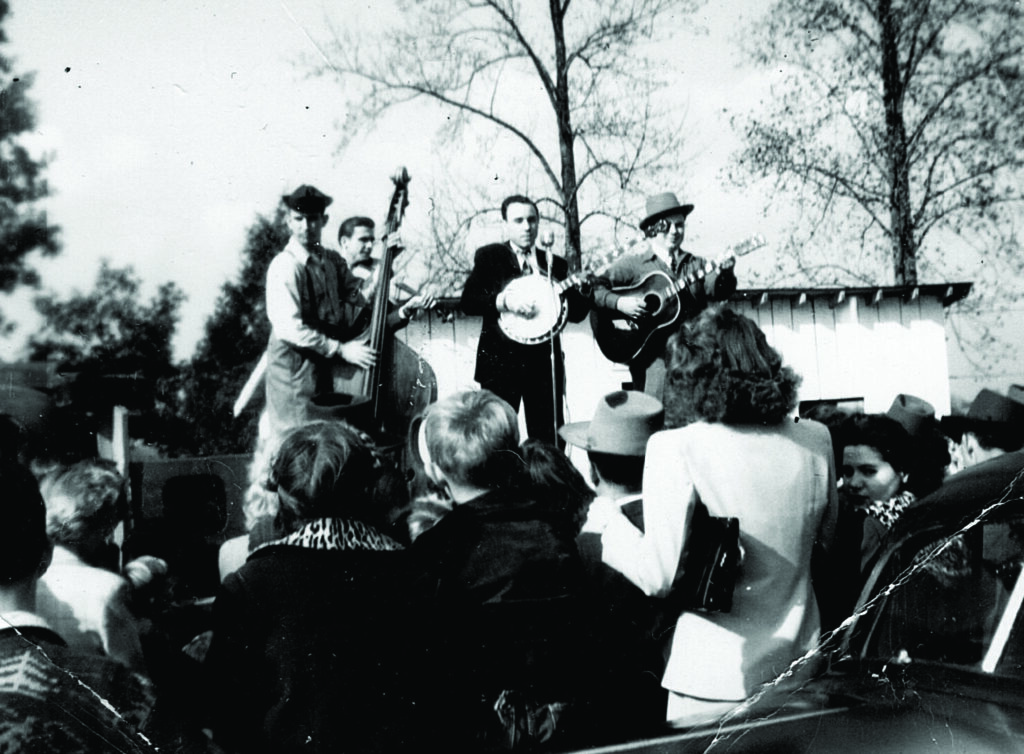
As was the case with most of the bluegrass legends, the radio became a major influence during Earl’s formative years. In the little community of Flint Hill, Earl could hear sounds from WBT in Charlotte, North Carolina, WSPA in Spartanburg, South Carolina, WSM in Nashville, Tennssee, WNOX in Knoxville, Tennessee, WLS in Chicago, Illinois, and even XERA in Villa Acuna, Coahuila, Mexico. When combined with the live acts that were coming to schoolhouses and theaters in Cleveland County, North Carolina, this created the blueprint for the creation of bluegrass music in which Earl played a major role.
Earl’s love of Maybelle Carter truly shines in this excerpt from his notes. Like many musicians growing up during the Great Depression in the South, Earl looked at the Carter Family as a model for the music he wanted to create. He would even incorporate her famous style of guitar playing into his own unique guitar parts as part of Flatt and Scruggs.
October:
“I remember so well the joy I received (from) The original Carter Family…I not only enjoyed their singing but the most beautiful Guitar playing and Auto Harp of Maybelle Carter. She Played so well and her style of picking, seemed to spell out…each word they sang…I always call Maybelle, Mama Maybelle and she gave me the warmth that I feel she deserves the title…Mama Maybelle (was a neighbor) of our family and we will never forget the unselfishness of her and her family…I cherish the visits I made in her Home, she would have Guitars, Banjo, Autoharp, and other instruments sitting around. Quite often she would ask me to pick some for her and several times she taped my efforts for her own amusement…I would show her how I remembered her early days of Radio starts and stops and how she would go out of the last song into their theme “Keep on the Sunny Side”. I will always remember the smiles she gave while I imitated and reminded her of their Radio Shows. She gave me so many happy memories as well as my family.”
Earl’s introduction into being a full-time musician was not a glamorous one. Like many other musicians that began to flock to Knoxville and Nashville following WWII, Earl found himself overwhelmed by the less-than-ideal living conditions and hard hours of being a struggling musician. As a 21-year-old from a small farming community, the move to Knoxville opened Earl’s eyes to the opportunity of show business as he spent time around soon-to-be household names such as Chet Atkins and Archie Campbell.
November:
“After the war ended (1945) and workers were getting sufficient (soldiers coming home from war, going back to work) a group I was picking with Orange Blossom Hillbillies…went job seeking to WNOX Knoxville and to Chattanooga…We did do a guest spot on the WNOX Tennessee Barndance and a lot of picking backstage. Lost John Miller was a member at WNOX and had a band called the Allied Kentuckians…After getting back to Shelby, a couple days or so went by and the local police came to our House with a message to contact John. I called him and he wanted me to come to Knoxville and discuss going to work with him. I went…and John told me his sponsor was giving him a choice of WSB in Atlanta, Ga. or a Saturday (morning) 15 min. show on WSM. He would pay me $50.00 a week and board and this sound(ed) great being used to working 40₵ per hour at the Lily Mill.
“I spent the 1st night in a $1.50 Room at the Earl Hotel. No curtains, No Bath, only a sink. A torn window shade that would roll to the top if it wasn’t handled very carefully. A strong odor of the JFG Coffee Factory…The noise of Street Cars. A Public bath down the hall in the Hotel.”
We worked two weeks at WNOX before going to WSM. John had a House trailer appx. 8’ x 22’ parked behind a gas station in Knoxville. No bath, we used the public restroom at the gas station (this is where I learned to shave with cold water it worked fine and helped in times to come, when I made do shaving) …He was not known outside WNOX so we lived in Knoxville and would drive over to Nashville each Friday night to do the Saturday (morning) radio show.”
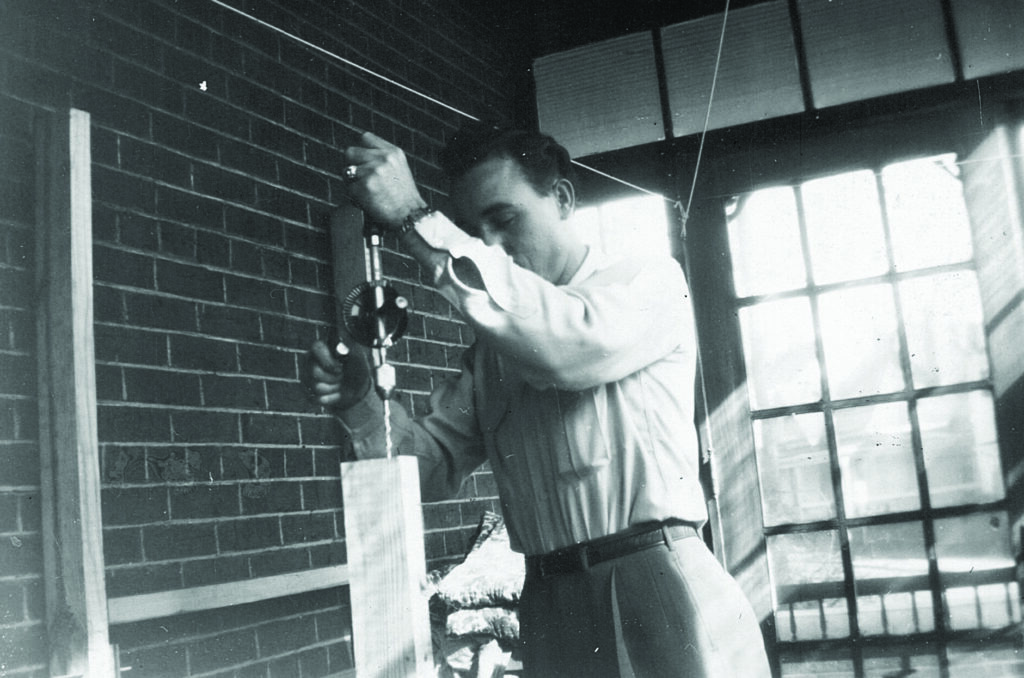
This anecdote from Earl’s time at the Lily Mill sheds light on a lesser-known aspect of Earl’s talents. Earl constantly looked to invent and improve, and his ingenuity could be found in the cam tuners and capos that he crafted for his banjos. He was known to constantly tinker with his prized Granada, endlessly working to improve it throughout his career.
“Even after getting my first job (at the Lily Mill) …hauling thread from the spinning room to a winder room, the big machines seem to fascinate me. Especially the parts on the machines that were automatic. I would toy with ideas such as “more parts of it could be automatic or improved.” Even scrap some of the machines and rebuild another one.
“I did manage to put a change of operation in the label machine which (literally saved) baskets of labels (every) eight hours. However, it was a tough job doing it and I didn’t get to get the point across to the front office officials. I attempted to explain my idea to…my Boss and requested to take the idea up to the machine room since he seemed to not understand. I did whittle out of wood with my pocket knife a mockup and (he) said we would take it to the machine room and make it ourselves since he knew quite a bit about that department, I waited…several days and nothing more was said to me about it. Then several days later when I approached the spooler room, (my boss) had the part made, put on the machine, and was showing it off to…the top man each smiling and (my boss) being highly complimented…So much for that.”