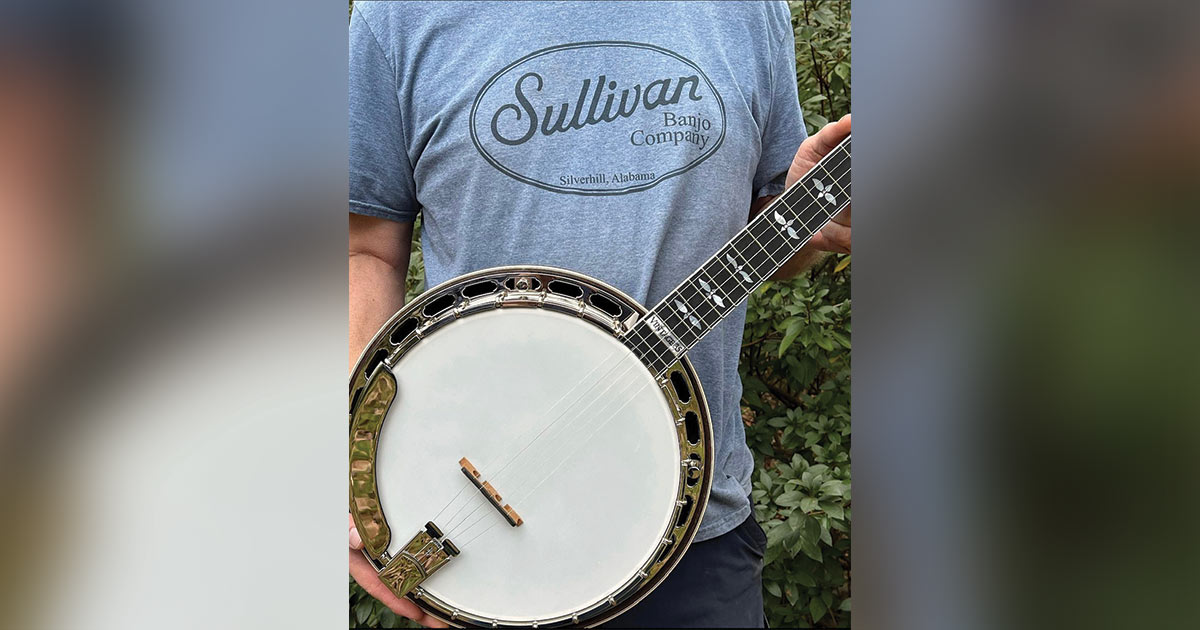
Sullivan Banjos
Putting The Fun In Banjos
All Photos Courtesy of Eric Sullivan
“Banjos = fun” is the lifelong philosophy of one American luthier.
“Sullivan Banjos is fairly recent,” its current proprietor, Eric Sullivan of Alabama, shared during a recent interview. “It started in 1970 when Dad (Bill Sullivan) was working at General Electric in the tool and die division. The availability of banjo parts 54 years ago wasn’t what it is today. Being in the tool and die department, the employees had equipment at their disposal during lunchtime so he started making banjo parts and pieces. Word began to spread. People would bring banjos to have parts made or repaired. Dad told Mom, ‘When this business can make $20,000 in sales, I am quitting General Electric.’ Within two years, the boy quit! What Dad hated most was the hour drive to work and the hour drive to home. He said, ‘That’s two hours that I’m not getting paid for to be away from my family.’ Looking back, that one decision is what set everything in motion for us.”
Eric elaborated on what became his life’s work: building banjos. It is all he has ever known. “This is the only job I’ve ever had. I’ve been doing this almost 40 years now. I started helping Dad in middle school. The business was at home. It was so busy that we had a two-line phone in the bathroom.”
Eric continued to work with his dad through high school and never even considered doing anything else. He was happy where he was and with what he was doing. The banjo business was good. He said, “What Dad started in 1970 was First Quality Banjo. It began as a single one-sided piece of paper that turned into both sides of the paper, into a small catalog, then a little bit bigger catalog.”
First Quality Music
It involved everyone in the family. It kept growing and growing. Eric recalls, “From First Quality Banjo it went to First Quality Music Supply, then to First Quality Music. We were at Mom and Dad’s house for 28 years. We decided it was getting a little bit too big for the neighborhood, so we bought five acres in the industrial park (in Louisville, Kentucky), had a 10,000 square foot building erected, and for some reason that I haven’t figured out, we decided to be a music store instead of a manufacturer.”
The music company started carrying various instruments and sound reinforcements. “Before it was all over, we had another 10,000 square feet added on. It had grown so far from our core mission. We had 30 employees. It was a great time. I can’t complain. To work with Dad in the shop every day was one of the best times I’ve ever had, but it was stressful. We had to clear about $7,000 a day to make ends meet.
“For the longest time, we sold parts and pieces. We manufactured for other companies. We did custom work for other people. We did production. We did contract work for Gibson for 17 years: a thousand necks a year. We made their pot assembly and their top tension resonators. We supplied them lots of parts. It became too much.
“In 2007 Dad passed away unexpectedly of a brain aneurysm and everything kind of changed. Next up was 2008 with the recession and it was pretty rough. We scaled back a lot. We got to the point where we needed to refocus. After a couple of moves and downsizes my wife and I finally bought everyone else out and moved the business south. We turned it back to Sullivan Banjo Company. We brought the business back to the way it was when Mom and Dad had the business when it started.”
Sullivan Banjo Company
The banjo builder relocated and redirected his efforts. “My wife, Marsha, and I moved down to (Silverhill) Alabama close to the Gulf Coast. I have a 3,000 square foot shop behind the house. I can walk to work now. My overhead is about $35 a day. It’s wonderful! We just work on banjos. That’s all we do now.”
Eric explained their scaled-down operation. Married for 31 years, the couple lives, loves, and works together. “It’s just the two of us. We work Monday through Thursday. I wanted it set up like Dad started it. It’s very banjo-oriented. It’s one of those things where bigger isn’t always better. Marsha doesn’t have as much as fun as I do. She has most of the paperwork!” he mused. “We even get our seven-year-old granddaughter out here to help a little bit.”
The Sullivans consider their customers their friends and it shows. “I wanted the time to talk with people on the phone and discuss how we are going to attack problems. It’s been a nice change. The stress level is way down. It’s really nice to go back to the way it was. It’s been a blessing.”
Eric is content with the decisions that he has made. “How can you stay centered if you get in a car and go drive somewhere and do something that you really don’t like to do? Then get up the next morning and do it again! I try to keep that focus that there are people who didn’t have a father who started a business. We are extremely fortunate that we have found something that we genuinely love to do.
“This is it. I’ve never had to work a day in my life! It is wonderful. Is every day fun? Absolutely not. Do I make mistakes? Absolutely. Are some customers hard to deal with? Absolutely. But there are just so many more wins. It’s nice to stay home and do what you love to do. You go home dirty every day, but you don’t work.”
Surprisingly, Eric Sullivan is not a banjo picker. “I cannot play a banjo to save my life! I gave it fifteen minutes and my little baby-soft fingers hurt so bad. We all have a job to do. In a car race, the driver stays in the car. The pit crew works on the car. We build banjos. I don’t play banjos. I can tune one, but Dad was the only one who really played all that much and it was only a little. He’d pick on the banjo a little after lunch in the office. You never want to be mediocre. You can’t fake playing the banjo. It takes a lot of time and I’d rather be out in the shop working on them.”
The Banjo-Making Business
The craftsman feels the art is shrinking. “Too many banjo builders are aging out or passing away. There are not enough younger guys coming into the market. Gibson quit making banjos in 2010. Ome was purchased by Gold Tone. Geoff Stelling has retired. When you get down to boutique American-made banjos, it’s us and a few others like Huber, Hatfield, and Neat left. It’s a dying art. I understand it. There’s easier ways to make a living. You do it for the love of the game.”
He is encountering a few bumps in the road. “It’s becoming harder to source quality parts. The cost of the quality parts is exponentially increasing. We’ve been able to team up with some top class vendors. They really come through with the best products and the best services.”
Eric praised Czech Republic’s Jarda Průcha. “We can’t do what we do without his parts. We supply our own wood rims, resonators and tone rings, but as far as metal parts, his are the best. I won’t go anywhere else. We don’t use Chinese components. We get the best equipment that we can source. He’s the best on tension hoops, flanges, arm rests and tailpieces.
“We use another guy, Bill Rickard, in Canada. He makes some of the finest tuners on the planet. The quality of the components that we use, the value that we bring to the table is our trademark. Quality and value never go out of style. We’re not the most expensive banjo on the market, but our banjos will stand toe-to-toe with any banjos out there.”
There is pride in his workmanship. “It’s a good feeling when you realize that someone out there is using a banjo that you produced to make memories for themselves and their families. You’ve been able to become part of their good times. We used to make a Terry Baucom model and to get to have conversations with that gentleman. It’s just something so nice. I never want to do anything else. I just want to make banjos!
“This year we are trying to lessen the amount of the small custom and repair work that we do. With other smaller banjo shops starting to disappear, the lead times are getting so long that it is unfair to the customer. There are some jobs that are languishing so long that we are better off to say no to them. We’re trying our best to just simplify everything. We’re going to focus and dedicate ourselves on banjo production for the music stores that sell our banjos.”
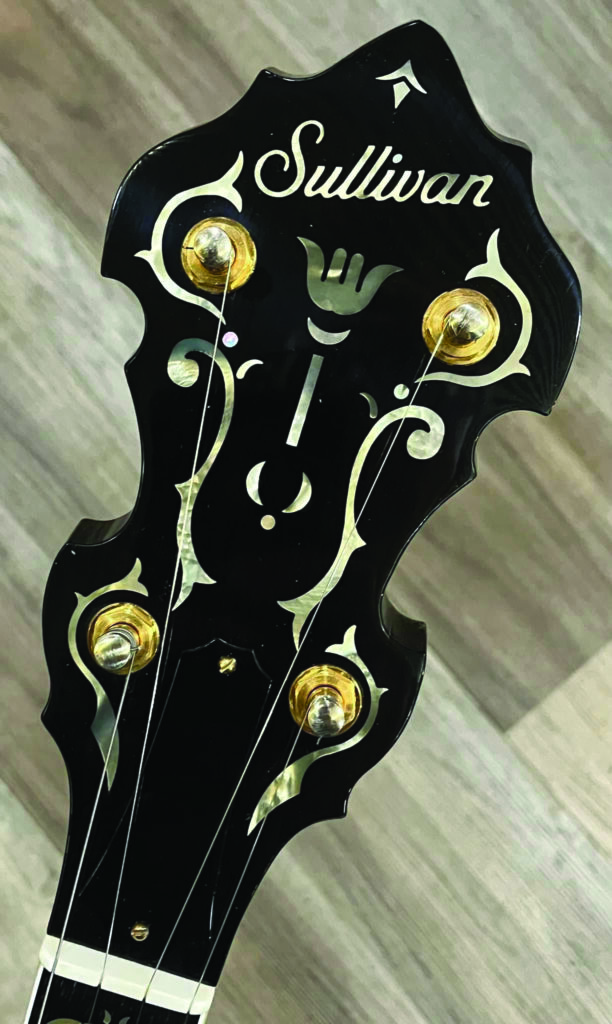
Sullivan is doing this to free up time and to deliver on time to his dealers. “We can’t make it without our dealers. We have to take care of those guys. I make banjos for a living. They sell banjos for a living. We both have an interest in getting these banjos done. We are looking to do about 60 banjos in 2024.”
Sullivan explained his banjo-building operation. “Business is pretty basic. You plan your work and you work your plan. You’re looking at two to three weeks. You get your neck wood and run it through the process: you put your binding on, your fret wire in, you shape everything out, and then you have to wait for the glue to dry. When you finish it, it might take 25 seconds to put on a coat of nitro-lacquer. Well, it needs to sit 25 or 30 minutes before I put the next coat on. You put on 20 coats and then it needs to sit for a week or so to harden. It cures by evaporation so there’s some down time.”
When asked if he built banjos one a time, Sullivan scoffed. “You can’t survive like that. If you can build one in three weeks, you can build two. While you’re sitting and waiting, you work on another one. You do a lot of umbrella living where you’re working on several banjos at the same time. The problem comes up when you’re waiting on parts or glue to come in. Life happens. We try to balance it all. By focusing on one aspect (building new banjos), it is going to cut down on our lead times.
Sullivan’s 2024 Models
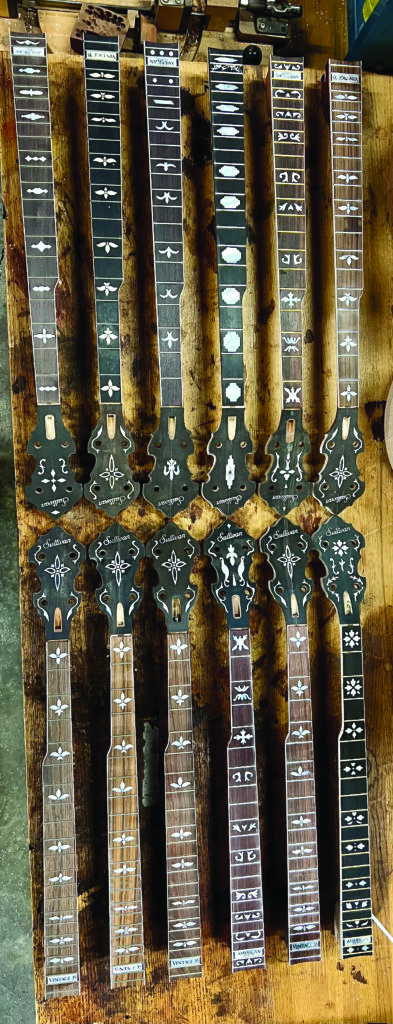
Sullivan discussed his models for 2024. “We probably have 15 different models. We have three vintage 35s: a maple, a mahogany and a walnut. We have a line called American Classic. It’s basically a vintage 35 with the classic Gibson-style inlay pattern. It’s all one banjo in different clothes.”
The banjo builder then discussed the new Mike Scott model. “How can you not like Mike Scott? He’s like the cheeriest guy that I’ve ever met. You can almost hear his smile on the phone. Mike was our very first endorsing artist way back before Dad passed away. We had a vintage 35 with his name on the tone ring. Mike has a couple of them and he’s played all over the world with them. I asked him why he always played the Style 18. He said that’s what people expect to see.”
The builder and the picker collaborated. “We came out with a model with curly maple like his 18 with Style 18 inlays, but we went with the double cut peghead shape. We went with similar looks on a standard banjo because top tension is very expensive and makes a little heavier banjo. We got 90% of the look. We don’t have any kind of block like where Gibson puts ‘MASTERTONE.’ We have Mike Scott’s signature in pearl.”
Mike Scott shared a little of their history, “When I moved to Nashville in 1983 while working for Jim & Jesse & The Virginia Boys, I met Bill Sullivan, owner and founder of First Quality Music and Sullivan Banjos. You never forget the ‘quality’ people and friends you meet out there on the music and bluegrass trails. Bill and his son, Eric, were just that.
“Throughout the years, Sullivan Banjos have been of the highest quality and workmanship of any new banjo I’ve personally owned and played. I received the last Sullivan Banjo, a ‘Mike Scott Signature Series’ that Bill constructed before his passing on September 23, 2007. I was honored to be asked to play my banjo at his funeral service.
“Over the years I have continued to perform the majority of my shows with my Sullivan banjos, from the many festivals, concert halls, The Grand Ole Opry, touring nationally and internationally, as well as teaching at various colleges, camps, and workshops.
“I am excited that Eric Sullivan and I have designed two new ‘Mike Scott Artist Model Banjos’ that are in production now and will be available in 2024. The continued quality, tone and excellence are still at the utmost when playing on these awesome banjos! You will see them available directly through my contact at mikescottmusic.com or sullivanbanjo.com. I will personally hand-sign each model built and sold. I know you will be as excited as I am when you get your hands on these new banjos! Thank you, Sullivan Banjos!”
The luthier elaborated on the design of the two versions of the Mike Scott banjo: a deluxe and a no-frills one.
“We’ve got a high end (that can be ordered with gold plating) and a not-so high end model without peghead and fingerboard binding. The resonator binding is dark and it’s going to have a satin finish. There are no cheap American-made banjos. We’re not going to compromise the quality of components. If you were playing in a dark room, you couldn’t tell the difference (sound-wise).”
Sullivan is also designing a one-of-a-kind anniversary banjo just for Scott. “We are building one special model for him to honor his 50 years in the music. We’re trying to find a way to incorporate some nods to his past in a very classy way. We have a tone ring based on his Style 18. Mike has a piece of curly maple that was given to him 30 or 40 years ago. We are going to make this banjo from that piece of historical neck wood that meant a lot personally for him. It will be a one-off piece never to be repeated.”
Scott interjected. “I sent him a piece of highly-flamed curly maple wood given to me in 1977 by an elderly east Tennessee muzzle-loader builder when I was 15 years old. He lived in Elizabethton, Tennessee, near my hometown of Watauga (near Johnson City). My dad, Virgil Scott, found out this gentleman and craftsman had curly maple wood. We went by his house and he gave me enough wood to build four banjo necks. I do not have the man’s name, but I have been trying diligently to find out.
“I won all the cabinet making awards during my high school years so I built three banjo necks from the wood this man gave me. I had enough left for one more neck. I have kept it all these years. This piece of curly maple was 12 years old in 1884. Now in 2024, it is about 152 years old from 1872 when it was milled. I’m excited to get it when it is finished. It will have CNC photos on the neck inlays exhibiting my 50 years of bands and music. This will definitely be a keepsake family heirloom to commemorate my career and tying me and my banjo to my east Tennessee roots!”
Sullivan reflected on the current music scene. “We are in a time now where most of our bluegrass legends have passed away, even the second generation. There’s a balance between keeping their legacy going, but still catering to a new crowd. The music is changing. How do we keep it alive? It’s working with people like Mike to get a high quality banjo.
“Banjos and bluegrass will always live side-by-side. The younger generation is starting to use the banjo for other music. We want to make the banjo an absolute bluegrass necessity, but it’s also a very versatile five-string musical instrument to be used in other genres. We are trying to find ways to bring new manufacturing techniques, new materials, and we have an aging population who might be looking for a seven pound banjo, not an eleven pound banjo.
“We have a perfect storm here. Of course, the Gibson-style Mastertone is the best for bluegrass because bluegrass was created with those instruments. But how do we incorporate banjos into new music? You might not have to have a tone ring. You might be able to use high-end aluminum parts. We have a golden opportunity to re-introduce the banjo to a whole new crowd. It’s getting people to see the potential.
“Hopefully, with our Mike Scott model, it is a very traditional instrument with a little lower price point on one of the models. Maybe we can get them in some younger people’s hands. It’s not all about quantity, it’s about consistent quality. In the Mike Scott model, you’ll see the consistent quality that each instrument has. We just try to do what we can do and we’re good with that.”
Talking prices, Sullivan banjos start at $4500. “The standard Mike Scott model is in that ballpark. We’re hoping to be under $4000 for the lower-priced model. It’s such a niche market. It’s so small. Since we moved to Alabama, about four years now, manufacturing costs for tone rings have already gone up two and a half times. Glue has gone up. Lacquer has gone up.”
“We’re just regular old people that sell to regular old people. One thing that Sullivan banjo does differently: I’ve never put posts on Facebook. We don’t tell anybody who we’re working for. We’re very discreet. We’re very private. We haven’t advertised since 2009. We’ve been in the business 54 years. If you don’t know about us, you’re probably never going to find us, but we’re so busy! We never take a deposit. Your word is good. As much as we can, we try to make it as stress-free a transaction as we can. We’re doing our best to put the fun back in banjos.”
The 52-year-old confessed, “When a couple more banjo builders decide to retire or quit, I’ll be one of the oldest in it. I have two children, a son and a daughter. Neither of them wants anything to do with banjos. My son is a police officer. He loves what he does. He’d rather be under-paid, under-appreciated, and shot at as opposed to building banjos.”
His kids might not want to build banjos, but Eric is grateful for the life that he has chosen. They enjoy a debt-free company and live 30 minutes from the beach. The Sullivan Banjo Company’s mission is simple. “We try to provide a high-quality, high-value American-made banjo that will not give you a problem. We’re doing everything we can do to drop lead times and keep prices where they are. We try to partner with good, high-quality Christian people that believe what we believe. My name is on that banjo, but so is Mike’s. There’s a lot of trust there.”
To order a Mike Scott model or any other Sullivan banjo, call or text Eric: (502) 365-5022 or visit sullivanbanjo.com. He also welcomes potential customers to stop by his shop to pick out the banjo they want him to build and add in a little fun.