The Only Sunshine
By Jody Stecher
Beautiful and unusual instrumentation, rare points of view, and intricate, natural imagery come together to create “The Only Sunshine,” an atypical love song written by Jody Stecher and released in December 2023 on his album Mile 77.
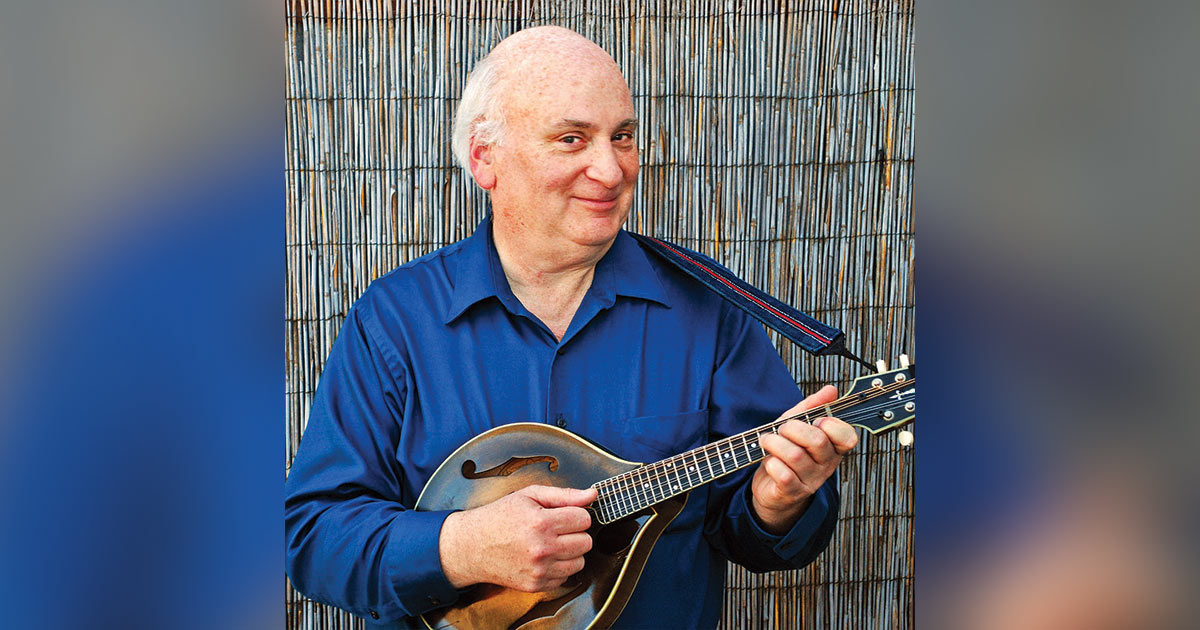
The writer behind this powerful statement song has a musical career that spans decades and includes scores of albums and time spent with too many bands to count. Valued as a brilliant vocalist, songwriter and multi-instrumentalist, Stecher has a style all his own that’s a bit hard to describe. Pete Kuykendall dubbed him simply, “Instant Lonesome,” a most high compliment in Stecher’s view.
Musically speaking, Stecher is exceptionally versatile. He has prominence as a session player and is known for his musical prowess in Indian, blues, old-time, traditional and other genres. In bluegrass alone, he was a member of great bands (Peter Rowan Bluegrass Band, Perfect Strangers) and has collaborated with David Grisman, Jerry Garcia, Fred Sokolow and others. Since the 1980s, Stecher has performed in a duo with wife and musical partner Kate Brislin. They released five albums for Rounder Records and self-released additional albums. Now retired from the road, the two are still singing and recording, both together and separately.
From Sadness to Comfort, Fear to Security
Using the vehicles of sunshine and fog, Stecher wrote “The Only Sunshine” partly from the point of view of a clinically depressed person. Far from autobiographical, the song does pull from Stecher’s life experiences.
Sharing the motivation behind the “sunny” side of the song, Stecher explained, “I was born on the first of June, on the East Coast. Bright sun is lovely for me. I tend to have an upbeat personality, but for some reason, people who are clinically depressed like to tell me their stories. They tell me the same thing: ‘I feel better when the sun goes down. The brighter it gets, the more depressed I feel, and the sunshine is an enemy.’”
Upon acknowledging an aversion to sunshine (When I got older I hid in the darkness / In the comfort of the shadows at the end of the day), the singer finds a type of “sunshine” that is welcome and worth keeping (You’re the only sunshine ever made me feel better), and that is love. “There’s sadness in the song, but also comfort,” Stecher said. “The singer is addressing a lover. He or she is saying, ‘I don’t feel that way about you. You’re so sunny, and it makes me feel better to be in the sun with you.’”
But then, there’s another personification in the song as well: the character of fog (The fog and the deep night they seem to hide something). The inspiration for this side of the song is the thick fog that rolls in at night to Stecher’s western San Francisco homeplace. “We get covered in fog at certain times of the year,” he explained. “It can make people uneasy. When they can’t see to put one foot in front of them, they get the feeling there’s something lurking in there that’s going to harm them. But for my wife and me and our neighbors, we live in the fog. It’s a friend.” In the song, when the fog is present, it is hiding something like the singer himself, who is taking comfort in its protective cushion. (I know its secret: it’s hiding me.)
Overall, “The Only Sunshine” delivers a happy evolution—from comfortable hiding in the darkness to being loved in the light.
That Melody, Arrangement, and Instrumentation!
With its depth and solitude in both story and sound, some listeners have assumed “The Only Sunshine” to be in a minor key. In fact, it’s an “evocative set of notes in D major” that lends an intimate effect to the song. Stecher explained, “There are major intervals that sneak from below the minor up to A-major chords, and I’m singing it at the bottom of my range. If you’re singing outdoors trying to project from one mountain to another, you do it up higher and put an edge on your voice. But here, I’m singing as if to a lover, right next to me, and it’s quiet.”
The arrangement and instrumentation for the song—and indeed the full project—derived not only from Stecher’s ideas and musical talents but also the talents of the other musicians he chose for the album, the members of Mile Twelve. “One might think that a ‘modern string band’ wouldn’t be an obvious choice for my music, which has old-fashioned elements,” said Stecher, who recorded the aptly named Mile 77 with Mile Twelve shortly after his 77th birthday. “I was sure it would work, and when we came together to record, I found that our voices, instruments, timing and expressive approaches were a perfect fit.”
Stecher chose the members of Mile Twelve for their taste in arrangement and for their ingenuity with their instruments. Nate Sabat, for instance, brought to the song his wonderful musical imagination, which played out in beautiful, bowed bass lines. “His utilization of the bow as well as pizzicato is unusual, and I wanted to utilize that,” Stecher noted.
Well before the project unfolded, Stecher had found himself astonished at the playing of banjo player Catherine “BB” Bowness, who, once in the studio, played as beautifully as he had expected. On “The Only Sunshine,” Bowness played in tandem with Mile Twelve mandolinist Korey Brodsky. Elaborating on the collaboration between the two players, Stecher said, “There are two parts to the song. It’s not verse and chorus exactly, but more a verse and a bridge. The first is higher pitched and the second part is lower, which is uncommon in bluegrass. What they’ve done here … when I’m going low, they’re playing phrases in harmony that are brilliant, shiny, shimmering.”
Add to that the perfectly placed fiddling of Ella Jordan, Evan Murphy on complimentary guitar and vocals, and Stecher’s own rich guitar and vocals, and you have a unique love song that pulls you in from the first dark notes. It’s low on distractions and high on depth, blend, and relatable emotion. Look for “The Only Sunshine” and other songs from Mile 77 at jodyandkate.com.