Notes & Queries – April 2024
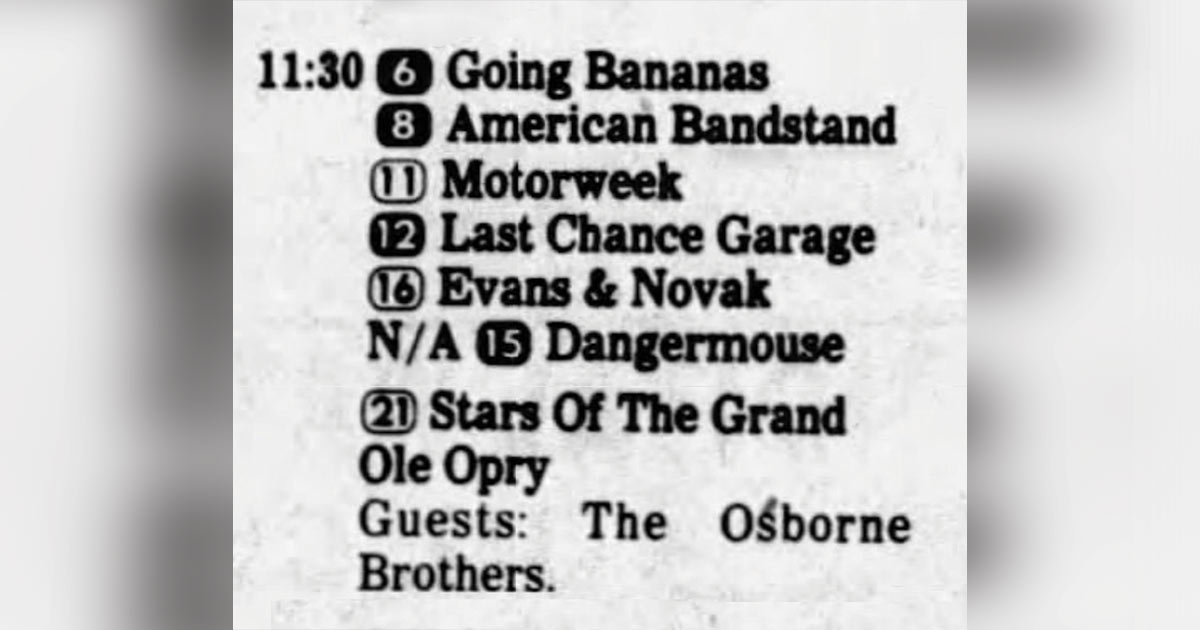
Q: I thought I knew everything the Osborne Brothers had ever done, but a friend said they had their own television show sometime in 1950s-1960s. She said her mother had watched them; her mother passed away last spring at 100. My friend insisted that was true. I suggested that maybe she was thinking of a television show they appeared on regularly. Can you tell me if she is right? – Nancy Houston, via email.
A: We reached out to two Osborne Brothers experts, both of whom are of the opinion that Bob and Sonny Osborne never had television programs of their own. Joe Mullins, radio broadcaster and leader of the Radio Ramblers, offered that “as far as I know they didn’t have their own program. They were guests on dozens of programs throughout their career, including in Detroit in their very early career, Cincinnati’s Midwestern Hayride, then all of the many programs in Nashville after they became Opry members in 1964. Frequently, the Osbornes were guests on TV with The Wilburn Brothers, and many great video clips are online with other TV shows hosted by Opry stars, as well as syndicated shows like Hee Haw and Pop Goes the Country.” C.J. Lewandowski, leader of the Po’ Ramblin’ Boys and the producer of Bobby Osborne’s last studio recordings, added succinctly that “they never did . . . just A LOT of appearances on Nashville-based shows and the Opry televised portion.”
Q: The recent recording of the Stanley Brothers’ “Jordan” by Darin & Brooke Aldridge got me thinking about the lyrics to that song. In your notes in the Stanley Brothers Starday-King boxed set, you mentioned that, even though the Stanleys’ record listed “Jordan” as being “traditional,” that the song was written in 1954 by Fred Rich. That same statement is in your book, The Music of the Stanley Brothers. My question is about the line, “that we may be ever caught ready.” The word “caught” seems to be mumbled so it came out as “call” or “called.” Cover versions by John Starling, Emmylou Harris, and the Aldridges all seem to use “called.” When Al Perkins and Chris Hillman put together a bluegrass band in the mid-1980s, they borrowed the line from “Jordan” and called their band Ever Call Ready. Most of the lyrics on various websites, relating to the Stanley Brothers, list the word as “caught,” which seems to make the most sense. I’m curious to know what you think the correct word is. – Orin Friesen, Bluegrass from the Rocking Banjo Ranch
A: I’ve always heard it as “called” “. . . we may be ever called ready.” But, in listening to the song again with fresh ears, it’s certainly open to debate. In an effort to clarify the situation, I reached out to Gary Combs, pastor of the Eastgate Church in Wilson, North Carolina. His mother, Wilda Dillon Combs, was a member of the Willow Branch Quartet, a gospel group from Bristol, Virginia/Tennessee, that had what is most likely the earliest recording of “Jordan,” circa 1955/’56. Pastor Combs wrote that the Willow Branch Quartet sang “found,” “. . . we may ever be found ready.” He added that “This was a highly requested song in the hundreds of churches and gospel singin’s where the WBQ performed, especially loved because of its bass lead.” As a follow up, Pastor Combs sent a PDF of the original sheet music that was published in 1954 by the song’s author, Fred Rich; it clearly reads “found.”
On November 30, 1962, the Stanley Brothers performed at the New York University School of Education. The concert was taped by budding audio enthusiast Peter Siegel. In performing “Jordan” on the program, Carter Stanley mentioned that “This is another song that we got from one of the revival meetin’s up in, uh, southwestern Virginia around Abingdon and Bristol through that part of the country. It’s called ‘Jordan.’” Clearly, the Stanley Brothers weren’t singing “found,” and the mystery word is probably still open to interpretation. There is much in the Stanley Brothers performance that is identical to the Willow Branch Quartet recording, and to Fred Rich’s sheet music, but there are other minor differences. Carter Stanley was very much in the mold of A. P. Carter. In addition to being a creative composer in his own right, he was an arranger. The Stanley Brothers’ recording of “Jordan” – garbled words and all – is their arrangement of the original.
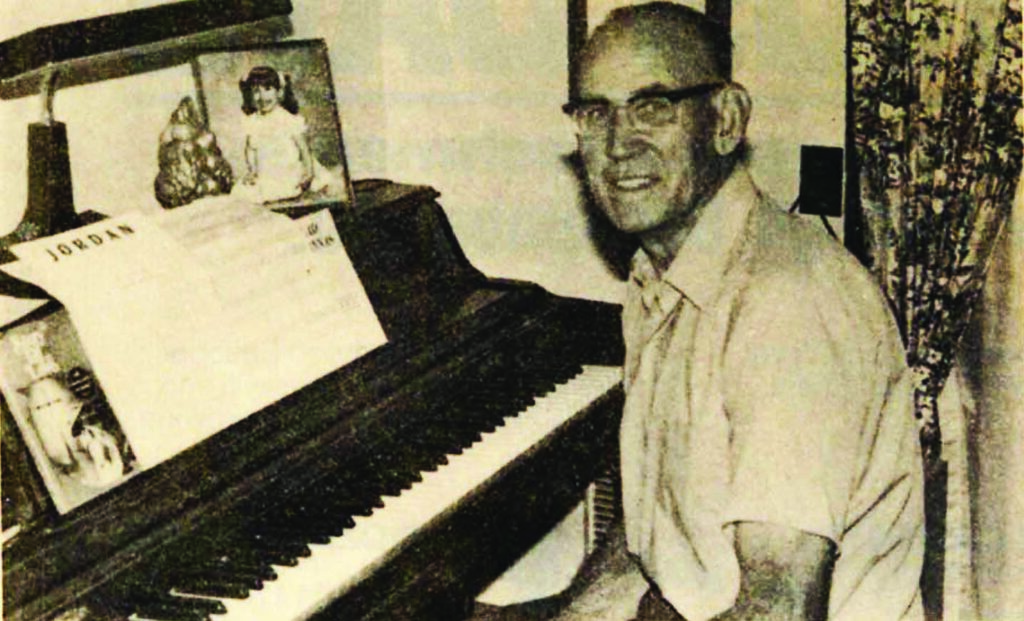
Fred Alvin Rich (November 4, 1914 – April 15, 2006) was a gospel songwriter from northern Georgia. For him, music was always an avocation. In life, he was a farmer, operated a grist mill, and plied his trade as a carpenter. He developed an interest in gospel music around 1934 and three years later attempted to write his first song. Rich was published for the first time in 1939. He wrote “Jordan” in 1954 and conceived the song’s chorus at the co-op where he worked in Blairsville, Georgia. He told the North Georgia News in 1963 that “I write my music by inspiration. Sometimes the tune comes to me while I’m plowing or building a house. In the evening, or more often on Sunday, when the house is quiet, I put down the notes on ruled staff paper. The words come to me as the music does.” By the time of the 1963 article, he had written approximately two hundred gospel songs, several of which were published by venerable southern gospel music publishers including Stamps-Baxter, J. D. Vaughn, and J. M. Henson. Rich was a self-taught writer who no doubt used his collection of three hundred gospel songbooks for guidance and inspiration. “Jordan” was initially self-published but sometime after the Stanley Brothers recording of it, Rich sold the publishing rights to Starday Music.
Q: Do you know if Ralph Stanley used the same banjo on all of the Stanley Brothers Mercury recordings? He was really laying it down on those records. – Jamie Holt, via email
A: We reached out to banjo expert Jim Mills, who had this to say about Ralph’s banjo and the 1953-1958 Mercury recordings: “I believe the banjo Ralph used on all the Mercury stuff was the same banjo. It’s a 1920s Gibson Mastertone Model RB-4 banjo that features the ‘Hearts and Flowers’ inlay in the fingerboard, with ‘Gibson’ and ‘Mastertone’ inlaid in the peghead. The Mastertone inlaid in the peghead – and not on a pearl block in the fingerboard, as was standard afterwards – was a throw-back to the ‘Ball Bearing’ era Mastertone banjos of 1925-’26. However, there was a period where Gibson banjos in 1926 and going into 1927 were combined with older 1925-’26 parts. That said, there are later examples of Mastertones featuring this same anomaly, and I’ve owned them. I have not seen Ralph’s old banjo in hand but I do not believe it to be a ‘Ball Bearing’ tone ring model as some have suggested. I believe it is a cast archtop model, either a rare ‘no hole’ tone ring (only made in 1927) or a 40-hole archtop tone ring made from 1928 on.”
Dog Music
What do the McPeak Brothers, Del McCoury, Dale Potter, Larry Sparks, the Vern Williams Band, Dick Kimmel, Bob Paisley, the Seldom Scene, the Black Mountain Bluegrass Boys, Bobby Atkins, Jack Cooke, Molly & Jack Tuttle, and the Barefoot Nellies have in common? They all recorded the classic country song “I’m Walking the Dog” which was made popular in 1953 and ’54 by country singer Webb Pierce.
Pierce’s recording of the song appeared in the fall of 1953 as one side of a Decca single, catalog number 28834. The flip side was “There Stands the Glass.” The October 10, 1953, edition of Billboard magazine noted “Very good reports from a number of areas. Most of the Southern hillbilly market is going for ‘Glass’ while Milwaukee, Philadelphia, and L. A. said that ‘Dog’ was the side selling.” Indeed, “There Stands the Glass” eventually went to #1 and stayed on the charts for 27 weeks. By contrast, “I’m Walking the Dog” peaked at #3 and was gone from the charts after only 17 weeks.
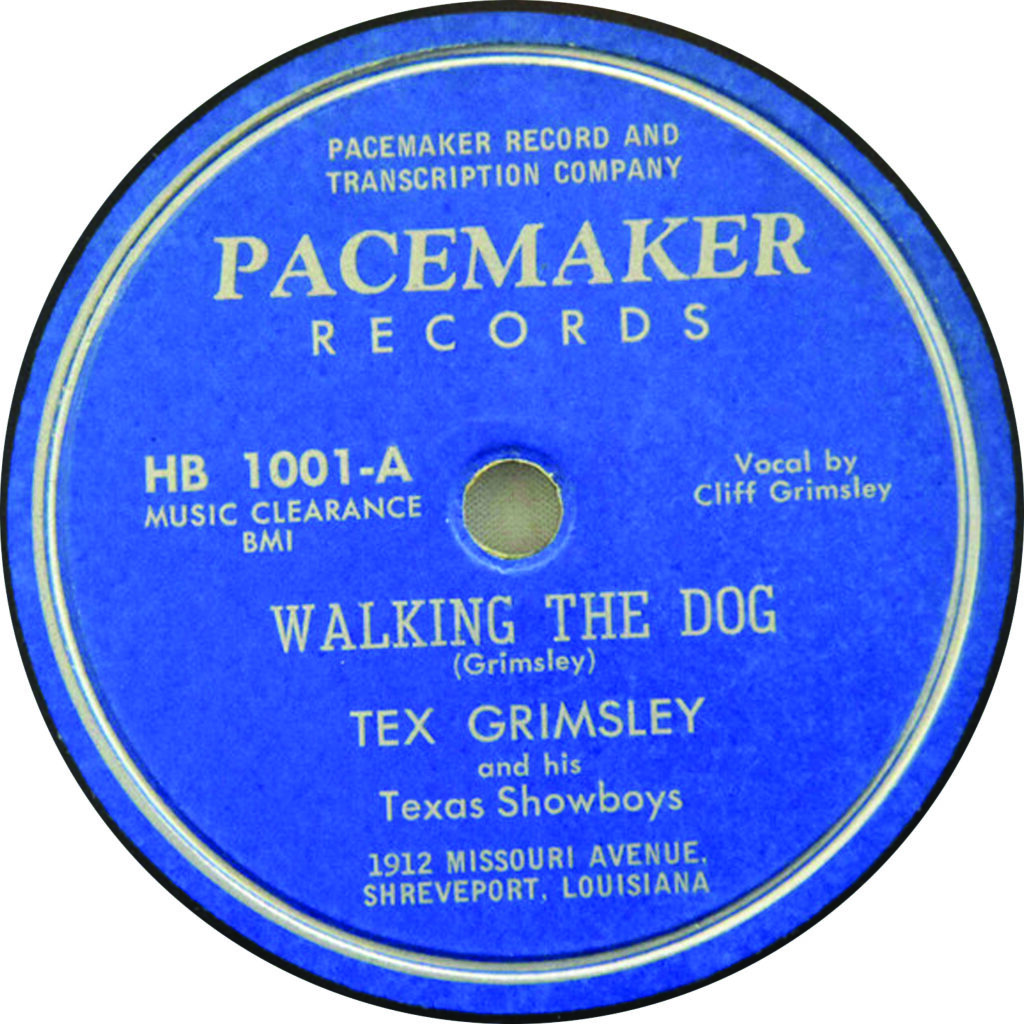
Although “I’m Walking the Dog” was popularized by Pierce, the piece was actually recorded a few years earlier by the song’s authors, brothers Cliff and Tex Grimsley. In 1949, Tex Grimsley and the Texas Showboys, with vocals by Cliff Grimsley, recorded the song for Louisiana’s Shreveport-based Pacemaker label. The city was home to radio station KWKH and that station’s popular Saturday night jamboree, the Louisiana Hayride. Tex Grimsley and His Texas Playboys had the distinction of performing on the program’s debut broadcast on April 3, 1948.
Willie Clifton “Cliff” Grimsley (October 18, 1922 – December 3, 2022) and Ennis Marcel “Tex” Grimsley (January 21, 1917 – October 4, 2002) hailed from Logansport, Louisiana; came from a musical family (father Grover was a fiddler and mother Myrtis played guitar); were featured in a band over WJLS radio in Beckley, West Virginia, in 1941; and were World War II veterans.
While in West Virginia, Tex befriended a Hungarian immigrant, John Tutterway, who taught him the art of building violins. It was only a short time later that the United States was drawn into World War II. Tex was stationed near Salt Lake City where he performed in a show with other servicemen at the Lyric Theatre. A Salt Lake newspaper tagged his appearance as “a hillbilly act featuring Tex Grimley.”
Two years later, Tex was back in Louisiana where he was stationed at the Alexandria, Louisiana, Army Air Field. Music continued to be a big part of his life: “Sgt. Ennis M. Grimsley, acting first sergeant of the tow target section here, is better known to Southwesterners as Fiddlin’ Tex Grimsley, king of the hillbillies. The holder of the ‘old time fiddling championship,’ who used to appear over Southern radio stations now confines his playing to barracks-mates.”
After the war, Tex headed several groups, including the Texas Showboys and the Texas Playboys. At times, Cliff played guitar and sang in one or both of the groups.
It was around 1952 or ’53 that the Grimsleys introduced “I’m Walking the Dog” to Webb Pierce. In his notes to a Bear Family collection of Webb Pierce material, Otto Kitsinger wrote that “while both brothers were in Pierce’s band (Tex on fiddle and Cliff on guitar) in Shreveport, Pierce complained one night in a club to the band members that nobody was dancing, and Cliff said he knew how to get them out on the floor, breaking into I’m Walking The Dog, which the brothers had been performing on the Hayride, and the dance floor filled up.”
Cliff Grimsley had opportunities to tour nationally but chose a stable home life instead. He was a multi-instrumentalist who played locally with friends and family; the steel guitar was his main passion. One of his musical highlights was performing in a group that appeared with Jimmie Davis during one of his runs for the governor of Louisiana.
Tex Grimsley likewise continued to play locally and was a frequent contestant (and winner) at area fiddle competitions. He was also known as an expert craftsman. By 1983, he had made upwards of 55 fiddles. Country music promoter Tilman Franks recalled that Tex “taught fiddle lessons for years and encouraged many people to play the fiddle. He was one of the pioneers in the music industry in Shreveport.” Speaking of “I’m Walking the Dog,” Tex noted later in life that “I bought a couple of good cars off the royalty.”
Over Jordan
Charles Osgood (born Charles Osgood Wood III, January 8, 1933 – January 23, 2024) wasn’t exactly your typical bluegrasser. He didn’t have a band, he didn’t tour, and he never recorded a bluegrass album. Yet, as a banjo player, who just happened to be a much-loved, widely-viewed newscaster, he was very much an ambassador for the music. Banjoist Tony Trischka offers a thoughtful memory:
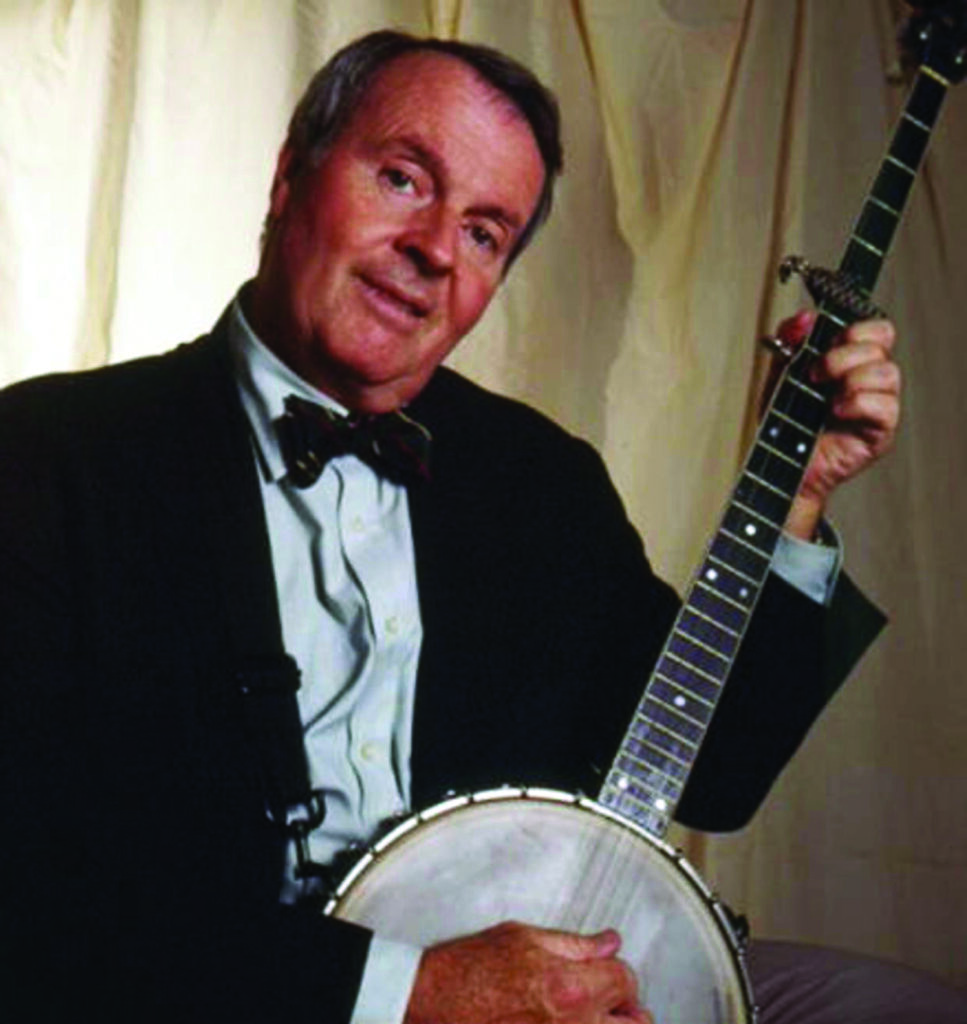
“Years ago, a banjo-playing friend of mine, a DJ at a Connecticut radio station, told me that Charles Osgood had come to visit the station for promo purposes. At some point, the topic of banjo came up because Charles was looking for lessons. My friend suggested me, and within a week Charles was pulling up to my house in New Jersey in his VW bug.
“I gave him a handful of lessons, with my son Sean observing from his infant swing. We’d spend an hour and a half, bouncing between banjoing and Charles telling amazing stories about his life in media. He mentioned that during Dwight Eisenhower’s illness he was chosen to be the president’s personal DJ, playing tunes that the Commander in Chief loved. Other wonderful stories followed. He was never looking to be a hot picker, just desiring to have more tools to use to accompany his singing.
“We became friendly, and it was such a joy when he did a feature on my friendship with Bela Fleck on the beloved show he hosted for many years, CBS Sunday Morning.
“What an honor it was to have him relate a winter’s tale with his warm and inviting voice on my first Christmas album, Glory Shone Around.
“Charles was a wonderful man, generous of spirit. He was larger than life and yet in the most understated, gentle way.”
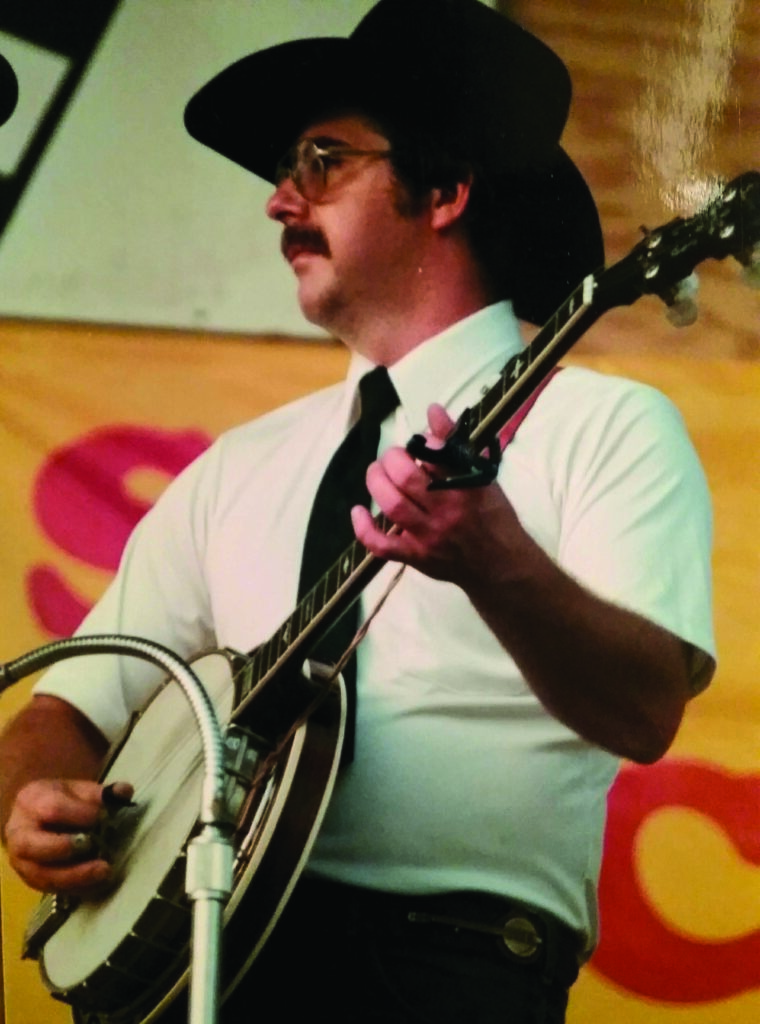
Patrick David “Pat” Parsnow (August 23, 1955 – October 8, 2023) was a bluegrass musician from Sterling, New York, who was proficient on banjo, guitar, bass, autoharp, mandolin and harmonica. He was most active from the late 1970s through the late 1990s. He played banjo and bass with a number of regional groups including Andy Pawlenko & the Smokey Hollow Boys, Moonshine Hollow, the Delaney Brothers, and Counterfeit Bluegrass. In recent years, he made occasional appearances with New Snip City, a band consisting of his sons, his wife and long-term friends. For decades, his camper at festivals and his family home hosted legendary bluegrass jams and parties. In those gatherings, he became solely responsible for introducing many people to the music, either inspiring others to become musicians themselves or creating lifelong fans and listeners of bluegrass. For those efforts, he recently received the 2023 Frank Saplin Award for dedication and ambassadorship to bluegrass music at Bill Knowlton’s Bluegrass Ramble Picnic.
Raymond Strachan “Ray” Tate, Jr. (January 8, 1937 – October 8, 2023) was a driving force behind the Old Town School of Folk Music in Chicago from the early 1960s through the early 1980s. Although his main area of expertise was classical guitar, he listed bluegrass as his first choice in music. As an instructor at Old Town, he taught the genre to countless budding Chicago pickers. Among his more illustrious student success stories was John Prine.
Tate was born in Chicago and grew up on country music. He was familiar with the WLS Barn Dance and performers such as Bob Atcher. He also had memories of hearing Bill Monroe when his group featured accordion player Sally Ann Forrester. At age 10, he received a guitar as a Christmas gift. He took lessons and, like many others, played along with records.
Tate continued to hone his talents on the guitar and in 1963 started teaching at Old Town. By 1965, he was the head of the school’s faculty. That same year, while hanging out at the Fifth Annual University of Chicago Folk Festival, someone shoved a bass fiddle in his hands and he wound up on stage performing with the Stanley Brothers. He recalled one humorous incident that occurred on an up-tempo number. “I started slapping the bass, Bill Haley stuff, and Carter Stanley turned around to me and said, ‘If I wanted a drummer, I’d of hired one’.”
In the early part of 1969, Tate and a partner opened the Fifth Peg in a building across the street from Old Town. It was there, during an open mic night, that John Prine showed up. Subsequent lessons from Tate at Old Town set the singer/songwriter on a guitar finger picking journey.
From 1971 until 1982, Tate served as the Executive Director of Old Town. He oversaw a staff of some 50 teachers, participated in fundraising, and staged concerts that featured many first-generation bluegrass performers including Ralph Stanley (with a young Ricky Skaggs), the Osborne Brothers, Jim & Jesse, and Bill Monroe. On one of Monroe’s outings to Chicago, Tate invited him to Old Town for a workshop with his students. A cherished keepsake of that day was a photo showing Tate (with guitar) on stage with Monroe (with mandolin).
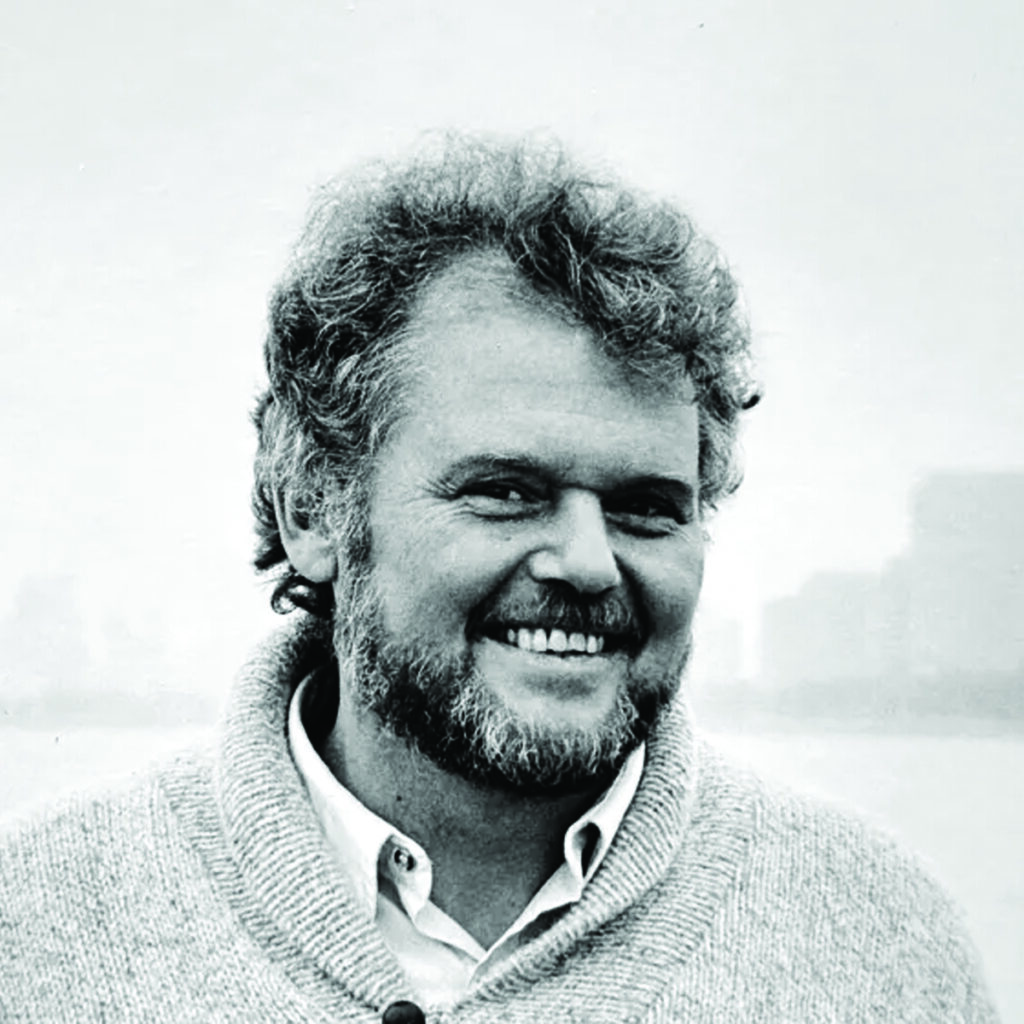
After stepping down as executive director at Old Town, he embarked on a number of endeavors that included hosting guitar seminars at various cities throughout the United States; an appointment as Director of Special Projects at Chicago’s American Conservatory of Music; a move to Texas that included training horses, forming a cowboy music band called Spirit of Texas, and forming an arts program for gifted students; the formation and/or continuation of a production company with which he composed jingles for radio and television commercials and put together more than 25 film scores and television themes. In addition to his musical ventures throughout the US, Tate also lived and toured overseas.