Fifty Years of Old & In the Way
The Long Strange Trip of Spud, Dawg, Red, Mule and Vassar
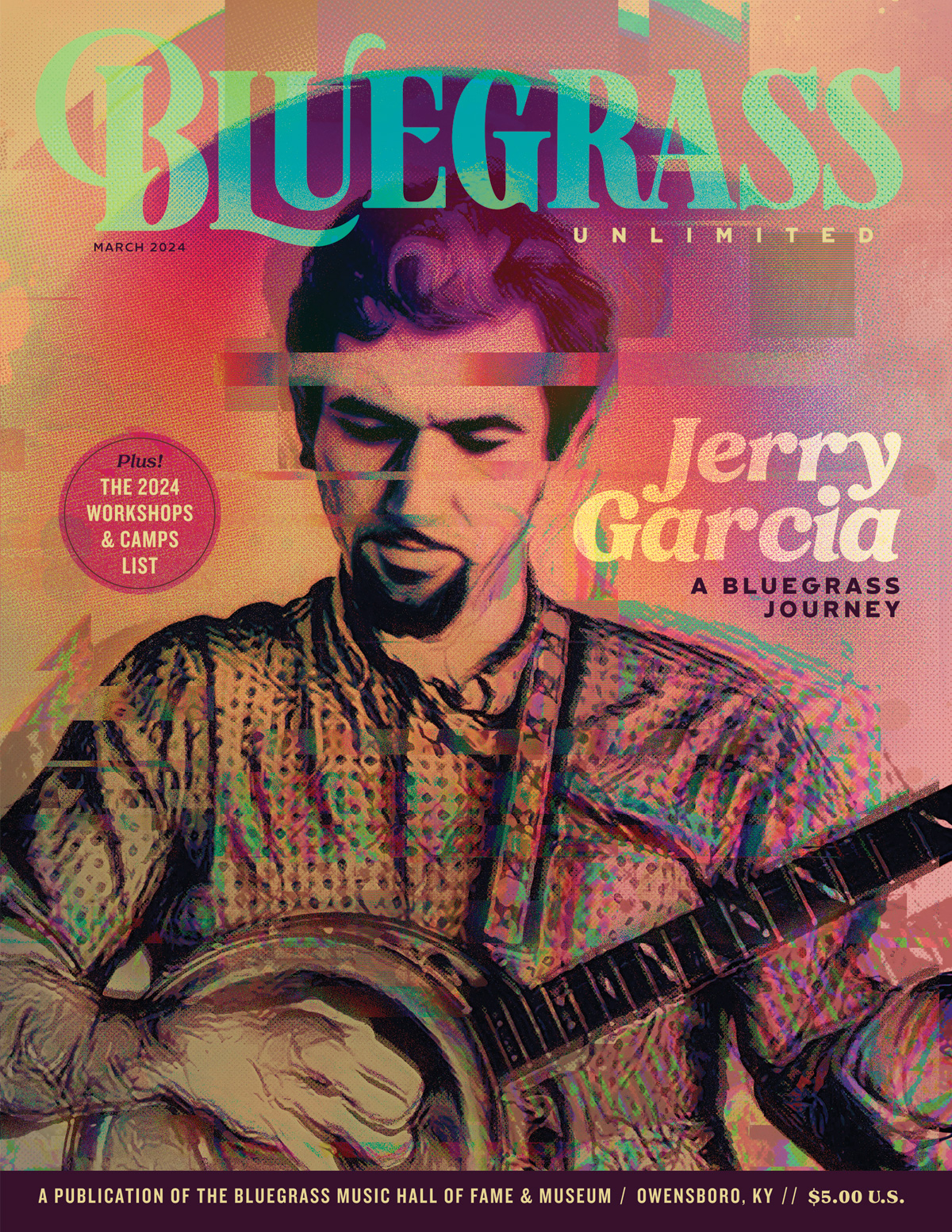
Jerry Garcia’s burning ambition as a young musician was to play banjo in Bill Monroe’s Blue Grass Boys. He never made it, and had to satisfy himself with being the leader of one of the most successful and beloved bands in rock music, the Grateful Dead. But he never lost his love for the high lonesome sound.
By 1973, the Dead had released 10 albums, including the critically acclaimed country-ish Workingman’s Dead and American Beauty (both 1970). Garcia had also been heavily involved for a couple of years with the New Riders of the Purple Sage, in which he played pedal steel guitar. The Dead was on a bit of hiatus, so Garcia had extra time on his hands. It was time to get the banjo out of the closet.
Guitarist Peter Rowan met mandolinist David Grisman in 1963 at the fiddler’s convention at Union Grove, North Carolina. Rowan was a year away from joining the Blue Grass Boys as guitarist and lead singer. Grisman had begun making a name for himself by producing an album by Red Allen and Frank Wakefield for Folkways. He would join Allen’s band in 1966.
Grisman met Jerry Garcia in 1964 in the parking lot at Sunset Park in West Grove, Pennsylvania. “Back then we were all on a quest,” Grisman has written, “searching out that ‘high lonesome sound’ of Bill Monroe, Flatt and Scruggs, the Stanley Brothers, and other idols.”
Garcia had played in several San Francisco bluegrass bands in the early 1960s, including the Hart Valley Drifters, the Wildwood Boys and the Black Mountain Boys with such musicians as David Nelson, Robert Hunter, Jody Stecher, Eric Thompson and Sandy Rothman. But by his own admission, Garcia’s chops on the banjo were pretty rusty when O&ITW started. He hadn’t played much banjo since 1965, when he switched to electric guitar with the Warlocks, which soon changed its name to the Grateful Dead.
Rowan, Grisman and Garcia had all been away from bluegrass for a few years when they started jamming together in 1973. Rowan left Monroe’s band after two years and formed the folk-rock band Earth Opera with Grisman. Earth Opera recorded two albums for Elektra. In 1970, Rowan joined Seatrain, which included former Blue Grass Boy Richard Greene on fiddle.
Rowan and Grisman were neighbors in Stinson Beach, California. “We would get together and play a little,” remembers Rowan. “After a couple weeks of that, David said, ‘You know Jerry still lives just up the hill, and he’d love to pick. So we got in the car and drove up the hill, up Mount Tamalpais, to the last house on the hill. Jerry was sitting in his front yard with his banjo waiting for us. We just started playing there in the yard. There’s something about bluegrass that calls you back. You never really leave it behind.
“We were like kids again. We were rediscovering the bluegrass origins and just devouring the material. We dug out a bunch of old songbooks—Bill Clifton, the Stanley Brothers, Red Allen—and just started firing up the bluegrass enthusiasm. We would meet in the evenings after supper up at Jerry’s house and play. It was a very copacetic time.”
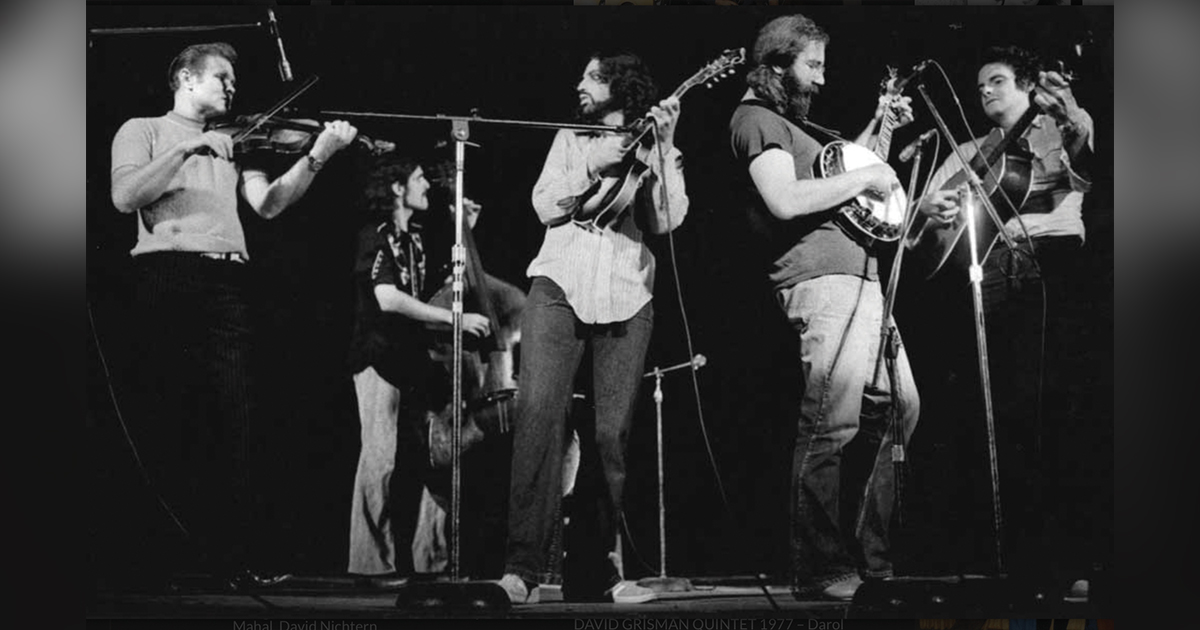
John Kahn, the electric bass player in Jerry Garcia’s band with organist Merl Saunders, was recruited to play upright bass in the band. After a few months of jamming, the band decided to do the occasional gig. The first outing was a two-night stand at the Lion’s Share in San Anselmo; the first night’s gig was preceded by a live set broadcast over KSAN.
The band would go on to do some 40 gigs between March and November 1973, most of them in California, with a couple in Oregon. On O&ITW’s only eastern tour, the band performed in Virginia, New Jersey, Massachusetts, Connecticut and Pennsylvania. The Virginia gig was at the Warrenton Bluegrass Festival, a massive gathering promoted by Jim Clark that featured dozens of top acts, including a few folk and rock stars.
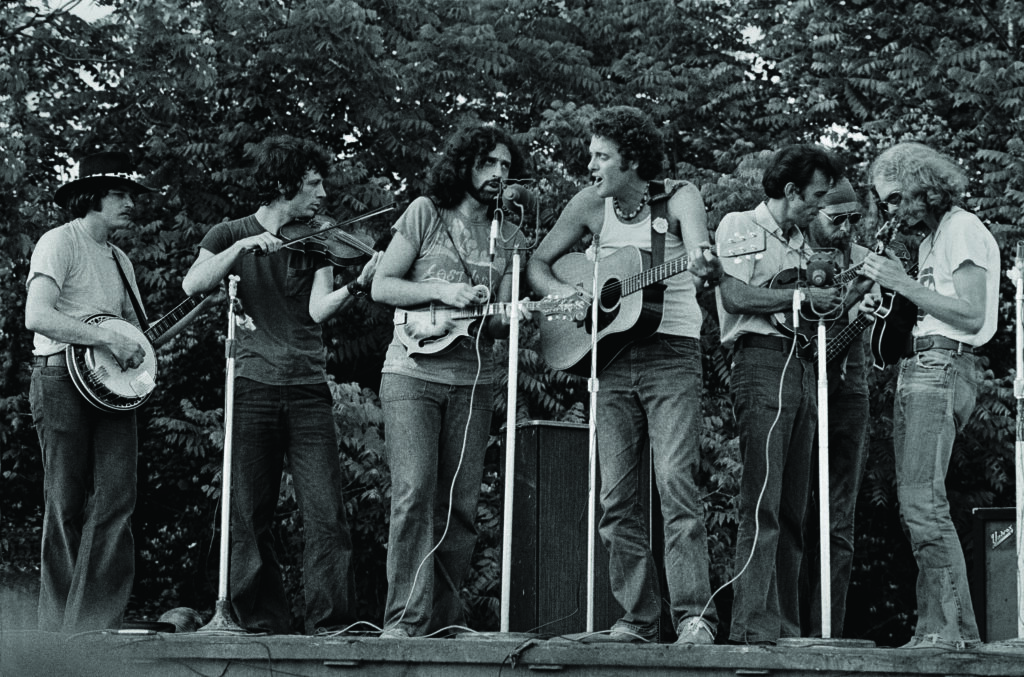
Rowan remembers the festival as great fun, for most of the band. “David, Vassar and I had lots of fun jamming and visiting with friends. But Jerry couldn’t do that. Without any kind of security, he would just get mobbed if he went out into the crowd. He was not comfortable with that kind of crowd pressure, so he just stayed in his hotel room while we went out and had fun. There’s a famous picture of me, David, John Hartford, Sam Bush, Butch Robins, Buck White and a bunch of other people all jamming on stage. The only one missing is Jerry.”(See photo on page 16).
The band played its first several gigs as a foursome without a fiddler, before being joined by Richard Greene, a former Blue Grass Boy and bandmate of Rowan’s in Seatrain. Greene played four gigs with O&ITW before deciding he was too busy with other projects to commit to the band. He was replaced by John Hartford, who played nine gigs before reaching the same decision as Greene. He was replaced by Clements, who was on the remainder of the band’s gigs.
Vassar Clements, a highly respected bluegrass and jazz fiddler from Florida, turned out to be the final piece of the puzzle. “Vassar inspired the whole band,” recalls Grisman, “and that was the start of an amazing musical relationship. It was ecstatic!”
Rowan vividly recalls the first time he heard Vassar: “Rual Yarbrough (banjo player and former Blue Grass Boy) had played me a cassette of Vassar playing in a jam at a New Year’s Eve party. My jaw hit the floor. This fiddle playing had Scotty Stoneman’s fire, Chubby Wise’s beautiful, mellifluous sound, and then the blues. It was like nothing I’d ever heard.”
Clements burst onto the bluegrass scene in 1949, when he replaced Chubby Wise in Bill Monroe’s Blue Grass Boys. He fiddled on such classic Monroe records as “My Little Georgia Rose” and “I’m On My Way Back to the Old Home.” He next spent five years playing with Jim and Jesse and the Virginia Boys, recording with them on Starday and Columbia.
By 1973, Clements was the hottest fiddler in the country, thanks to his touring and recording with two popular and influential bands, John Hartford’s Aereo-Plain band and the Earl Scruggs Revue, and his featured role on Will the Circle be Unbroken, the landmark three-record set by the Nitty Gritty Dirt Band.
O&ITW never did any commercial recording, but a live album capturing a moment in time in the life of the band would become one of the best-selling bluegrass albums in history. The album was recorded October 8, 1973, at the Boarding House in San Francisco by Owsley Stanley and Vickie Babcock, using eight microphones (four per channel) mixed live onto a stereo Nagra tape recorder.
The material on the album included bluegrass standards (“Pig in a Pen,” “White Dove”), a cover of a song recorded by both the Rolling Stones and the Flying Burrito Brothers (“Wild Horses”) and original songs by Grisman (“Old and in the Way”), Clements (“Kissimmee Kid”) and Rowan (“Midnight Moonlight,” “Panama Red” and “Land of the Navajo”).
Old & In the Way was released in 1975 by Round Records, a label co-owned by Garcia. The album entered the digital age in 1986 when it was released on CD by Rykodisc. The CD was subsequently licensed to Sugar Hill Records, which distributed it for several years. It was among Sugar Hill’s top sellers year after year.
Four additional releases of O&ITW concert recordings have been released by Acoustic Disc, David Grisman’s record company: That High Lonesome Sound (1996); Breakdown: Original Live Recordings from 1973, vol. II (1997); Live at the Boarding House: The Complete Shows (2013) and Live at Sonoma State – 11/4/73 (2023).
The band fell apart at the end of 1973, the last gig being the one at Sonoma State. There was reportedly tension between Rowan and Grisman, but it was probably more a matter of differing priorities and ambitions than anything else.
Rowan says of the experience, “It was fun until something changed. Then it wasn’t fun anymore. The cracks were starting to show. The thing about O&ITW was we had no agenda. We didn’t have a manager. There was no record company saying, ‘You guys need to record.’ There was just this mad enthusiasm.”
Grisman’s memories are happier. He says he enjoyed “the whole nine yards. We had a great time together, all too brief, but it’s gratifying that the music has endured.”
The band regrouped in April 1974 to play at the Golden State Country Bluegrass Festival in San Rafael, California. In addition to a five-song set played by the whole band, Garcia and Grisman joined Richard Greene, Taj Mahal and David Nichtern to perform as the Great American String Band. Garcia also performed a few songs with mandolinist Frank Wakefield and sat in with the Nitty Gritty Dirt Band for an entire set. Vassar Clements, who had top billing on the festival’s poster, fiddled with several acts.
Except for the two festivals the band played, the audiences at O&ITW gigs were mostly Deadheads there to see Jerry Garcia rather than hardcore bluegrass fans. “The people there had never heard bluegrass,” says Rowan. “They were like all of us the first time we heard it. They were on the floor, just knocked out.” Grisman adds, “Whoever they were they dug it!”
“We did what we did out of sincerity and passion,” says Peter Rowan of O&ITW. “I think it’s the passion that has reached the audiences over and over again. Over the years, I’ve met so many people that said Old & In the Way opened a door for them. They became fans of the Stanley Brothers and the Lonesome Pine Fiddlers, that more obscure world of bluegrass that’s a world unto itself. Also, musicians; they come up all the time and tell me it was that record that got them started.”
David Grisman says he’s not surprised by the enduring popularity of the music made by Old & In the Way fifty years after the band played its last gig. He credits that staying power to the bandmate he knew as Spud Boy: “Jerry Garcia made an indelible impact on American culture and part of that was his very real connection to the roots of American music, which includes the music we made together in O&ITW. That music made and continues to make an impact on listeners, probably because it’s true to those roots and fun.”