Notes & Queries – January 2024
Don Stover’s Banjo
Recently, Bluegrass Unlimited editor Dan Miller conducted an interview with singer/songwriter Jim Lauderdale for a BU podcast. During their discussion, the subject of Don Stover’s banjo came up, and whatever happened to it. The banjo appeared on a number of Don’s albums from the early 1970s, most notable was the classic Things in Life (Rounder 0014). For answers about the fate of Stover’s banjo, we reached out Matteo Ringressi of the Italian-based Truffle Valley Boys. He replied:
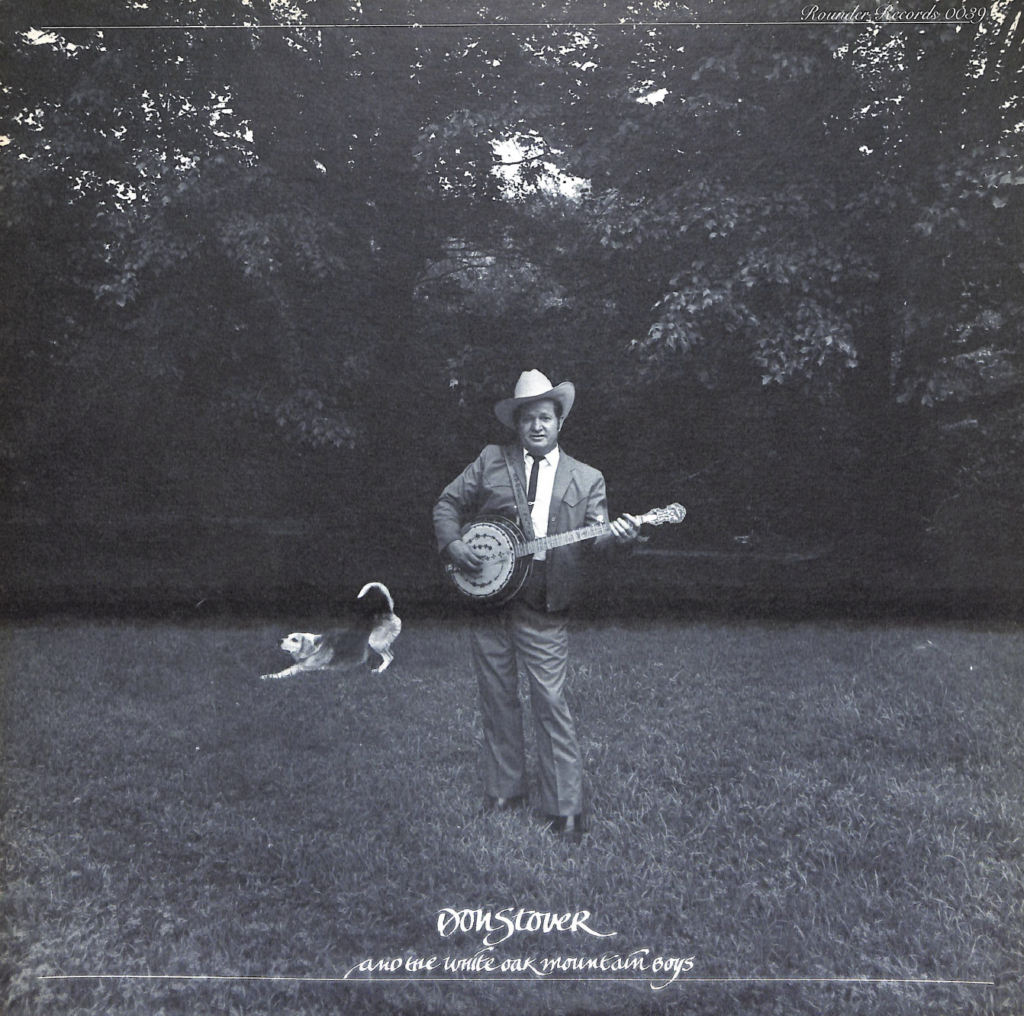
“Germano Ciavone [banjo player for the Truffle Valley Boys] says he discussed it at length with both one of Don’s sons and Dick Bowden and Don’s RB6 was crushed by the airline on a flight returning from Japan. It’s speculated that the tone ring might have survived and it was sold to someone down the line, but the neck, pot assembly etc. . . . were destroyed.”
Dick Bowden confirmed the above: “That’s what Don told me, and his son confirmed it. It wasn’t an original 5-string. It was a converted tenor.”
Vintage Photo
Multi-instrumentalist Matt Levine posted a vintage photo on Facebook recently with the burning question: “Anyone know who these dudes are?” Just like the Arkansas Traveler who asked his own questions, and then answered them, too . . . the back of the photo Matt asked about contained a list of handwritten names that presumably belonged to the people on the front: Dave Young, J. D. Himes, Jimmie Krow, and Wm. H. Boeckel.
An outreach to several next-of-kin for the names listed on the photo yielded a reply from a daughter of William Boeckel. She informed us that the electric guitar player at far left was her father. From additional period photos from her father’s collection, it was determined that the group name was The Dave Young Show. J. D. Himes appeared on fiddle and Bobby Diamond was on banjo. Dave Young, sporting a white coat and slacks, played guitar. The photo dates from 1955. The listing of the name Jimmie Krow was an error.
The Dave Young Show debuted on radio station WGCB in Red Lion, Pennsylvania, on March 18, 1953. It remained on the air until December 31, 1956. In the intervening years, the group performed at area firemen’s carnivals and at country music parks such as Hellam, Pennsylvania’s Valley View Park. Young was known occasionally as Your Old Country Boy and, at times, as the leader of another group called the Ozark Mountain Boys. Following his days at WGCB, Young drifted into musical obscurity.
Perhaps the most well-known member of The Dave Young Show was banjoist Bobby Diamond. He was born Robert Frederick Rook, Jr. (May 16, 1933 – September 22, 2011). He evidently took the stage name of Bobby Diamond early in life; he was twenty-two years old at the time this group photo was made, and was already known as Bobby Diamond. His tenure with The Dave Young Show likely represents his first professional work. He later enjoyed a stint in Baltimore with Jack Cooke’s Virginia Mountain Boys. A 45 rpm single by Cooke, released on the Ark label (circa 1963), featured Diamond’s exciting banjo work on two songs: “Let Me Rest at the End of My Journey” and “(New) Cripple Creek.” At the close of 1963, he filled in as a banjo player for Bill Monroe during the second week of a two-week engagement at the Ash Grove in Hollywood, California.
Diamond recorded another single with Jack Cooke at some point in 1965. It was released on the Gambler label (catalog number 1641) and contained “I’ve Always Been a Rambler” and “Virginia Mountain Banjo.”
Defining an exact chronology of Diamond’s career in the middle 1960s is a tedious undertaking. He apparently moved in and out of several bands, including Jack Cooke’s, Red Allen’s, and the Franklin County Boys.
During the stretch with Red Allen, others in the band included Porter Church along with Bill and Wayne Yates. Diamond didn’t appear on any of Allen’s studio recordings at that time, but an album later appeared that was culled from a circa March 1966 radio broadcast that was hosted by Pete Wernick over radio station WKCR-FM. This same period saw the introduction of David Grisman to the band. One of Grisman’s takeaways from this era was the band’s sleeping arrangements. In the February 1989 issue of Bluegrass Unlimited, Grisman told Dix Bruce: “You haven’t played bluegrass until you’ve slept in a hotel room between Red Allen and Bobby Diamond.”
From December 1965 through the first half of 1966, Diamond played fiddle with the Franklin County Boys. From 1968 through the middle of 1970, he played fiddle (and occasionally banjo) with Del McCoury. When he first went with McCoury, the band didn’t even have a name. In 1982, McCoury related to Eugenia Snider that “I didn’t even think about a name. We were just playing in bars and clubs. But one day Bobby Diamond said ‘You know what? There used to be a band called the Dixie Pals and they broke up. You ought to take that name. It goes good with yours.’ After we talked about it I forgot all about it. But then when we played in clubs people would come up and ask who we was and he’d say ‘This is the Dixie Pals’.”
Diamond did one other stretch with Del McCoury in the first half of 1973. He subbed for fiddle player Billy Sage who was recovering from a shoulder injury.
The Dave Young Show featured an interesting mix of instrumentation. While possessing three essentials of bluegrass – 5-string banjo, acoustic guitar and fiddle – the group also sported an electric guitar, as played by William Henry “Bill” Boeckel (February 1, 1934 – November 12, 2016).
Boeckel, a York County Pennsylvania native, was 21-years-old at the time of this photo and was playing a new Les Paul model Gibson electric guitar. A defining feature of the electric guitar in the photo is the one-piece “wraparound” unit that was both a bridge and an anchoring place for the strings. Guitars with this feature were manufactured from 1953 until 1955.
Following his work with Dave Young, Boeckel played with the Southland Playboys, whose work included appearances on the WWVA Jamboree. He had offers to play with professional touring groups but chose family over life on the road. Later, as Boeckel’s children came of age, they were integrated into a family band that eventually included his son and two daughters. Leisha Boeckel recalled that “we all played in bands . . . he had us all playing from the time we were in elementary and junior high school. He didn’t really have to teach us. My dad couldn’t [read] a note and I can’t read any of them black dots either, and neither could my brother or sister. We can just listen to it a of couple seconds and then play it. We started going to VFW and Legion halls. I loved it.” The family group’s repertoire included traditional favorites such as “Roll In My Sweet Baby’s Arms” as well as contemporary fare by mainstream acts such as Alabama. Boeckel occasionally switched from electric guitar to fiddle, depending on the needs of certain songs.
Joseph Daniel “Joe” (or J. D.) Himes (July 8, 1926 – June 29, 1974) played fiddle for The Dave Young Show. Like his other bandmates, he was a native of York County, Pennsylvania. Fiddling appeared to be a family tradition; his uncle Nelson Himes was a mainstay of York County fiddling for many years. In the middle 1960s, J. D. appeared with a country group called The Diamonds and, with his wife Thelma, was a driving force behind a Big Country Jamboree that accompanied the grand opening of the area’s New Craley Drive-In. A civic-minded member of his community, J. D. belonged to a number of organizations including the Veterans of Foreign Wars and the York County Fiddler’s Association.
(Leisha Boeckel, Ira Gitlin, Bill Knowlton, Matteo Ringressi and Richard F. Thompson contributed to the history of The Dave Young Show photo.)
Over Jordan
Ronnie Earl “Ron” Cornett (December 14, 1954 – September 17, 2023) was a popular Kentucky-based radio personality and a concert/festival master of ceremonies. He was also a co-founder of the Northern Kentucky Bluegrass Music Association. Prior to his professional bluegrass activities, Cornett was a proficient picker who played guitar, mandolin and bass. He lent his talents to the band Revival Ridge, which had the honor of performing twice at the Ryman Auditorium in Nashville.
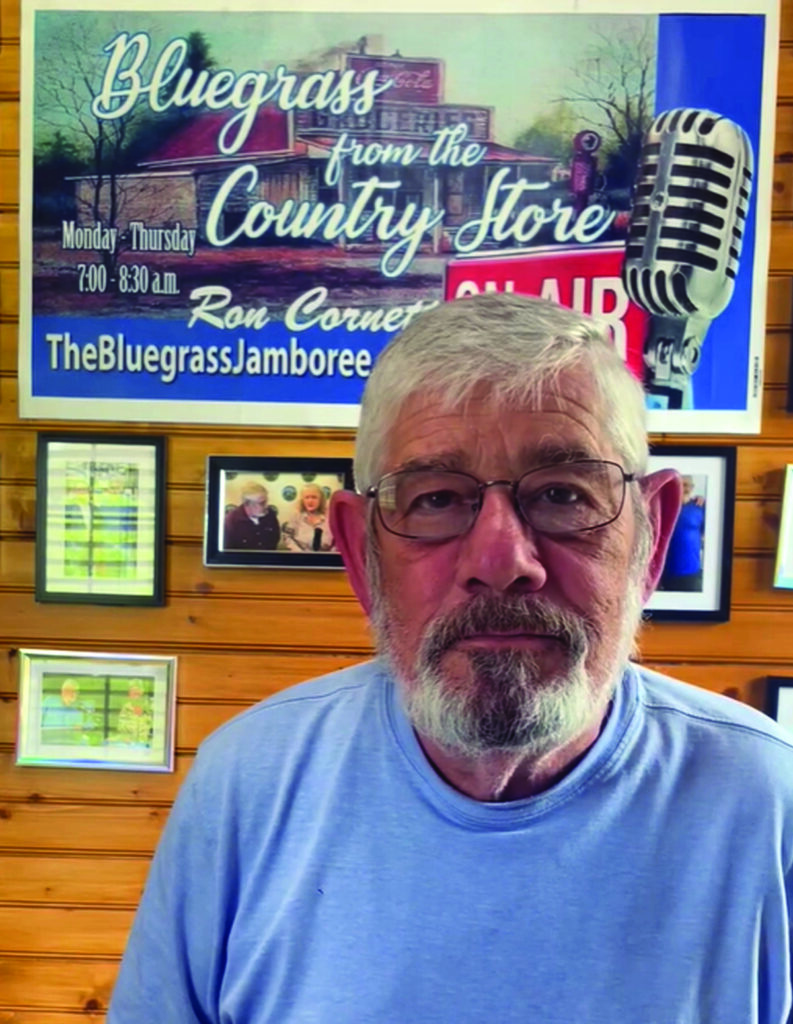
Cornett was a native of Piney Grove which was located near the central Kentucky city of London. After graduating from high school, he served a seven-year hitch in the Army.
Early on, the music of Flatt and Scruggs and Bill Monroe fueled Cornett’s passion for bluegrass. Picking sessions with friends deepened his love for the music.
But it wasn’t until the late 1990s, after a move to northern Kentucky, that Cornett’s involvement kicked into high gear. He found other jamming situations, one of which was connected to his day job. The latter led to a bluegrass festival and a stint as a bluegrass DJ on a local radio station.
During this same period, Cornett was a member of three bluegrass / bluegrass gospel bands. He appeared on Revival Ridge’s 2007 gospel disc They Need Jesus, playing and singing bass.
Most recently, Cornett hosted a program called On the Road Bluegrass which was streamed over The Bluegrass Jamboree. In addition to playing music from CDs and albums, Cornett featured artist interviews and sometimes live performances.
A measure of Ron’s connection with his radio audiences can be found in a recent remembrance by members of the band Retro 78: “Ron was not just a friend, but a true legend and ambassador of bluegrass music, and his legacy will forever echo through the melodies of this beloved genre. Ron’s passion for bluegrass was unwavering, and his dedication to promoting the music was truly inspiring. He played a pivotal role in nurturing the genre’s growth and preserving its traditions. His enthusiasm was infectious, and his knowledge was unparalleled.”
Walter George “Smokey” Greene (March 10, 1930 – October 19, 2023) was a mainstay for bluegrass and traditional country music in New York, Vermont and surrounding regions. He was a performer, band leader, radio disc jockey, club owner, and festival promoter. Banjoist and long-time friend Don Stover proclaimed once, “Smokey, if it weren’t for you, a lot of fellows would have probably starved to death.”
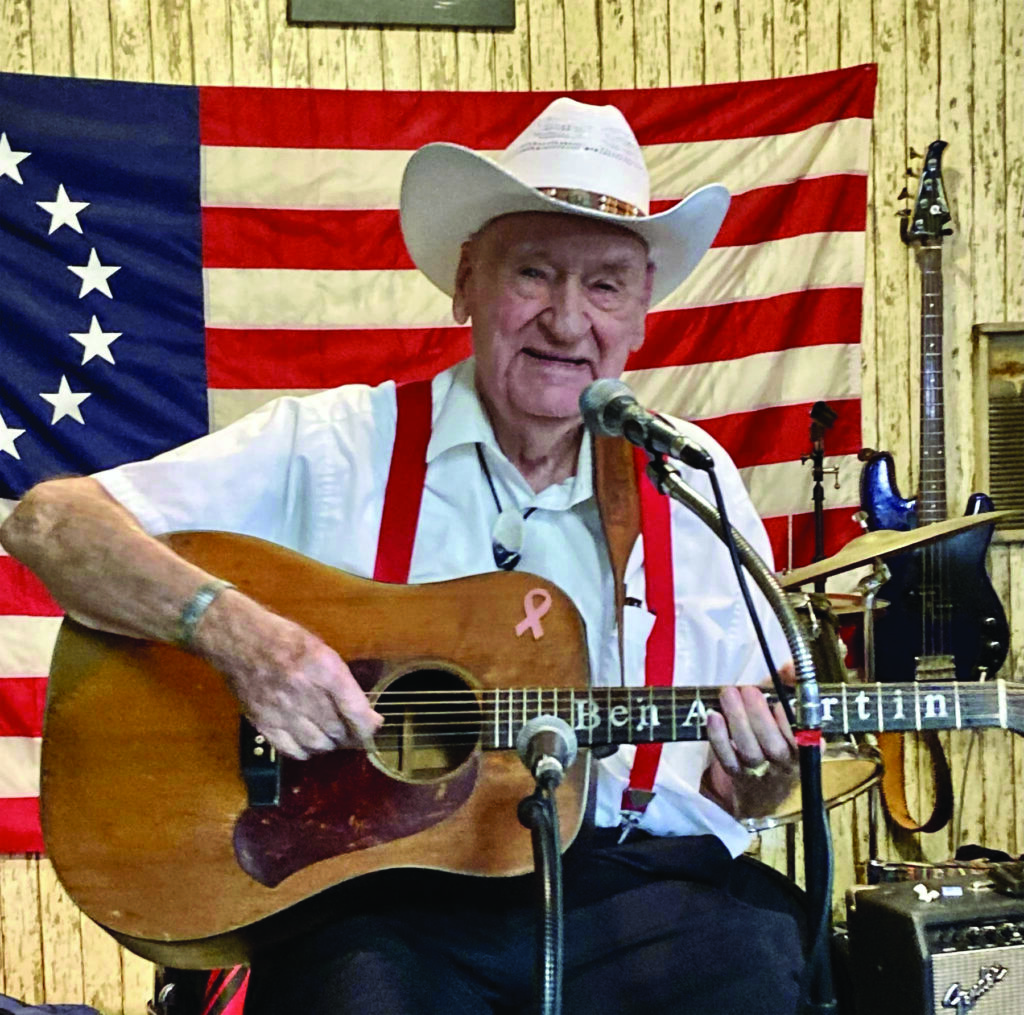
A native of Vermont, Greene was born into a musical family that included fiddling uncles and cousins. His own talent blossomed in 1943 when he acquired and learned to play a tenor banjo. Three years later, at age sixteen, he made his first money as a performer by playing banjo and being a caller for square dances. The following year, with a brother and a sister-in-law, Smokey formed the Greene Family Band.
Greene spent a decade in the Air Force, from 1947 to 1957. During part of that time, he saw service in Korea. Later, while stationed in California, he played guitar in a country band. He acquired his nickname — Smokey — by supplying packs of cigarettes every night for his band members.
After his discharge, Greene headed back to New York and tried his hand as a performer. He worked as a solo, often playing four or five hours a night, five nights a week. In 1960, he assembled the Green Mountain Boys and played at area country music parks and as an opening act for touring professionals.
In 1966, Greene opened a country music club in Schuylerville, New York. In time, he began booking bluegrass acts such as Reno and Smiley, Bill Harrell, Don Stover, Charlie Moore and the Country Gentlemen. To his surprise and delight, the bluegrass acts consistently out drew the country bands.
Greene moved to Glens Falls, New York, in 1970, opened an even larger club and took on work as a disc jockey.
1972 was a pivotal year for Greene. It was then he staged his first bluegrass festival. It had the distinction of being the first bluegrass festival in the state of New York. He ran festivals for the next sixteen years, and staged his last one in 1988.
Greene recorded slightly over 100 songs, most of which were released on a series of seven albums and CDs. The first appeared in 1967 and was titled simply Smokey Greene. A 1986 release called Keep Country in Country Music was also the slogan of Green’s fan club. Many of his albums were self-released or appeared on regional labels. His most widely distributed release was The Friendly Voice of Smokey Greene, which appeared on Pinecastle in 1996. His most recent release was 2006’s He’ll Waltz Across Texas No More.
Throughout the 1970s, 1980s, and into the middle 1990s, Greene’s group was known as Smokey and the Boys. In 1995, the group was disbanded and Smokey began working as a solo.
Greene retired to Zephyrhills, Florida, in 2003 and continued to work as a solo. Throughout the summer months, he worked up to a dozen bluegrass festivals. Summing up his life’s work, he told Tampa Bay Times staff writer Logan Neill in 2007, “I’ve loved this music all my life. It’s the only thing I ever truly wanted to do.”
Frank Dale Harlow, Sr. (October 26, 1939 – October 22, 2023) was an Ohio-based luthier who specialized in the making of resophonic guitars. A meticulous craftsman, he did most of his work on the instruments by hand. Although he considered his work to be a hobby, as opposed to a vocation, he put his heart and soul in each instrument that he created. An instrument never left his shop unless it felt like he would like to own it for himself.
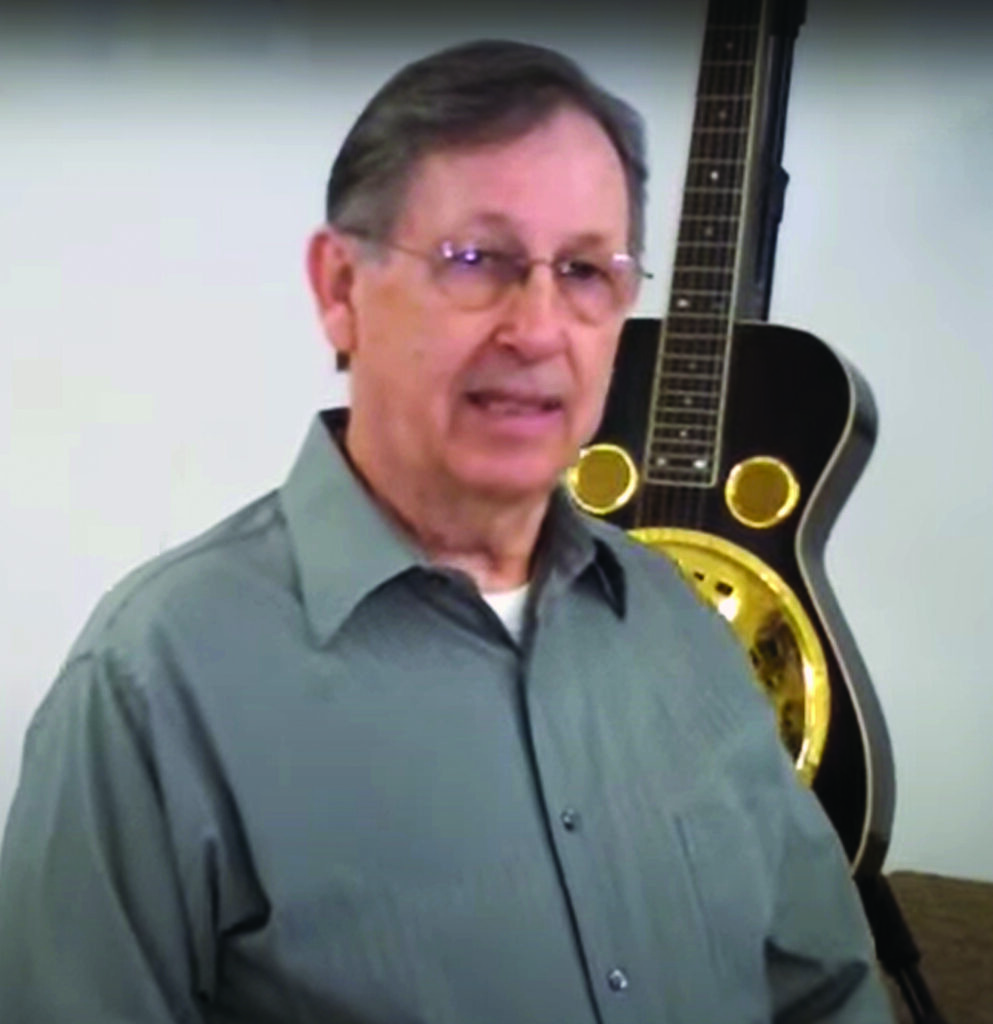
A native of Bristol, Virginia, he moved with his family to Vandalia, Ohio, in 1948. He remained in the community for the rest of his life. His father played banjo, piano, and was a good harp player. As a youth, the first instrument he ever held was a resophonic guitar. By his own admission, he didn’t play like most other pickers and modestly felt he wasn’t all that good. Throughout his life, he played guitar and sang.
Harlow’s professional life was spent as a truck driver for General Motors Corporation. Even after retirement, he continued to drive part-time for Harco Industries of Englewood, Ohio. In all, he logged fifty-two years as a driver.
It was while working as a driver that Harlow developed the desire to build instruments. He mapped out the process in his head for a year before purchasing all of the necessary tools. He made his first instrument in 1990.
An early proponent of Harlow’s work as a luthier was Gene Wooten, who was then performing with the Osborne Brothers. Banjo chief Sonny Osborne was so taken with Harlow’s craftsmanship that he stipulated that Wooten always use a Harlow resophonic guitar when playing with the Osbornes.
Because most of his work was done by hand, it would take anywhere from seven to seventeen months to build an instrument. He acquired his raw materials from a variety of sources. A brother and sister-in-law at one time had designs on starting a furniture business. From their property, they harvested walnut and cherry timber which they cured in a barn. Sadly, the brother died before realizing his dream and Frank was able to purchase some of the lumber. Yet another stash, of poplar, came from a house that was built in 1823. The house was abandoned and was to be set ablaze as practice for local firefighters. Prior to being torched, Harlow harvested the poplar planks. And still another source for materials was an old upright piano that was destined for the local landfill. It contained precisely the right wood to craft bridges for his guitars.
No two of Harlow’s instruments were the same, but they all had a distinct “Harlow sound.” He was always experimenting. He once tinkered with incorporating a soda can as part of one of his guitars. At Sonny Osborne’s request, he built what came to be termed a guitjo. It consisted of a body of a classical guitar and a 5-string banjo neck. He also built a guitar from wood that was harvested from Bill Monroe’s homeplace on Jerusalem Ridge in Kentucky. And, although he was known primarily for his resophonic guitar work, he also built three banjos.
Although Harlow’s output was not extensive, he gained a loyal following of players that included notables such as Gene Wooten, Rob Ickes, Tim Surrett, Gary Hultman, Ferrell Stowe, Brian England, Steven Baldridge, Dan Simon and Kim Gardner.