Restoring a Special 1922 Gibson A-2 “Snakehead” Mandolin
My love for everything mandolin started 60 years ago at age 16, when I bought my first Orpheum A model . Since that time I have bought and sold many mandolins through the years. Oddly enough, my playing doesn’t come close to what it should be after all that time! This story is not about those years of buying, selling, collecting and playing. It is the story of a very rare find.
While working with an antique dealer friend of mine, we were summoned to a home, by the son of a man who had recently passed away, to evaluate the estate. The visit was relatively routine as we walked through the home and we each commented on some of the finer pieces, which (obviously) had been well cared for. As we entered one of the bedrooms , there (on the floor) in the corner was a mandolin case. I asked the young man what was in the case and he responded that it was a ukulele his father had owned. I then asked would it be alright if I looked inside. He replied, that he thought it was broken, but “yes, go ahead.”
Latches opened, I carefully lifted the lid. There inside was a tobacco brown A model Gibson mandolin. But suddenly, my heart sank. In focusing on the body of this vintage relic, I sadly overlooked the fact that there was no peghead. Not only was it broken off, but it was gone. I asked of its whereabouts, but to no avail!
The young man had obviously no attachment to the mandolin for without hesitation he said, “You can have it if you want.” I politely accepted and said what a shame that it had been so badly broken. And so began the long journey of bringing this old instrument back to life.
What was I to do and where to begin? I knew of only one person to whom I could turn for help. His name has become almost legendary in the playing, repair, and building of mandolins. Of course, I am referring to David Harvey, who leads the Mandolin Division at Gibson. Although we have had many opportunities to communicate with each other over the years, I hoped that he might be willing to participate in this old mandolin’s restoration.
David had done some restoration work for me in the past, on two 1950 Gibson F-12 mandolins (sometimes referred to as “The Twins”). I was sure that he would be able to supply me with information as to the provenance and also a course of action that might bring this A-model back to life.
It began with a phone conversation which culminated in David’s agreeing to evaluate the mandolin, after which time he would recommend appropriate steps (if any) to save it. I wasted no time in packing and shipping the instrument off to him. In less than a week, I received an email saying it had arrived and that it would be a while until he would be able to give a full evaluation.
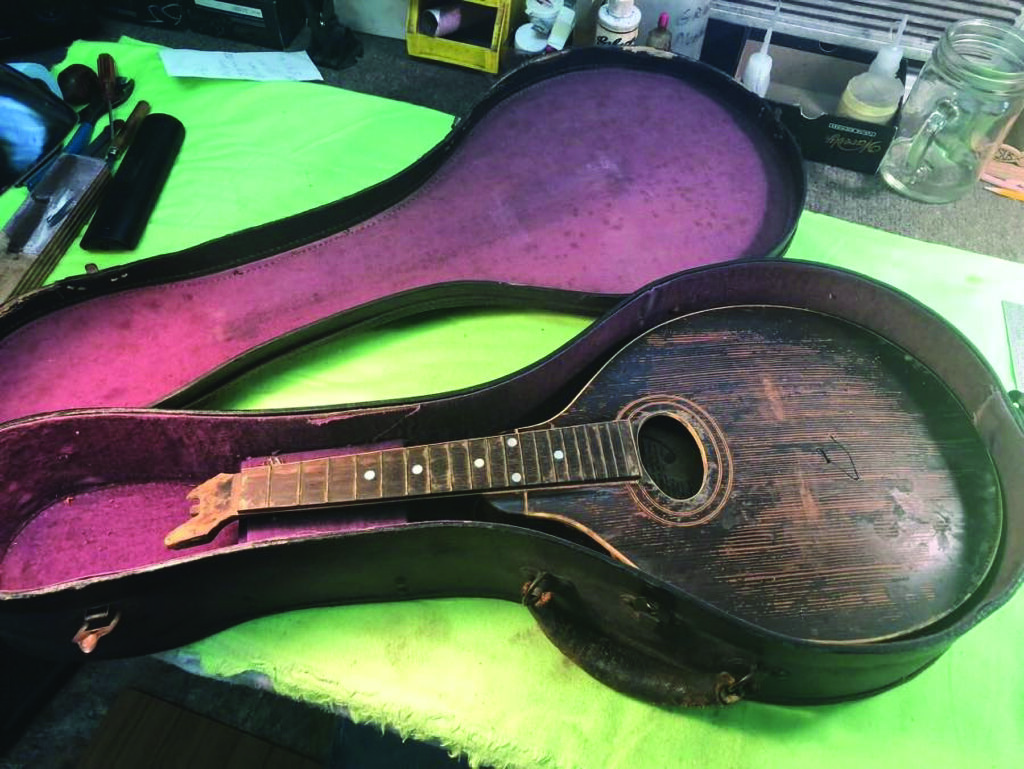
The completely unexpected information that I was to receive, came in the form of a phone call a few weeks later. “I have found out a few things that you might be interested in, Kevin,” David said. He told me that the serial number indicated a build date of 1922. Using resources of his vast experience and knowledge he determined that this A model was indeed a “Snakehead.” Further, it would require the installation of a new neck. My decision was immediate: if this mandolin was to make lovely music again by all means let’s do it! And so the process began.
David started by first removing the neck from the “old soldier” and sent photos as each step was undertaken. After another few weeks David called again. My first thought was “Is there a problem?” He assured me that although the process was a slow and tedious one, that in the end there was every chance (since the body was in structurally very good condition) that it would more than likely be a fine mandolin again. The conversation took a dramatic turn when he asked if I was able to look up the Mandolin Archive. Phone in hand I went to my computer and brought up the Archive. He told me to go in about 40 or so pages and look for a 1922 Snakehead. I found the page and the mandolin. He said “Read the description,” which I did. To paraphrase, it said, “1922 A-2 Snakehead believed to be the lowest serial number of that type known.” I asked David what that meant, and he said “Your mandolin’s serial number (#70243) precedes the one listed in the Archive by 93 numbers [Page 50 of the Mandolin Archive. Serial # 70336 – owner listed as Mike Bisetti]. And, it could possibly be the very first Snakehead (barring the discovery of any lower serial number) that was ever built!” I must admit that at that moment I was stunned, thinking, “What if I had not seen it and it had been tossed aside like so much trash!”
Now my amazement turned to joy at the thought of owning and playing a very important piece of Gibson mandolin history. And probably of even greater importance to me, the fact that for many years to come this mandolin would be making music again and bringing enjoyment to its listeners.
David assured me many times (during the 3 years that it took to restore the A-2), that although the work was tedious, progress was always being made. Each time pictures were sent to me my excitement and anticipation grew, that this master craftsman was actually creating a new life for an instrument that (through no fault of its own) had lost its ability the make the beautiful music for which it was intended.
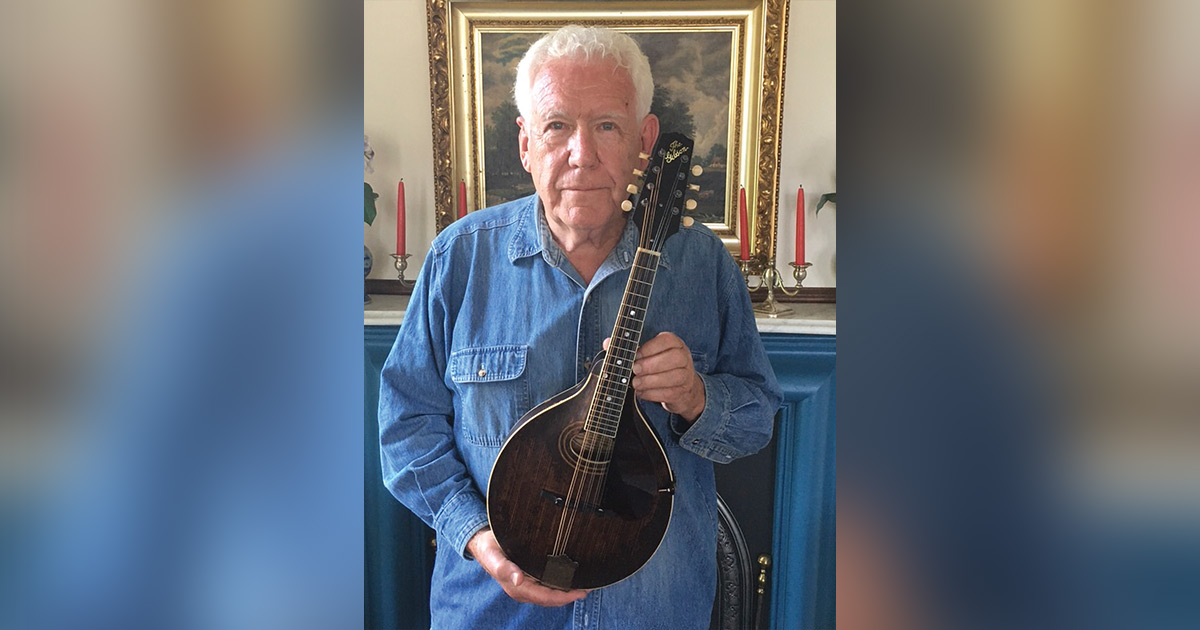
And so, as the photos reveal, the A-2 is now completely restored and is making beautiful music once again. My grateful thanks go out to David for his painstaking efforts to restore this wonderful mandolin. Should it be that I may live to be 100 years old, I am afraid that I will never look as good or will be capable of making the beautiful music of this wonderful instrument.