Asheville and Bluegrass Music
Asheville, North Carolina is located deep in the heart of bluegrass country. There has been a long tradition of bluegrass music in that area and many of the heroes of bluegrass music have called, or still call, Asheville home. However, the guy who is responsible for teaching bluegrass at the college level in Asheville started his life in bluegrass about 2300 miles away in Los Angeles, California.
Long-time Bluegrass Unlimited contributor Wayne Erbsen (now the head of the bluegrass program at UNC—Asheville) started playing music in the Los Angeles area in 1962. Wayne said, “We always had a guitar or ukulele laying around the house and we lived near the Ash Grove, so I got to see all of the talent that came through the Ash Grove.” Seeing the Kentucky Colonels, Flatt & Scruggs, Bill Monroe, the Stanley Brothers, and many more bluegrass bands play live got Wayne excited about playing the music. He formed a bluegrass band when he was in high school and while attending the Santa Monica Community College performed in a band called the Smoggy Mountain Boys. After two years at the community college, he then went to attend UC Berkeley and while in that area of northern California had the chance to occasionally perform with Vern Williams and Ray Park. He also joined a band called Stoney Lonesome while in Berkeley.
Although Wayne has been teaching bluegrass and old-time music at the college level at UNC—Asheville (UNCA) for just a few years, he actually started teaching music at the college level over fifty years ago.
In 1972, after attending the bluegrass festival in Bean Blossom, Indiana, Wayne wound his way down to Charlotte, North Carolina. He said, “I went to Charlotte to visit some festival friends, Stan and Linda Hancock and was only planning on staying a few days. When I paid a visit to John Sipe’s Violin Shop, John mentioned there was an excellent community college in Charlotte (Central Piedmont Community College), so I called to see if I could teach there. This is where there was a fork in the road. Instead of calling the history department, I called the music department. Gene Bryant was the music department head and he invited me to come in and bring my fiddle. He was a wonderful, gregarious, open guy and he asked me to play him a tune. I played him a hot old-time fiddle tune and he said, ‘OK, I can hire you to teach some classes on the guitar in the standard curriculum, but if you want to teach anything else, you’ll have to go to the continuing education department. So, I went there and told them that I wanted to teach banjo, fiddle, guitar, mandolin, the history of country music, vocal harmony, and vocal repertoire. He said, ‘OK, let’s go!’ So, I put up signs all around and started teaching students.
“After Gene Bryant hired me, he said, ‘What else can you teach?’ I explained that I had a masters degree in American History from the University of Wisconsin and so he called over to the head of the history department and asked if he needed anybody (the new fall semester was starting in a few days!) The history head said, ‘Yes, send him right over!’ So he hired me on the spot to teach American History.”
When Wayne started teaching at Central Piedmont, the movie Deliverance had just come out and he said, “Everyone and their brother wanted to learn how to play the banjo.” Wayne said that he had about 40 beginning banjo students in his first banjo class. He made up a booklet that they could use as a course book. He said, “I called it A Manual For How To Play the 5-String Banjo For The Complete Ignoramus!” When he went to have them printed for his students, the owner of the print shop explained that the more copies that he printed, the cheaper it would be per book. He printed 400 copies and started taking them to sell at music shops. That first book led to Wayne creating his Native Ground Books & Music company which has now published 40 books on music topics, put out 18 CDs, and also published 11 of his wife’s historic cookbooks. Wayne continued to teach both music and history at Central Piedmont for two years.
After spending nine months touring and playing music in Europe, Wayne came back in to the United States and was hired as an “artist in residence” at Catawba Technical Institute in Hickory, North Carolina. Shortly after arriving in Hickory, Wayne was downtown with his fiddle and a well-dressed gentlemen saw him and asked, “What do you got there? Is that a fiddle?” That gentlemen turned out to be legendary bluegrass fiddler Jim Shumate. Wayne said, “I thank my lucky stars that I met him because we became the closest friends for years. He would come over to my house about once a week and give me fiddle lessons. At some point, I decided that this was a golden opportunity, so I started interviewing him.” The result of the interviews was an article written by Wayne that was published in Bluegrass Unlimited in our April 1979 issue.
While he was in Hickory, as an artist in residence at the Catawba Technical Institute, he taught free classes in the community and performed at schools, nursing homes and festivals. Additionally, he was also hired as an artist in residence at Asheville Technical College in Asheville, North Carolina. Wayne said, “Asheville was like a bonanza as far as bluegrass. I got to be friends with Tom McKinney and played a lot with him and I started a bluegrass radio show.”
Wayne also became friends with David Holt, who had started the Appalachian music program at Warren Wilson College. When David’s touring schedule blossomed, he hired Peter Gott to take over for him at the college. Peter’s long commute, combined with running a farm, made it difficult for him to continue after the first year and he asked Wayne to take over. Wayne said, “Things had changed and now you could go to college and get credit for learning banjo, fiddle and things like that. So, the classes that I taught at Warren Wilson were accredited. So, I did what I did in Charlotte. I taught all of the bluegrass instruments, even dulcimer, and had a bluegrass band and a string band. I taught there for 38 years and had a thriving program that is still going. In one of the last few years I took my students to England and Italy to play for the clogging team from Mars Hill College. That was a great experience. I also took a group of students to Greece.”
Three years ago, Wayne took over the bluegrass program at UNCA from Toby King. Toby had started the program in 2014 about six or seven years prior to Wayne coming out of retirement to accept the position.
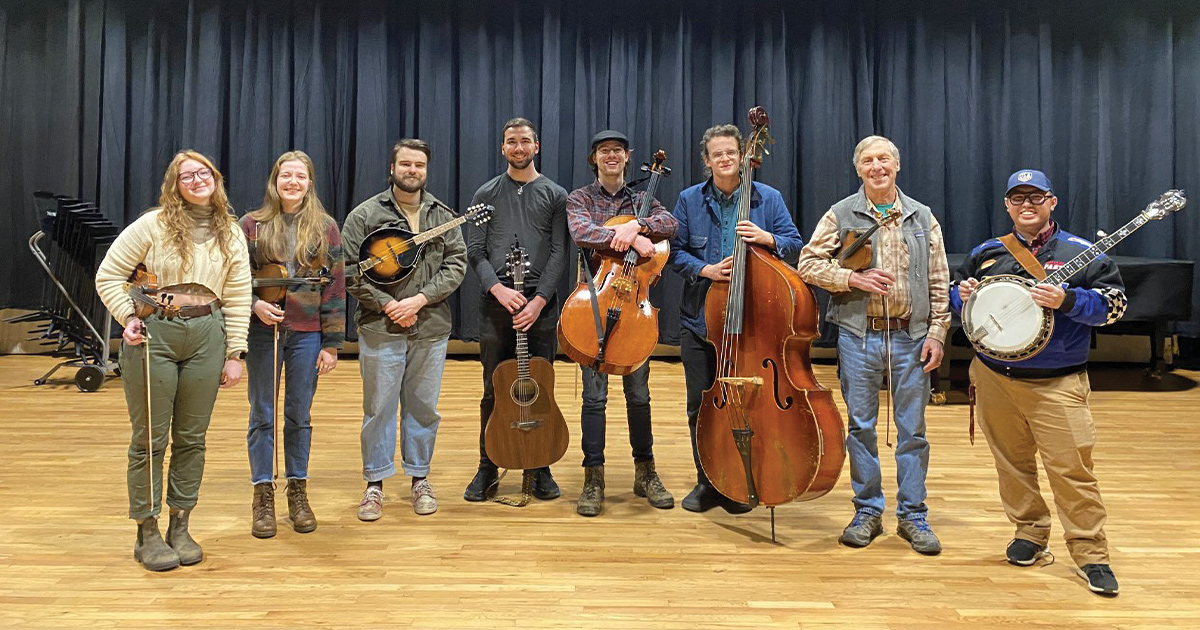
Wayne teaches an accredited bluegrass ensemble class at UNCA, which meets one time per week for two hours. He also teaches private lessons on the bluegrass instruments and harmony singing. Any student can take the individual instrument lessons and receive credit, however, students who wish to be in the band class must audition. Last year Wayne took the band, called the UNCA Bluegrass Band, to perform at the IBMA World of Bluegrass. He said, “There are some really talented people in this band. I’ve been able to get quite a few gigs for these students. They are going to go to Italy this coming July and August to back up the cloggers from Mars Hill.”
When talking about his approach to teaching the band, Wayne said, “I kind of move myself to the back seat and let them run the band. I do that intentionally because I want it to be a democratic band where the students have most of the say in terms of what goes on…who takes what breaks, who sings what parts…the only thing that I mainly do is suggest songs. It works out well because they have ownership in the band.”
Wayne Erbsen has been teaching college-aged students how to play traditional instruments, sing bluegrass music and form bluegrass and old-time string bands for over fifty years. He continues to do so with enthusiasm, stating “The UNCA Bluegrass Band is the most fun band I’ve ever been in.” For more information about the program at UNCA, go to: https://music.unca.edu/engage/ensembles/