Crooked Tree
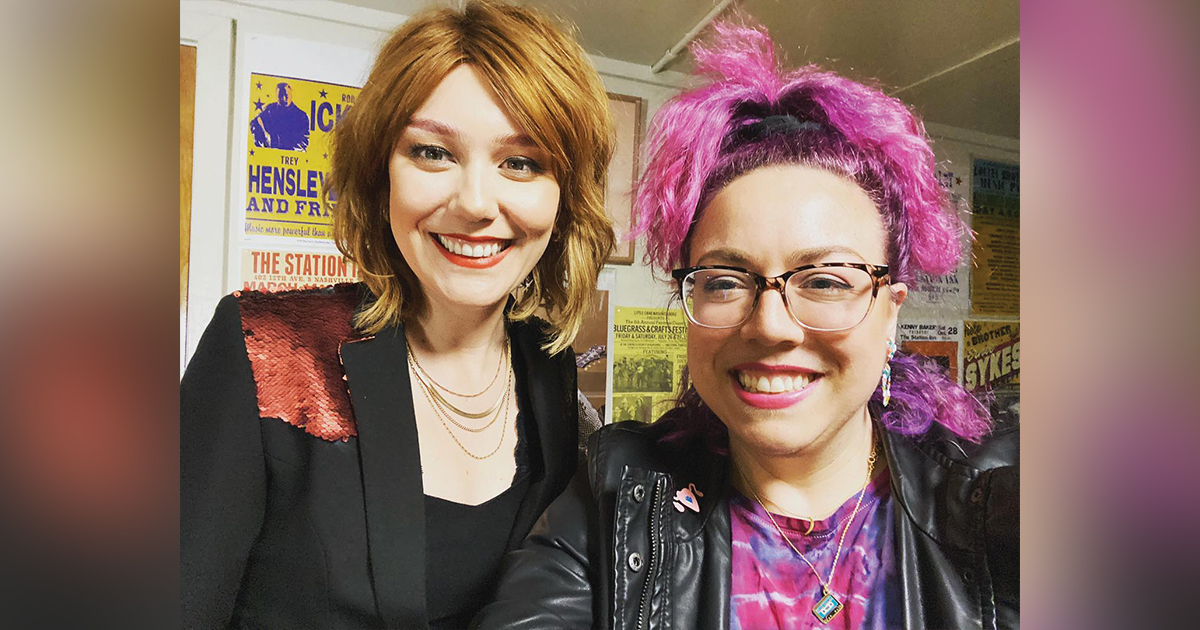
by Molly Tuttle and Melody Walker
“It’s about embracing what makes us unique,” said Molly Tuttle of her hit song, “Crooked Tree,” which, among other accolades, is this year’s winner by a large margin in the Bluegrass Unlimited Reader’s Poll (Favorite New Song Category).
Cowritten by Tuttle and Melody Walker (Front Country), “Crooked Tree” is the title track to Tuttle and Golden Highway’s Grammy-winning album (Crooked Tree, 2022). The song peaked at #2 on the Bluegrass Today Grassicana charts, where it has since spent more than 26 weeks. The album reached #1 on Billboard’s Bluegrass Album charts and earned Tuttle Album of the Year at this year’s International Folk Music Awards.
Perhaps even more important than the song’s acclaim is the meaning behind its words. “Through my experience of losing my hair to alopecia areata when I was three years old, I learned how struggles can make us stronger,” explained Tuttle of her personal connection to the song. “Growing up, I often felt I didn’t belong because I looked different from everyone I knew, but as an adult I learned to embrace that part of myself, and it made me a better person.”
Walker, too, understands the feeling of being a “misfit,” having been diagnosed with scoliosis as a child. “I wore a brace through middle and high school,” she said. But like Tuttle, the trials of younger years helped build resilience—a helpful trait for the “very different life path” of a career artist.
A Parable in Song
To portray and celebrate the “uniqueness” of us all, Tuttle and Walker retold an old story of a crooked tree and a straight tree (and the resulting fate of each). Walker explained how they came to this approach, “The song’s lineage is long and winding: in the 4th century BC, Taoist philosopher Zhuangzi wrote the parable of the ‘crooked,’ or ‘useless,’ tree. This story was repeated over the millennia and eventually found its way into a book and then movie, Wristcutters: A Love Story, in which Tom Waits’ character tells this tale. Since then, the quote has been sort of misattributed to him, and we found it in an Instagram post by Margo Price.”
Ideally for “Crooked Tree” listeners, the lyrics “show” as much as “tell” about trees that, while sharing the same space, end up in starkly different situations (Two trees in the forest, one was crooked one was straight / Crimson bark and emerald needles, growing day by day / And though they looked so different, they enjoyed the rain the same side by side … The perfect trees were driven down the mountain to the mill / They turned them into toothpicks and twenty-dollar bills).
In the end, the different, crooked trees not only survived, but were left alone to thrive in their own way (No one left to tell them if they’re growing right or wrong but the whispering wind).
Touching Hearts through the Craft of Songwriting
After starting with these image-rich illustrations, the songwriters spell more out in the chorus (Oh can’t you see? … I’d rather be a crooked tree), and that summation continues in the final verse. Getting to that clarity, for Tuttle, meant opening up about her ideas, something that can be intimidating in a songwriting session. She explained, “When we went to write the last verses, I remember saying something to the effect of ‘A river never wonders why it flows around the bend’ as a joke because I thought it was overly sentimental or too flowery,” said Tuttle. “Melody took it and ran with it, and we both ended up loving how the last verse drove the point home. It was a good lesson for me to throw ideas out there in a co-write even if I think they’re stupid. Sometimes, the ones you’re embarrassed to say end up being just what you need to complete the song.”
Walker said of that final verse, “I love the last line, and how Molly & Shelby sing it in harmony live (So who am I to wish I wasn’t just the way I am, who am I?) This speaks to the intrinsic dignity of all people, and how we are all perfectly imperfect.”
Touching on the rhyme, structure, and melody of the song, Tuttle explained, “Theverses are held together by a rhyme scheme where the third line of the first verse rhymes with the last line of the next one. The chorus melody lifts into a higher register, which sets it apart from the verses and adds to the urgency of the lyrics.”
The rhyme scheme also features internal rhymes (the ends of the three lines of each stanza, plus the ending tag that rhymes with the end of the next). “It’s an intricate way to write,” noted Walker, “but ties the story together even in structure.”
Tuttle and Walker both grew up in the California bluegrass scene and, according to Walker, shared an affinity for “the naturalist” songwriting of folks like Laurie Lewis, Kathy Kallick, Kate Wolf, and Peter Rowan. After writing together for a few years, these friends and contemporaries hit their writing stride during the pandemic. “For a few weeks we were writing almost every day whenever we were both free,” said Tuttle of their many FaceTime sessions.
In “Crooked Tree,” the two have brought together the best elements of songwriting to create a well-crafted celebration of humanity that has clearly resonated with fans. Chart action and awards point to that response, but it’s the live-show camaraderie that really touches Tuttle. “When we play it live, I’ve seen people crying in the audience and singing along,” she said. “I’ve seen a lot of people covering it online, which I love. Recently, a friend sent me a video of a busker playing it on the street corner in Asheville.”
Molly Tuttlegrew up in Northern California where she discovered a love of bluegrass from her father (music teacher and artist Jack Tuttle). Known perhaps first for her virtuosic guitar skills, Tuttle has, in recent years, emerged as a powerful multi-instrumentalist, vocalist, and songwriter. In 2022, she was named IBMA Female Vocalist of the Year. Crooked Tree is Tuttle’s debut album with Nonesuch Records and her first to feature her band Golden Highway. Learn more at MollyTuttleMusic.com.
Since touring with her band Front Country, Melody Walker has made a name for herself in Nashville as a songwriter, writing with acts like Tuttle, Sierra Ferrell, Della Mae, and others. Walker’s songwriting tips and protest songs have gained her a large TikTok following, and she is the host of East Nashville’s premiere Americana & Roots songwriter round Writers’ Kitchen every Tuesday night. Learn more at MelodyWalker.com.