
Notes & Queries – January 2023
Queries
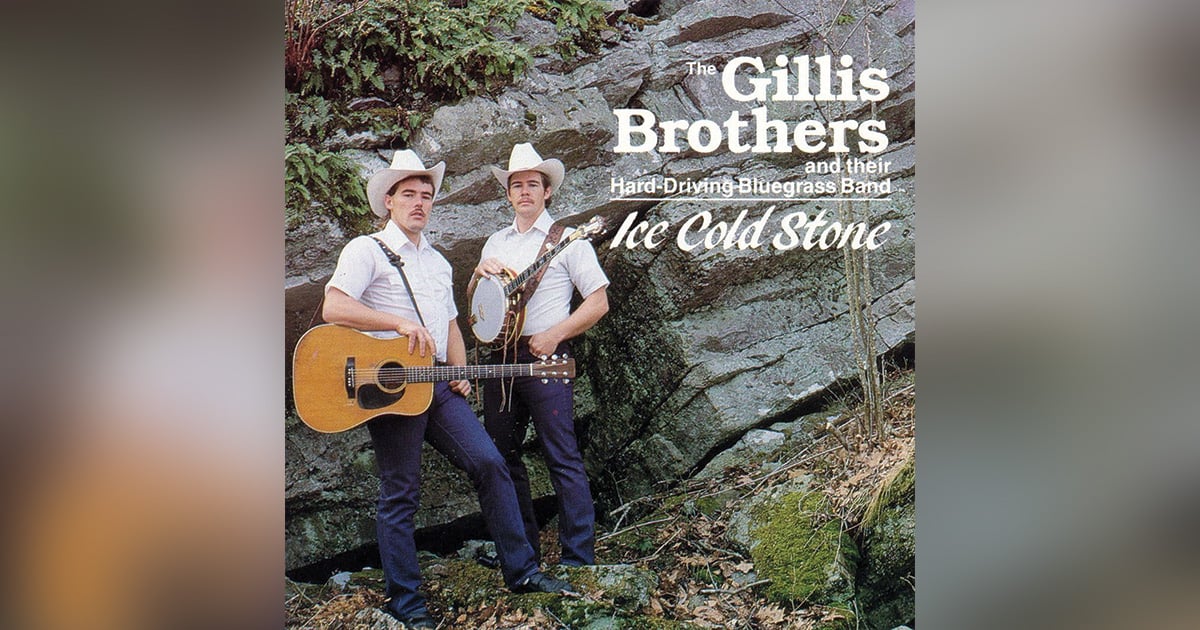
Q: The title track to the Gillis Brothers and their Hard-Driving Bluegrass Band’s second CD, “Ice Cold Stone” (Hay Holler HHH-CD-302, 1992), is somewhat of a mystery. Larry and John Gillis learned the song at a jam session and label owner Kerry Hay, who helped arrange it for the album, was unable to trace the source for songwriting credits. Jim Eanes had recorded it as “Love Me Now” for Rural Rhythm in 1968, Anita Carter as “Love Me Now (While I’m Living)” for RCA Victor in 1967, and Texas Ruby as “Love Me Now” for Starday in 1963. The Anita Carter version is credited to Harlan Howard and the Ruby version is credited to William York (a pseudonym for Starday owner Don Pierce). It’s an awesome recording (with some wonderful fiddling by Owen Saunders!), but who actually wrote the song? Billy Q. Smith, via email.
A: It appears that the first recording of the song was made in the middle 1940s by cowboy singing star Tex Ritter; he cut the song at a July 27, 1945, session for Capitol Records. The November 16, 1946, edition of Billboard magazine announced the new release as one side of a 78-rpm disc, Capitol 327. It’s no wonder that the Gillis Brothers learned this song from oral traditions. In addition to the versions listed above, credible covers were recorded by Lulu Belle and Scotty (ca. 1950), Cowboy Copas (1952), Jim Greer and the Mac-O-Chee Valley Boys (1966), the duo of Bill Grant & Delia Bell (1978), and old-time band Country Ham (1984). What confused the situation as far as writer’s credits for the song was the fact that virtually no one – with the exception of Lulu Belle and Scotty – gave credit to Tex Owens. Cowboy Copas claimed the song as his own, while Bill Grant & Delia Bell claimed an arrangement, and Country Ham simply credited it to no one.
In contrast some entertainers of his day who professed to be singing cowboys, Doie Hensley “Tex” Owens (June 15, 1892 – September 9, 1962) billed himself as the real deal. He was born on a ranch near Killeen, Texas, and had three uncles who were Texas Rangers. As a youth, when not working on the ranch, he learned to play guitar and sing. At age fifteen (ca. 1907), he struck out on his own, working on a cattle ranch. It was then he had occasion to see a wagon show. The program had such a profound effect on him that he joined the troupe that very day and performed blackface routines for the next year or so.
For the next fifteen years, Tex led somewhat of nomadic life with work in the oil fields of Texas and later as a house-to-house canvasser, a bridge contractor, a farm hand, an automobile mechanic, and lastly as a town marshall. His return to show business was purely coincidental. In 1931, while recuperating from surgery to remove an inflamed appendix, he was adjacent to a ward with children who were recovering from exposure to severe winter weather. To amuse the little ones, Tex broke out his guitar and sang to them. They responded so well to his talents that he auditioned for a spot on radio station KMBC in Kansas City, Missouri. He was billed as Radio’s Original Texas Ranger. Shortly afterwards, he organized a backing group that was called, appropriately enough, the Texas Rangers. Tex logged eight years at the station and reportedly worked thousands of personal appearances in the midwest.
It was while working in Kansas City that Tex composed his most popular song, “The Cattle Call.” He recorded a version of it for Decca Records in 1934. But, it was recordings (he made at least four of them) by Eddy Arnold, starting in 1944, that made the song such a huge hit. The song was, for many years, Arnold’s theme song.
Owens’s work eventually took him to California where he had an uncredited part in the John Wayne film Red River. It’s likely that the move put Tex in Tex Ritter’s orbit, thus leading to Ritter’s recording of “Love Me Now.”
Thirty-one of Owens’s songs are registered with ASCAP; some of his publicity stated that he wrote over one hundred. He was posthumously inducted into the Nashville Songwriters Hall of Fame.
Owens’s daughter, Laura Lee, was a singer in her own right and performed with Western Swing legend Bob Wills. She also appeared in several Hollywood productions. Tex’s sister, known as Texas Ruby, was also a popular singer who was married to fiddler Curly Fox.
Q – Who was Tommy Thompson that claimed to have written the words for Bill Monroe for his melody of “Kentucky Waltz”? Tom Isenhour, via email.
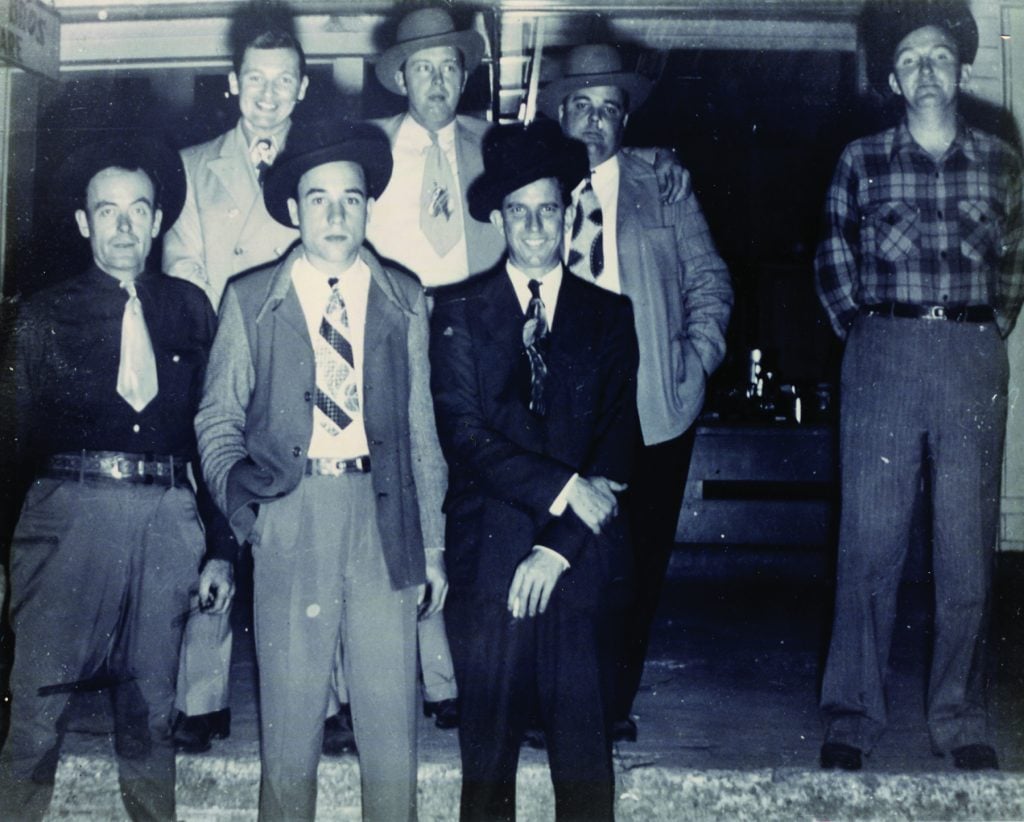
A – In life, his given name was Frank Anthony Thompson (October 16, 1898 – February 20, 1969) but he always went by Tommy. Actually, his preferred spelling was Tomie, and it sometimes appeared as Tommie. He was a guitarist and vocalist who sang songs of the west, and was known affectionately as the Singing Range Rider. His most active years as a performer were from 1941 until 1952, during which time he was a featured performer on the Grand Ole Opry.
Tomie was born in Des Moines, Iowa, to parents who had moved west from Tennessee. By age fourteen, his parents had died and he was left to fend for himself. He found work in Colorado, on a ranch that was owned by friends of his late parents. From there, he made his way to Deming, New Mexico, where he worked at Outlaw Park taming wild horses. His work there was interrupted by World War I; he served from September 1, 1917, thru February 22, 1919.
A year after his return from the war, he married Iowa native Mayme Olive Hladek, on May 13 1920. At the time, he was employed in civil service as a fireman. By 1925, he was a floorman in the Quaker Garage in Cedar Rapids and in 1929 was a truck driver for Kings Crown Plaster. By 1930, things were not well for the Thompsons, domestically; they divorced later that year.
Throughout the 1930s, Tomie found work farther west at Rancho San Louie Ray in Santa Margarita, California, as a bronc peeler. It was about this time that Tomie began performing on the radio. In the Los Angeles area, he broadcast over KRKD, KGFJ, and KHJ. His proximity to Hollywood afforded opportunities to appear in several films, including Lives of a Bengal Lancer (1935) and Clive of India (also 1935). His work often included doubling for the lead actors in scenes requiring more advanced/faster horseback riding.
Desiring to have more of a presence on the silver screen, Tomie was advised by movie producers to get more radio experience as a singing cowboy and to get a horse of his own. To those ends, he relocated to Nashville where he secured an early morning spot singing cowboy songs on WSM, and he purchased a horse that came from the same bloodline as one owned by cowboy singing star Gene Autry.
An item from Ohio’s Circleville Herald told that “Tomie Thompson, the Singing Range Rider, landed a permanent spot on the Grand Ole Opry program effective with the show’s renewal October 11th (1941).” Yet another announcement, some five months later, reported that “Tommy Thompson, a genuine cowboy, will make his [Grand Ole Opry] debut as the Singing Range Rider. His opening song will be ‘You’re My Darling’.”
Throughout much of the spring of 1942, Tomie worked with Bill Monroe, whose group also included, at times, Sally Ann and Dixie Belle, Art Wooten, and Howdy Forrester. A July 11, 1942, broadcast of the Opry had “Tommy Thompson and Big Howdy” performing “When My Blue Moon Turns to Gold Again” and “Lonely River.” A scant three days later, it was reported from Texarkana, Arkansas, that “on Wednesday, July 15, 1942, Miss Gladys Kennedy of Oakdale, Louisiana, and Mr. Tomie Thompson of Nashville, Tennessee were married. They will reside in Nashville, Tennessee.” The couple was married on stage before an audience of 5,000 people. If there was a honeymoon, it was short-lived as the Opry program for July 18, 1942, featured Tomie and Howdy Forrester performing “Home on the Range.”
It was during Tomie’s tenure with Monroe that he reportedly contributed to the writing of “Kentucky Waltz,” which was later recorded by Monroe at his first session for Columbia Records in 1945.
The advent of World War II found Tomie, at age forty-three, answering his country’s call once again. He enlisted in the armed forces for a second time on July 23, 1942. Curiously, Tomie continued to be featured in several Opry announcements and advertisements, some of which were probably put in motion prior to his enlistment. For instance, the 9:30 portion of the Opry for August 1, 1942, listed participating performers as including Roy Acuff, Big Howdy, the Crook Brothers, Tomie Thompson, Rachel and Oswald, Jug Band, the John Daniel Quartet, and the Possum Hunters. An October 20, 1942, tent show in Huntsville, Alabama, boasted Bill Monroe, Cousin Wilbur, Clyde Moody, Fiddling Art Wooten, Jam Up and Honey, Uncle Dave Macon, the Dixie Dewdrops, and Tommy Thompson—the Singing Range Rider.
Tomie’s time in the service the second time around was brief; eight months after enlisting, he was discharged on March 2, 1943. A bit of publicity that was released several years later told that Tomie was wounded in both World War I and World War II. His discharge came as the result of an injury he sustained as a member of a parachute-ski unit that he had been connected with for only thirty-nine days.
Once back on the home front, Tomie added Gladys – who went by the stage name of Lonnie (or sometimes as Lonie) – to the program and they toured as a husband-and-wife duet. They secured an early morning program on WSM, from 6:30 to 6:45, three days a week. They also appeared on Saturday evenings on the Opry, with two performances each night. In November 1943, the couple participated in several Opry package shows that included the Solemn Old Judge, George D. Hay as master of ceremonies and a revolving cast that included Minnie Pearl, the John Daniel Quartet, Eddy Arnold, and a comedian named Uncle Rufus. Also on the bill was Paul Howard, bandleader of the Cotton Pickers.
Tomie’s contributions to “Kentucky Waltz” notwithstanding, he was not a very prolific writer. His first copyrighted work came in 1943 when he collaborated with fellow Opry member Wally Fowler to come up with “You’re My Darling, You’re My Sunshine.” Fowler released the song not long after it was written.
Tomie closed out 1943 by working a New Year’s Eve package show in Anniston, Alabama, with Bill Monroe that included Cousin Wilbur, Clyde Moody, Chubby Wise, Sally Ann, Burt Payne and the Roving Ramblers, The Singing Phillips Sisters, Desso Baker, Glenn Simmons and Oscar Mitchell. And, of course, Lonie and Tomie Thompson, the Singing Range Riders.
In 1944, a February Opry outing in Evanston, Indiana, headlined by Eddy Arnold was sandwiched between dates with Monroe that ran from January to June. The casts with Monroe continued to be stellar ones: Chubby Wise, Clyde Moody, String Beans, Curley Bradshaw, Sally Ann Forester, and Cedric Rainwater.
By 1946, Lonnie and Tomie were billed on shows as Former Stars of the Grand Ole Opry. However, in August and September 1946, Tomie toured as a part of Bill Monroe’s group, with performances in Alabama, Louisiana, Georgia, and at Pennsylvania’s Sunset Park.
The end of 1947 found Tomie back in Iowa where he and Lonnie appeared on WMT’s Sunrise Program but by 1950 the couple was apparently back in the Nashville area where they appeared in several low-profile gigs as a draw for a regional talent contest and as entertainment for a political rally.
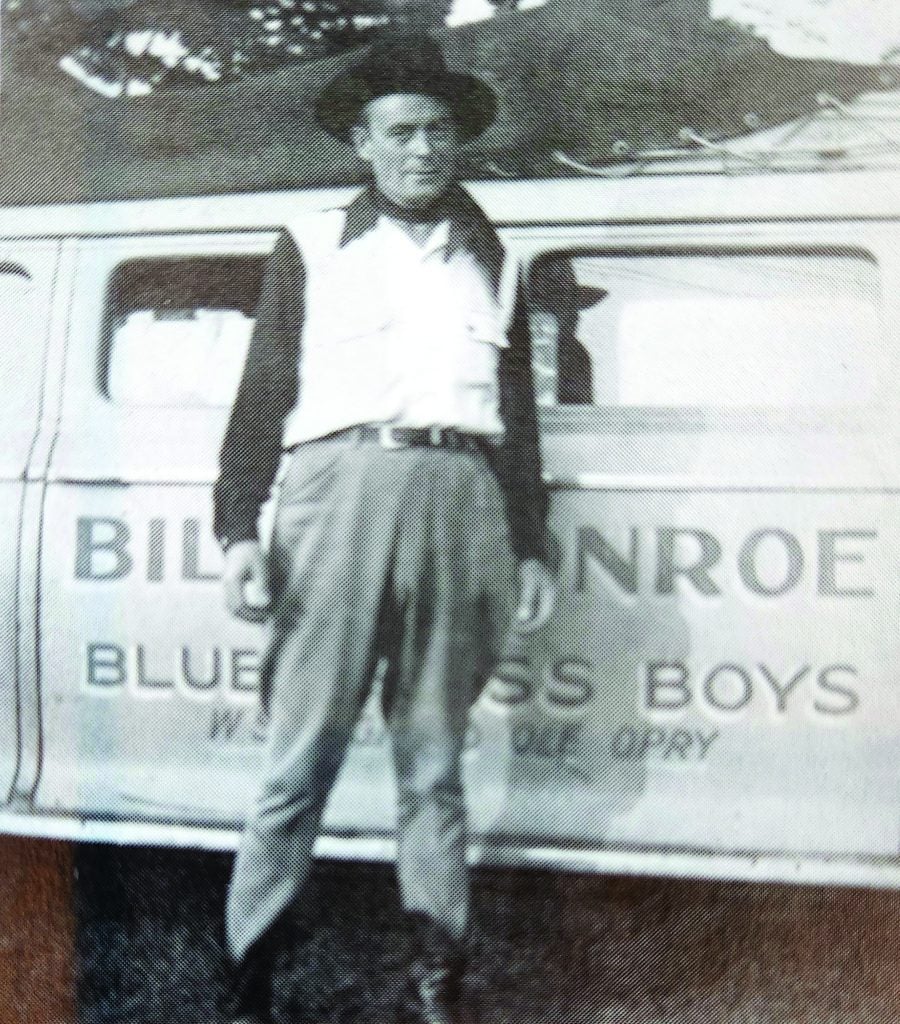
One bright spot in the Thompsons’ career came in March 1950 when it was announced that Don Law of Columbia Records country division had signed the pair to the label. The duo, with backing on some selection by fiddler Dale Potter and steel guitar player Jerry Byrd, recorded two sessions for a total of eight songs. The first session yielded “Frost is on the Trees,” “Waltz of the Shawnee,” “They Tell Me I’m Crazy,” and “I’ll Never Get You Out of My Mind.” In reviewing two of the songs, Cash Box magazine wrote: “A couple of ballads provide Lonie and Tomie Thompson with an occasion for some good harmony. Backed up by a fine guitar, they run through these two sides in an accomplished manner. While the disk won’t stop traffic, it deserves ops attention.” All four of the songs were credited to Tomie as writer.
The second session, recorded a few months later, included “That Shining River,” “That Golden Road,” “Show Me the Way,” and “Life’s Race With Satan.” Cash Box confirmed what the titles suggested: “. . . this is special material which is suited only for ops who have spots that call for religious biscuits.” As with the previous session, most, if not all, of the songs were credited to Tomie.
Almost as quickly as Tomie and Lonnie got their start on Columbia, they were ushered out as part of a general house cleaning at the label. A January 13, 1951, press release from the label that was reprinted in Billboard told that “Columbia Records has made considerable revisions during recent weeks in its country and Western roster, bringing its number of additions to eight, and pruning more . . . Outgoing artists include . . . Lonnie and Tomie Thomson.”
It’s possible that the reversal of fortunes, recording-wise, put in motion Tomie’s next move. On April 15, 1951, he brought suit against Bill Monroe, seeking compensation for his contribution of the lyrics to “Kentucky Waltz.” The suit alleged that in 1942, Monroe asked Thompson to write the lyrics, which would then be copyrighted in both their names, and that royalties would be shared equally. Monroe admitted to asking Thompson to write the lyrics but denied the other assertions, adding that the statute of limitations “prevents Thompson’s recovery.” Monroe added further that at the time of the song’s creation, he had bought out Thompson’s interest in the song for “valuable consideration.” The case was tried in U. S. District Court on July 23, 1952, and Thompson was awarded a settlement of $1,000.00. The settlement also included a bill of sale that transferred any interest Thompson had in the song to Monroe.
The duo of Tomie and Lonnie, the Singing Range Riders, seemingly drifted into obscurity after the settlement of the suit. They eventually took up residence in Smackover, Arkansas, where, starting in 1955, Tomie served as the town’s constable. He died on February 20, 1969, following a brief illness. Gladys “Lonnie” Thompson, who was twenty-six years Tomie’s junior, died on September 12, 1994.
Over Jordan
Ray Quarles Edenton (November 3, 1926 – September 21, 2022) was best known as a celebrated Nashville session musician who, as a member of the A-Team, participated in over 10,000 recording sessions. While the majority of his work was on mainstream country recordings, he also lent his talents to a host of bluegrass performers including Bill Monroe, Flatt & Scruggs, the Osborne Brothers, Jim & Jesse, and others.
A native of Mineral, Virginia, a small community located about fifty miles northwest of Richmond, Edenton grew up under the spell of a fiddling grandfather and two older brothers who were musicians. Around the age of six, Ray started playing guitar at area dances with his brothers and cousins. Later, as a young teen, he is reported to have performed on regional radio stations in Maryland and Virginia.
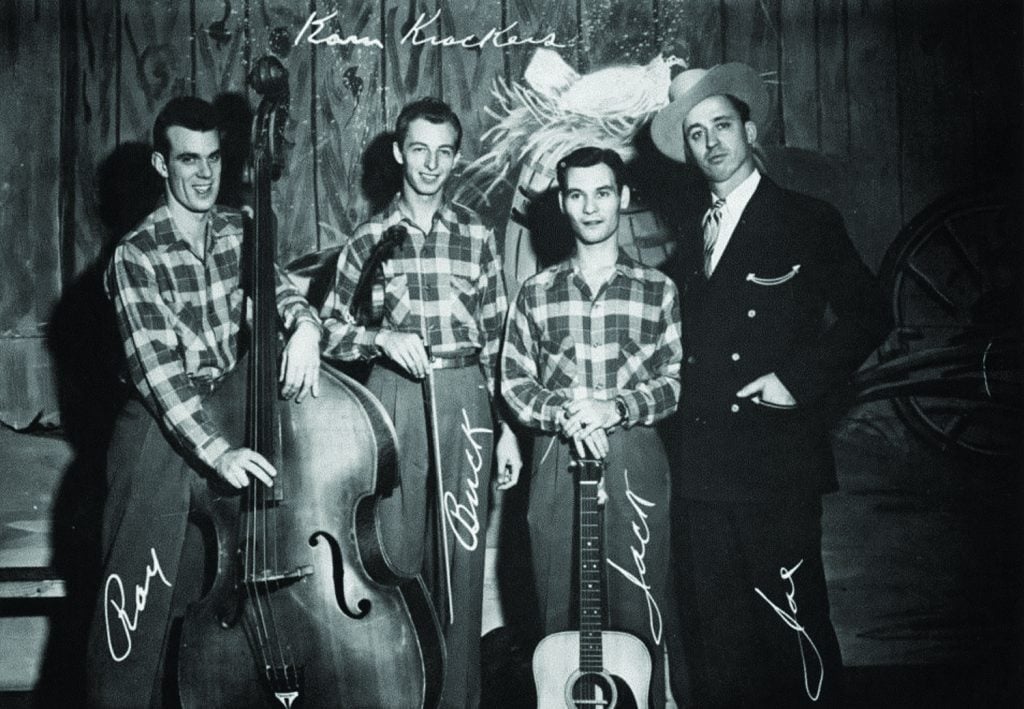
After military service during World War II, Edenton secured a spot with the Korn Krackers on WRVA/Old Dominion Barn Dance in Richmond. The group included multi-instrumentalist Joe Maphis.
In 1949, Ray moved to Knoxville and worked over radio station WNOX. He also participated in his first recording session, a five-song outing for Mercury Records artist Red Kirk.
The next two years were not the best for Edenton. He spent twenty-seven months in a Veteran’s Administration hospital for the treatment of tuberculosis.
Once released from hospital care, Edenton headed to Nashville where he appeared on the Opry and worked in several road bands, including those headed by Hank Williams and Ray Price.
Edenton’s session work in Nashville started in 1953, and soon afterwards included chart-topping releases for Webb Piece and the duo of Kitty Wells and Red Foley. Among Edenton’s first bluegrass sessions was a January 27, 1957, outing with Flatt & Scruggs that included “Six White Horses,” “Shuckin’ the Corn,” and “I’ll Take the Blame.” His distinctive, closed chord rhythm, added a percussive sound to these, and countless other tracks.
A May 1962 session with Bill Monroe found Ray contributing baritone vocals, as opposed to rhythm guitar, on three songs – “Old Country Baptizing,” “I Found the Way,” and “This World is Not My Home” – that were included on Monroe’s second all-gospel album, I’ll Meet You in Church Sunday Morning.
But, it was with newly-minted Grand Ole Opry acts such as Jim & Jesse and the Osborne Brothers that Edenton got some serious workouts. In 1965, Ray’s guitar work was heard on two albums by Jim & Jesse: Y’all Come! Bluegrass Humor and Berry Pickin’ in the Country. And, from 1965 to 1979, Edenton appeared on six albums by the Osborne Brothers: Voices in Bluegrass, Up This Hill and Down, From Rocky Top to Muddy Bottom, Bluegrass Collection, Bluegrass Concerto, and (with Mac Wiseman) The Essential Bluegrass Album.
Other bluegrass and related artists that Edenton recorded with include fiddler Tommy Jackson, Wilma Lee & Stoney Cooper, the Louvin Brothers, Jimmy Martin, Curly Seckler and Hazel Dickens.
Edenton retired in 1991 and was the subject of several video interviews in which he recounted his experiences as a member of Nashville A-Team of recording session musicians.
Gary, Can you identify the Blue Grass Boys appearing in the 1965 movie “Second Fiddle to a Steel Guitar”? The bass player is tall and thin, though his face is not shown in close-up, and appears to be James Monroe. The banjoist is left-handed. The fiddler looks familiar, but I can’t name him. The songs must be lip-synced because the fingering doesn’t match the music.